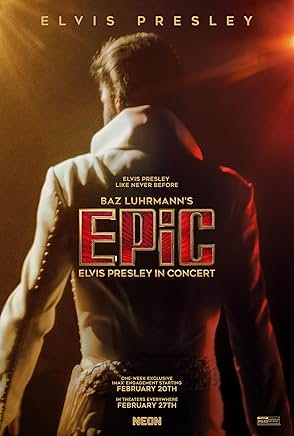

Elvis was a hero to most (uh)
But he never meant shit to me
-Public Enemy, “Fight the Power” (1990)
My mom loved Elvis and wanted to see Baz Luhrmann’s film “Elvis” (2022). Post pandemic, she hated going outside more than ever, and I hoped that my promise to take her to see it and spend the day with her would be enough of an inducement to get her some fresh air, but shockingly her love for Elvis and all tall men did not win that battle. I’m a huge Luhrmann fan and have seen all his features except this one because a whole movie about Elvis was a heavy lift. Well, damn it, Luhrmann is revisiting a subject matter that I have zero interest in, but he is catching me at a good time. I have been watching a lot of movies about music artists that I either do not know (“It’s Never Over, Jeff Buckley”) or care for (“A Complete Unknown,” which was unofficially for mom because she loved Bob Dylan) and by the end, I at least saw the theoretical value even if I was not won over. Did “EPiC: Elvis Presley in Concert” (2025) have the same effect? No, but fans will love it, and I could spot the parts that mom would have loved. If you are not into Elvis, “EPiC: Elvis Presley in Concert” is not going to persuade you, and it may leave you baffled how he ascended to become the King of Rock and Roll. It is a hybrid between a documentary and a concert film leaning heavily on the latter. “EPiC: Elvis Presley in Concert” mostly takes place when Presley worked at the Las Vegas’ International Hotel.
“EPiC: Elvis Presley in Concert” is made from archival footage with no narrator or other voices except the voice of Elvis’ interviewer. Luhrmann thanked Peter Jackson during the credits, and Jackson is quite the expert at restoring film as shown in his definitive documentary about World War I, “They Shall Not Grow Old” (2019). Maybe Jackson helped Luhrmann. In preparation for his scripted film, Luhrmann dug through unseen footage from “Elvis: That’s the Way It Is” (1970), which was Elvis’ first non-dramatic film chronicling his return to live performances, and “Elvis on Tour” (1972), which used footage from a tour with interviews likely similarly to how Luhrmann does it in this film. The problem: the audio was not synced to the visuals, so it took Luhrmann two years to complete this jigsaw puzzle. It is an undeniable technical achievement worthy of praise, and this work is pivotal for music historians.
When a moviegoer watches a film such as “Amazing Grace” (2019), which is described as an Aretha Franklin concert film, that person is not thinking about how the original film crew never synchronized the audio and visual footage so they virtually disappear from getting credit when the film arguably would not exist without them. You are not thinking of the process at all but are enjoying the experience of the only time travel that exists so you can watch and hear your fave. Is a film good because of the work that it takes to turn raw footage into a finished polished seamless product even if you do not like the finished product? It depends. As a fan of “Apollo 11” (2019), but not “Maria by Callas” (2018), direct cinema as a documentary genre is a matter of taste. Direct cinema is a way to capture the reality of the documentary subject so the audience forgets about the contemporary intermediary who makes it possible. The point is to not know about the process but have an experience. Observational cinema or cinema verite’s goal is to offer incisive insight into a subject matter. Both documentary subgenres offer no context in the form of interviews with talking head experts or academics. There is no narration.
Though all the aforementioned referenced films are considered direct cinema, movies like “Apollo 11” or “Summer of Soul (…Or, When the Revolution Could Not be Televised)” (2021) seem to straddle the subgenres whereas “EPiC: Elvis Presley in Concert” and “Maria by Callas” offer exclusive access to all the available insights of the now deceased subject, but they are performers. Limiting content to what they are willing to share unquestionably accepts that their insights are not also performances, but the truth, and that an artist whose medium is not writing can best convey in words their complete story. While direct cinema is perfect in terms of respecting their subject’s boundaries, it is frustrating in its limitations. Luhrmann takes the Vegas rehearsal footage, footage from multiple concerts and montages of movie performances, televised music performances and shots of the audience’s reactions with Elvis giving the same or similar answers repeatedly as if it offers fresh insight to the man. For fans, it does feel that way because it is new, and they get to see him horse around, interact with fans or direct his employees like a conductor except using dance movies. There is also so much air guitar. It opens with a lot of handwringing over Presley’s effect on the morals of children complete with a pastor who has impure thoughts and blames Elvis for them. Baby, you’re gay.
For me, if an elementary school kid could take dictation of what Presley says, the lemon is not worth the squeeze. “EPiC: Elvis Presley in Concert” struck me as incredibly sad. While the man is booked and busy, constantly moving and interacting with everyone around him, he seems like someone moving automatically, not connecting and engaged even in home videos with his friends and family. Everything feels like a performance except when he yearns about the places that he has not gone to or reflects on his acting career. I know nothing about Yungblud, but randomly I saw two TikToks of him engaging with his fans. In one, his eye contact with the fan is crazy intense. In another, he is going somewhere then turns his attention and responds instantly to someone calling to him, “Hi baby how you doing,” without slowing his pace. When I see reactions to Elvis or hear about him, I picture how Yungblud acts. As user Rachel L wrote, “He’s not even my type but that made me feel some type of way.” I was hoping to have that experience with Elvis, but instead it felt like a man as an automated factory giving more than required deeply kissing girls and women, doing onstage side lunges and yes, a lot of air guitar. He was enthusiastically going through the motions, but he seemed out of it, and he was as high as a kite. Occasionally Luhrmann slows down the footage to reveal his manager or family members looking on, but they seem strangely emotionless. It felt like the prequel to “Christy” (2025). For me, it was like watching a human sacrifice, not electric at all except for the invisible vibration plate that Elvis was standing on. How did no one see the inevitable end? Is it just hindsight being 20/20?
If Elvis was special, it was how comfortable he was peacocking. His look was only slightly more reserved than Liberace, and judging from his casual deep throating a mic, his homosocial activities now is closer to the line of sexual. I want to know where he got his shirts from. After a week of unrealistic male body images (Alexander Skarsgård, Jacob Elordi, Chris Hemsworth), Elvis has some baby fat even at the top of his game, which like, good for you, dude, mange (Italian). That man had a beard then shaved it to maintain those “sideburns.” Was Elvis a pretendian, i.e. a person who tried to look indigenous? When he is at the top of his game, he is deeply tanned, and his hair is slicked back, perfectly coiffed. At another point, when he loses the tan, he is so pale, it is shocking. His outfits have a lot of fringe. He is styled with bracelets and rings. If I spied turquoise, it would not be a question but a statement. I prefer Cher, but I was surprised at their vocal and physical resemblance. Both claim (Cher)okee heritage. In a single shot, he looks different depending on the angles. Oddly enough, even with the styling choices, I would not recognize him. At times, his smile is Tom Cruise adjacent.
If you like Elvis, get a ticket ASAP to “EPiC: Elvis Presley in Concert.” There is nothing better than sitting in a dark theater listening to your favorite musical artist. You will not need any semblance of a storyline or insight to enjoy it. If you are into Baz Luhrmann, you can see it to keep supporting him, but only the credits and a few intertitles indicate his signature style. If you are not into Elvis, this concert film will not convert you. It will feel like torture.