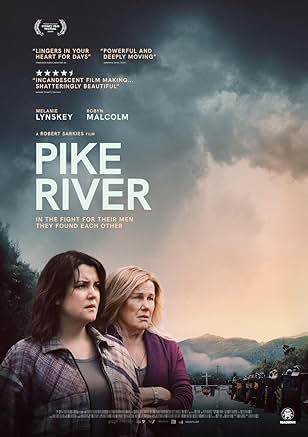

Set on the West Coast of New Zealand and starting on November 18, 2010, “Pike River” (2025) chronicles the impact of the Pike River mine disaster on two women as they fight for accountability and to retrieve their loved ones’ bodies. During this battle, Anna Osborne (Melanie Lynskey) must fight for her own life and help her kids understand why she is devoting so much time to this effort instead of them. Sonya Rockhouse (Robyn Malcolm) struggles to question everything that she was taught to believe and how to act, redirect her anger and fight the right people. As the years add up to over a decade, their friendship fuels their stamina and their refusal to back down and stop doing things the way that they are usually done. If you are not familiar with the tragedy, you’re going to be lost. If you are American, go ahead and use subtitles if they are available. It is a movie that assumes that you know all the major players and overall events, but even with repeat viewings, the focus on the human-interest story sculpts a more optimistic trajectory than what is still happening.
Intellectually, I damn well know that Lynskey is a New Zealander, but I forgot because she is so good at acting with an American accent. So is she finally getting a chance to use her real accent? Yippee! For me, Lynskey is one of the most classically beautiful women actors so seeing her play a regular woman, though convincing, is like casually throwing a Botticelli in a normal person’s living room. Lynskey does a great job and without her, Malcolm and Lucy Lawless as Helen Kelly, President of the New Zealand Council of Trade Unions (2007-2015), non-New Zealander viewers may be tempted to just stop watching the movie because of the uneven pacing of the narrative. They deliver powerhouse performances that anchor “Pike River.” Soft spoken, loving and caring Anna is immediately activated and radicalized. Though initially a follower of people with more expertise in resistance, she winds up taking the lead and setting the pace when no one in leadership makes good on their promises. She always keeps her eye on the prize and will fight anyone and everyone regardless of who tells her to stop. She activates Sonya and teaches her to learn how to think for herself.
I’m less familiar with Malcolm, and she has the heavier lift with her character. It feels as if a part of the story is missing. All the news reporters immediately home in on her as if she was a known figure before the tragedy. At work, people give her side eye. Her sons seem to have a closer relationship with their father. “Pike River” feels as if it begins in the middle of Malcolm’s story and leaving out critical pieces of information. It is the eternal struggle between a naturalistic depiction and a story crafted for the audience. Sonya will be a relatable figure to anyone taught to trust the people who hurt them: her ex-husband, the mining industry, etc., but her reality proves the opposite, so she lashes out at anyone that is not a member of her earlier belief system and is hostile to the union. When Anna decides to stop treating her like the enemy for Sonya’s visible allegiance with the mining company and befriends Sonya, Sonya is still a grumpy gus, but a willing apprentice. Sonya is a frustrating figure and often unlikable but riveting as someone with the capacity to change and grow, a rare, precious trait in most people. She is on a grief-provoked deconstruction journey, and it is not supposed to be pretty for everyone else.
For people unfamiliar with the events, it is easy to wonder why “Pike River” does not focus on Bernie Monk (Tim Gordon), the first outspoken person who stopped toeing the party line, Nigel Hampton (Arthur Ranford), the New Zealand criminal barrister representing the families and tried to push for manslaughter charges, or the aforementioned Kelly, who brings the media’s attention, specifically documentarian, Tony Sutorius (Jordan Mooney), the subsequent third Musketeer, to the families’ plight. I know that I am biased in all things related to THE Warrior Princess, but Lawless disappears into the role though her voice is recognizable anywhere. Even though she is supposed to play an activist role, she shifts the tone of the film to transcend into life and death matters as Kelly grapples with her mortality, a narrative surprise considering that it is Anna who is initially presented as fighting cancer. Her
Lawless’ depiction of radical acceptance, peace and devotion of Kelly’s final moments to the cause will be a revelation to people who were dismissive of her iconic role, but not to those of us who always knew that she needed the acting chops to do action, and drama would not be a strain. If “Pike River” is brilliant, it is the way that it deals with the ugliness of death, the emotions that it evokes, but also shows how people just get on with it anyway and keep pushing forward while they can. If you or someone that you know is facing death, you want to be Kelly. Around the one hour eleven-minute mark, once you have a better idea of who all the players are and the bureaucratic landscape, the film finally coalesces into a story where familiarity with the events is no longer required.
If you come to “Pike River” knowing what happens, the beginning is suitably mournful in the way that it briefly shows the boy and men that will be affected in the second biggest mining disaster. When they drive into the mine, the camera lingers outside without a score, just diegetic nature sounds. It is moving, and a cinematic memorial. A later image of a game of pool visually evoking the miners’ plunge into darkness is quite moving. Director Robert Sarkies emotionally conveys the importance of every character and moment even if writer Fiona Samuel does not offer context to help people understand what is unfolding. The movie prioritizes conveying real world reactions to events as opposed to understanding the overall story so for those interested in the latter, adjust your expectations and act accordingly.
For the clueless viewer, you will have no idea why at the start of “Pike River,” the camera is lingering on specific people such as Neville (Jeff Kingsford-Brown), Ben (Richard Crouchley), Daniel (Hamish McEwen) or newbie Joseph (Frankie Creagh-Leslie), their relationship to each other, how their survival or death will affect the women, etc. A subsequent scene with Sonya tending to an elderly man, Rocky (Ian Mune), is a prose dump to explain the creative choice, but you will need to be a sharp listener to get it. A lot of casual moments are important, and you may not realize it until it is too late. Later as the miners are sent to the hospital, and Sonya sees Neville, who rushes past her, it may take a minute to understand that he is not just a guilt-ridden official trying to avoid accountability, he is her ex and father to their sons who were miners. It is frustrating that the other families did not get individuated more. It was downright challenging to even learn their names even when they had lines: Laurie Drew (Barnie Duncan), Rowdy Durbridge (Peter Tait), and Mandy (Miriama McDowell).
“Pike River” is rightfully for New Zealanders first, but soon, there will also be New Zealanders who did not experience these events firsthand so it is frustrating that the movie is more challenging and will require repeat viewings to understand their history. More importantly, it suffers the problem of lots of movies that intersect with politics. It creates a simple image of victory that has not been fully achieved. To discourage dismissal of the entire movie once the credits roll, and fact checking comparisons start, films also need to convey that success is less satisfying and more incremental, and the problem is textured. It does stand as a showcase of great acting, gorgeous visuals, an emotional portrait of two individuals and a depiction of a friendship strong enough to stop Goliath from going about business as usual.