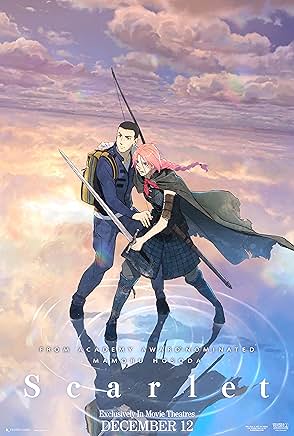

“Scarlet” (2025) is a gender bended William Shakespeare’s “Hamlet” meets “The Northman” (2022) and a skosh of Aria and Sansa from “Game of Thrones” combined with one “La La Land” (2016) styled musical number. When Scarlet (Mana Ashida) fails to avenge her father’s death, she wakes up in the Otherland. Her homicidal, covetous uncle Claudius (Kôji Yakusho) has turned the Otherland into a hierarchical place where anyone that he deems unfit cannot get to the Infinity Lands. The sixteenth century princess gets exposed to people from different eras, including Hijiri (Masaki Okada), an EMT who tries to help people from dying again. Death in the Otherland disintegrates a person into nothingness. Will Scarlet get revenge or will she find peace? This anime feature has good intentions but is ultimately too uneven and derivative to get an audience fully invested for the entire run time.
Scarlet is a daddy’s girl. King Amulet (Masachika Ichimura) loves her, and the kingdom is vibrant and colorful under his rule. Her mother, Gertrude (Yuki Saitô), seethes every time that she looks at them, and she seizes any opportunity to be mean to her daughter, but largely gets dropped after the first act. Gertrude is an enthusiastic inciter with Claudius, her affair partner. It is unclear why Gertrude is such a hater. Once Claudius is in power, the color gets washed out of the kingdom. Scarlet holds particular animus against the role that Cornelius (Yutaka Matsushige) and Voltemand (Kôtarô Yoshida) play in her father’s execution. Why? No idea. Reasons. Are they particularly interesting people? Nope. They are drawn as bruisers and written as focused enemies. They are only two of four people who appear physically responsible for Amulet’s execution. Side note: poison in the ear is just an expression, not a cause of death in this iteration of the story.
When Scarlet is in the Otherworld, it is the most engrossing part of “Scarlet” because it is unclear what the rules of this realm are so the viewer relates to Scarlet’s confusion, the strain of survival and grasping for purpose. It is a very dystopian, barren, desert looking area. When people die, they end up there if they do not immediately dissipate. Think Buffy the Vampire slain vampires transforming into dust except it is more of a petal shaped aftermath of burning a piece of paper. She mostly encounters hostile people except for Hijiri, who gives everyone culture shock as he tries to bandage up their wounds or stop fighting just using his words. Hijiri becomes a gateway to Scarlet getting exposed to other alternatives to living instead of fighting, including caring about other people’s safety more than her quest for revenge. There is a tepid allusion to romance, but it feels more perfunctory because they are the most attractive people around, and Hijiri is the nicest person that Scarlet has met since her father died. The whole movie is a struggle for her soul and a restoration of peace in the realms.
It took me two tries to finish “Scarlet,” and if it was not going to be released in theaters, I probably would not have tried so hard and just let it sit unfinished along with five other movies, which is a damning sentence considering that I am a completist. I watch too many movies, and I sacrificed animated films so I could prioritize everything else. This movie belongs to a category that would make it rank high on the list of animated films that I should like since it involves a heroine who kicks ass. While she is a sympathetic character and an impressive fighter, she is a little too naïve to root for. Also, she needs saving too many times, and it was easy for her to lose center stage.
“Scarlet” is an anime film, which is my favorite genre of animation. Some scenes, especially if set in contemporary times, look like photographs. The concept of the Otherworld is brilliant and holds so much potential since it is an unlikely meeting place for so many different types of people to meet from different regions and times. Unfortunately, the ensuing result is psychologically two dimensional. No one is individuated or nuanced even among the main characters except for the titular heroine. They are good or bad. The most variety that you may get is scared. Characters do change sides, but it is like flipping a switch. Instead of an emotional journey where the transformation is visceral, it often feels random.
Writer and director Mamoru Hosada is so eager to get to the fighting (me too), that he fails to world build. The main problem is that King Amulet and Scarlet are allegedly popular according to the dialogue, but Claudius’ forces are so massive in the real world and Otherworld that it is hard to imagine his appeal and how he was able to overtake their forces. Scarlet has ladies in waiting and fighting coaches, but they are like furniture. The caravan of normal people in the Otherworld ais there for flavor, more like a chorus than individuals, a Benetton ad and breather from the intensity. The concept of a peaceful life is a vague, group project, which is why when it suddenly turns into a “Lord of the Rings” style confrontation, it feels as if it materialized out of nowhere.
When Rosencrantz (Muntaka Aoki) and Guilderstern (Shota Soetani) appear, it feels more like checking a box than essential to the story. Hosoda includes other notable characters from the tragic play such as Laertes (Tokio Emoto) and Polonius (Kazuhiro Yamaji), but they play less of a central role. It feels as if AI received a prompt and wrote a story based on the data that it was fed. The problem is not borrowing elements from a renown play and reframing it. The problem is that the reframing does not resonate in a contemporary way even with its pacifist message aiming for world peace, which should work since it feels as if the real world is on the brink of World War III. Without three-dimensional characters in situations that feel relatable, and interactions rooted in organic dynamics, it is impossible to achieve the desire to achieve higher goals. “Scarlet” is a lot of empty calories and movement that never satiates.
As someone raised fundamentalist, the idea of forgiveness and peace should have hit me like a Mack truck, and I wanted it to, but it did not. It felt as if the groundwork needed to be laid out earlier at every stage of “Scarlet” for it to be effective in the final act. This movie is made of a lot of great ingredients, but the final dish is a fusion that never coalesces into a unifying flavor that will make people want seconds. If it was simply an empty fantasy tale of revenge, it could have worked, but as a lingering message that will stick to your ribs when the credits roll, it fails.