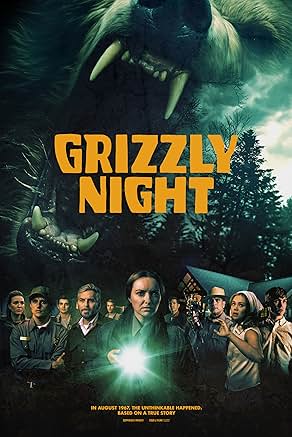

Mistakenly marketed as a horror movie, “Grizzly Night” (2026) adapts Jack Olsen’s 1969 nonfiction book, “Night of the Grizzlies,” which chronicles the events that occurred around August 12, 1967 at Glacier National Park in Montana when grizzly bears attacked campers at two separate camp sites. With similar sensibilities, it feels like a modest television movie homage to the Seventies golden age of disaster cinema with an all-star ensemble cast and a sensationalistic survival scenario such as “Airport” (1970), “The Poseidon Adventure” (1972), “The Towering Inferno” (1974) and “Earthquake” (1974). It is director Burke Doeren’s and cowriters Bo Bean, Katrina Mathewson and Tanner Bean’s first feature. If they work on their pacing to devote more time to introducing characters at the beginning, then when the crap hits the fan, the consequences would be more impactful, and the moral tone and human interactions would resonant more with its audience instead of feeling unexpected.
All the actors do their job well, but the most recognizable one is Oded Fehr as family man, Dr. John Lindberg, who is traveling with his family, nurse and wife, Ann (Sohm Kapila), and daughter, Terese (Sofia Khwaja). They are pivotal supporting actors who play an important role as the night turns sanguine. The next most famous actor is Brec Bassinger, who is best known as the CW’s Stargirl. Here she plays Julie Helgeson who is camping with her boyfriend, Roy Ducat (Matt Lintz), instead of her good friend and coworker, high schooler, Paul Dunn (Jacob Buster), who has a crush on Julie’s friend, Michelle Koons (Ali Skovbye). To help Michelle dodge advances from anti-hippie Raymond Noseck (Jack Griffo), Paul agrees to go with her and her friends, Denise Huckle (Sophia Macy), Denise’s dog, Squirt, and Denise’s boyfriend and Raymond’s brother, Ronnie Noseck (Nate Morley).
The real protagonist is Joan Devereaux (Lauren Call), a plucky park ranger, who gets separated from her best work friend, Leonard (Michael Vlamis), nicknamed Len, when head ranger Gary Bunny (Charles Esten) assigns them to their least desired posts for the night. “Grizzly Night” becomes a coming-of-age story as she goes from newbie to confident, but conscience stricken and respected expert who keeps people safe and battles sexist assumptions. She is taking a group of sixty-five people to the fully booked Granite Park Chalet, which Tom Walet (Brandon Ray Olive) manages and is clearly overwhelmed. Tom feeds the bears because he receives insufficient resources to dispose of trash properly despite misgivings from Eileen Anderson (Jazmine Shaw); thus, once again proving that listening to Black women can save lives. Do not worry. There is no racism or xenophobia in this movie. Just sexism and only a dollop. There are a lot of characters who play meaningful roles throughout the night, but good luck identifying them without this review: the group of three who discover one of the victims, which includes the jittery Janet Klein (Laura Schein), her husband, Robert (Josh Zuckerman), and expert camper, Don Gullett (Mateo Pollock); and a couple of men, Steve Pierre (Skyler Bible) and Father Connelly (Joel Johnstone), who are horrified at how cavalier everyone is about bears being so close to the chalet and are enthusiastic helpers once tragedy strikes.
If “Grizzly Night” was more mean spirited, it could draw a regressive lesson about the reasons for the attacks in the vein of the “Scream” franchise. Instead, the dialogue takes great pains to make Michele seem like a conscientious, progressive young lady, which may make some viewers think that she had it coming even if it is not the movie’s intention. Julie and Roy are framed as an adorable, barely holding hands young couple instead of the horny teenagers who get punished for having extramarital sex. The biggest surprise for most viewers will be that it is not a horror movie. These are not fun deaths, but gut punches. It is one of those somber stories about how a disparate group of strangers bands together, risk their lives and work on the common objective of saving lives, but still do not succeed. It is quite generous to the people who play roles in contributing to the attack and shows them as conscience-stricken and willing to reform.
“Grizzly Night” is a short, mournful movie, but it feels longer than its under ninety-minute runtime. It starts off too light and jokey. A better genre of movie to emulate would be a serial killer movie where the foreboding is palpable. The bears do not even seem like they are in the same area, which is great, but the shark did not need to be shown to instill fear. The acting sells the attacks, but actually seeing the bears is otherwise laughable and limiting. It was more effective having other people hear the screams and try to discern what they heard. When you are on a budget, showing less is more.
The Seventies disaster movies had recognizable actors who were associated with having a certain personality, so it was a substitute for character development. This cast needed more time to cook, specifically the people at the chalet, such as benign quotidian hints at the role that they would play later so it feels like a reward when it happens. The presence of a priest ends up being a pivotal note to establish the tone and offer peace to one of the dying victims of the attack. It ends up being a ceremony that makes the group hush and stand with this person in their final moments. It is an old-fashioned choice that works and winds up feeling ecumenical because of the directing and editing choices from Michael DeJohn and G. Mitchell Johnson to show tourists who were likely of different faiths respectfully being silent participants.
“Grizzly Night” also feels as if it tempered the sexism of that time and made the response to the attacks more somber than it probably was. Some of the victims were blamed because they may have been menstruating, and the blood allegedly attracted the bear attacks, but that was later disproven. Fortunately, that theory does not get bandied around during the movie. It is only recently that people are sad when people willy nilly kill a bunch of animals in search of the actual culprits, and a lot of scenes reflect a contemporary attitude. It may have been better to include it in the wrap up written summary than depicted.
“Grizzly Night” is a serviceable film, but it does not stick to the ribs. It meanders to the end, and you may find it challenging to recall which character played what role in the way that the events unfolded. On the other hand, it is admirable in how it invoked a more optimistic tone of how people can come together and learn from their mistakes instead of villainizing anyone. There is a collective grief and guilt because of the loss of life, which is an accomplishment in a world where real-life deaths are not guaranteed to carry such weight or inspire change. While no one knocked this film out of the park, they also did not stink up the room so let’s hope that these filmmakers get more opportunities to grow.