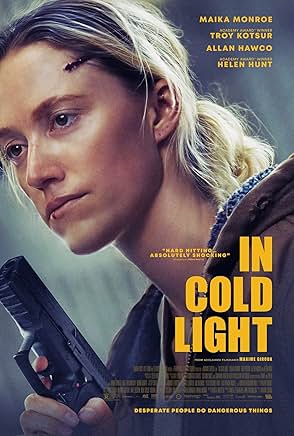

Say what you will about “In Cold Light” (2025), but no one can accuse it of typecasting. Maika Monroe and Helen Hunt play stone cold warring drug dealers willing to do whatever it takes to protect themselves and their families. After two years incarcerated at Canada’s Edmonton Institution for Women, Ava (Monroe) gets released, returns to Ponoka, Alberta, and has less than an ideal reunion with her family. Wanting to get back in the business, Ava faces resistance from her former partners, including her twin brother, Tom (Jesse Irving, who is convincing as the brother and impossible to mistake for anyone else). When a dirty cop, Bob (Allan Hawco) and his son, Adam (Noah Parker), kill Tom and frame Ava, she is on the run. What will Ava do? French director Maxime Giroux’s first English language film defies the conventions of a narco crime thriller to transform writer Patrick Whistler’s sophomore feature’s sparse dialogue script into a character study.
Monroe fans will need no convincing that the young actor has range, and her performance is a rigorous one. Her physicality and facial expressions reflect her character’s internal journey from a woman strung out on drugs to escape the innate condemnation of her existence and refusing to concede any emotion. Ava is a mystery to the audience, even herself, for most of “In Cold Light.” While the revelations of her origin story are heavy-handed, in retrospect, Monroe’s demeanor as Ava perfectly corresponds with it, which should not be taken for granted. There is a point where she is noticeably relaxed in her face, which was hard and tight for most of the runtime. That scene is not long, but noticeable because it reflects that her character is finally at peace.
Physically, Monroe probably ran the equivalent of a marathon. The opening sequence shows how Ava will go to any physical length to remain safe. She is a flight girlie. Fight and fawn are not instinctual responses to danger, but she has them tucked away in her back pocket. The filmmakers only trot them out sparingly. If you are secretly hoping for a women kicking butt movie, “In Cold Light” will disappoint you. The violence is realistic. It is not one of those movies where the character is a one-person army.
If you saw “Primate” (2025) and left wanting more Troy Kotsur, good news. The Oscar award winning actor plays Ava and Tom’s dad, Will. Monroe and Kostur have several great scenes together that standalone in informing moviegoers of all the issues with their relationship before there is a speck of backstory. Credit where credit is due: the cast and filmmakers strictly adhere to the show, do not tell rule, which is as it should be in film. It is obvious that Will is furious with her, and he is in part the reason that she gives no emotional quarter to anyone. “In Cold Light” manages to avoid making it seem misogynistic, which would be the default assumption considering how he favors Tom. The father and daughter conversations are in sign language because Kotsur is deaf in real life, which actually makes their communication style more riveting and raises the tension. Ava is a lot like her father, and thanks to the filmmakers, Kostur and Monroe, it becomes obvious without anyone remarking on it.
The value of having diverse actors like Kostur is having a talented actor bring a character to life. Smart filmmakers use his deafness to elevate scenes that would otherwise seem rote. During a confrontation, the motion detector light keeps going out so they must waive their hand furiously to reactivate it, which increases the frustration and is relatable. During a tense exchange with witnesses, they can share a private, poignant moment for the first time with tons of eyes on them.
If you were alive when “Mad About You”, a NBC television sitcom, aired, you will understand the chokehold that Academy Award winner Hunt had on a certain demographic of men. If you are going to see “In Cold Light” for her, better pay for a matinee because she is only in it for one scene. Hunt plays Claire, the big-time drug dealer trying to take over Ava’s old territory, and is the perfect foil for Ava. Her scene with Ava is counterintuitive and sheds a light on why Ava had a panic attack before getting released from jail. Less is more, but it would have been great to get more scenes between the two; however, this judicious amount is aligned with the trajectory of the story. Ava is not interested in the drug business, but it did give her control and was an achievement in a life with a gaping huge hole.
“In Cold Light” does drag when it is just about Ava being on the run regardless of how gorgeous cinematographer Sara Mishara makes everything look with the multicolored lights reminiscent of “All of Us Strangers” (2024). Giroux gets a bit too self-indulgent when Ava crashes a game room that uses night vision glasses or when the film texture looks grainy during a night scene set at the Ponoka Stampede & Exhibition Association, which could have symbolized a flash of PTSD. While one out of the present timeline scenes is clearly a flashback, another feels like a flash forward or is an oneiric hope for the future, but it leaves a dangling thread that could leave audiences with more questions if they remember that sequence after the credits roll.
Whistler almost shipwrecked “In Cold Light” when he uses an often-used trope to make a woman protagonist likeable. I watched a screener, and I almost wanted to turn off the television because it is the exact emotional manipulation in movies that I hate. Nay, despise! Fortunately, he does not stay on that course though it is a cheap way to provide motivation for Ava not to continue running. It is the kind of movie that benefits from multiple viewings because casual moments, especially the sparse dialogue, are retroactively more important than it seems upon initial viewing. Hint: Chekhov’s lightbulb. He does set up a situation for Ava that seems impossible to escape, and the resolution feels satisfying though it may defy expectations.
“In Cold Light” is an artsy fartsy take on drug rivals which leans heavily on character development and relationship dynamics. It is amazing how much clarity everyone gets when put in extreme circumstances. Better to choose therapy, individual and family. People looking for a flashier crime story should probably skip this one, but fans of the cast will appreciate this twist on the genre. If there were less on the run scenes and more time devoted to the underdeveloped theme of the external versus the internal view of oneself, it would have been even better.