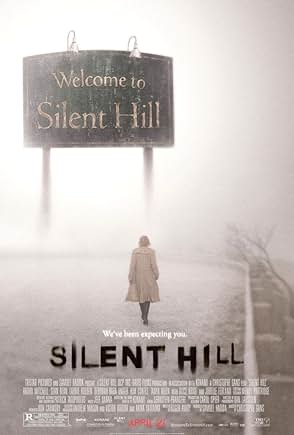

“Silent Hill” (2006) adapts a Japanese video game and is the first of three movies in the franchise. Ohio couple, Rose (Radha Mitchell) and Christopher (Sean Bean) Da Silva (Portuguese?), disagree about how to stop their daughter, Sharon (Jodelle Ferland), from sleepwalking. Rose decides to take her daughter on a road trip to investigate the titular ghost town, which Sharon whispered during one of her episodes, to find the source of her daughter’s episodes. The mother and daughter get separated, which leads Rose on a nightmarish scavenger hunt to find her daughter. Meanwhile her husband is in the same location looking for his family, but the police cannot find them. What is happening?
I actually paid to see “Silent Hill” in theaters, but only remembered the images, not the story. I have problems remembering people’s names, but Radha Mitchell in this first installment is apparently an exception to that rule. I do not even remember her in other movies or television series, which is not the same as not seeing her in other things. With the release of “Return to Silent Hill” (2026), I decided it was time to revisit the horror classic. Rose is underwritten but she is a mother who is willing to brave any danger to save her child. The opening scene is a microcosm of the entire movie with Rose inappropriately dressed for the surprise, perilous hike that she embarks on to find and rescue her daughter from accidentally hurting or killing herself.
Thirty years before, in 1974, the West Virginian town had a mysterious fire and appears completely abandoned. The seemingly eternal burning fire in Centralia, Pennsylvania inspired the story. The location is almost its own character. My memory recalls that the town was described as a hellmouth, but the actual story is dramatically different. That site basically houses three dimensions: the real world, the fog world which is grey but habitable, and the darkness dimension that seems inhospitable to human life except in one location. The dimensional shift results in disruption of equipment, which is a very sci-fi, usually extraterrestrial, trait. Not even armed with a bottle of water or a spork, Rose follows almost indiscernible clues to find her daughter. Video games movies usually feel like the narrative equivalent of a car chase scene expanded to ridiculous portions whereas “Silent Hill” is so surreal and evocative that it never feels monotonous, and there is a story even if it is a demented one.
Sharon has a doppelganger in that town. People still live in the fog dimension, and their reaction to her daughter’s image is like a Rorschach test on whether they are good people or not. By the end of the movie, you will still have questions. I often complain about lack of character development, prioritizing sizzle over steak, aka more atmosphere than story in horror, and a ugliness in spirit. Those criticisms should apply to “Silent Hill,” but they do not. These characters are archetypes that work. Bean is given slightly more to do here than in “Anemone” (2025). Christopher functions as an audience marker to prove that Rose is not an unreliable narrator, and all the weirdness is not a result of a concussion. She is not dead. His interaction with the surviving cagey townsfolk adds tension because it does not just feel as if everyone is reacting to a natural disaster, but something else.
I totally did not recall that Laurie Holden was in “Silent Hill,” but she is, and an actor has not looked so iconic in a cop uniform since Robert Patrick in “Terminator 2: Judgment Day” (1991). Holden plays Cybil Bennett, who looks like a more severe, kick ass version of Rose. As the movie unfolds, she literally and figuratively sheds protective layers to reveal her true motives, and that short hair cut feels like a reference to Joan of Arc. She is another outsider, not a town resident. Her tight, leather uniform resembles the monsters’ tailored appearance. It feels like Gans or perhaps the Japanese game creators drank from the same well as Guillermo del Toro without feeling derivative.
The town folk in the fog dimension are a strange bunch. Dahlia Gillespie (Deborah Kara Unger) seems haunted and delusional. Another woman, Anna (Tanya Allen), seems like a hostile fanatic. Alice Krige appears, and no spoilers, but she is most famous for playing the Borg Queen in “Star Trek: First Contact” (1996) so that should give you an idea of the kind of roles that she plays: commanding women who seem human but are cold and cruel with little interest in feedback or dissent. There are men, but they are mainly clad from head to toe, henchmen who scatter or close in depending on the circumstance. They initially appeared fully cloaked and in gas masks.
Director Christopher Gans has only made five feature length movies, including “Silent Hill” and “Brotherhood of the Wolf” (2001), a martial arts, French eighteenth century movie, which was awesome if my memory is correct. Writer Roger Avary contributed to Quentin Tarantino’s films “Reservoir Dogs” (1992), “True Romance” (1993) and “Pulp Fiction” (1994). While no one is quoting this movie, it is better than most horror fare thanks to Gans’ devotion to the game. The town transforms at night with insects swarming at the command of Pyramid Head (Robert Campanella) who wields broad swords that can rip through metal doors. Campanella also did the movement choreography of the other creatures, which include the Dark Nurses and an armless man who must be a xenomorph’s cousin. Occasionally Rose discovers a body wrapped in barbed wire. The backstory behind the horror is explained in detail.
S
P
O
I
L
E
R
S
“Silent Hill” is Stephen King’s “Carrie” on steroids. Basically, the town tortured Alessa (also Ferland), Dahlia’s daughter, all her life because Dahlia never revealed Alessa’s father’s identity. After the janitor (also Campanella) raped her, the town decided to burn her at the stake, but she did not die. She fractured into a good self, Sharon, with her real self (Lorry Ayers) stuck in a hospital bed and the demon, which based on the dialogue, sounded like a supernatural spirit who gave power to Alessa to survive and get revenge, but others interpret as her dark side. If the filmmakers messed up, it is not establishing that Alessa was different before anything happened. The father’s identity was never established or revealed in the sequel.
Even though the community appears to be woman led, it is obvious that any woman who is different can be called a witch. For Mitchell to have a convincing face off with Krige is impressive. It becomes a lesson in how a community scapegoats people who are different, and the power of a mother’s love, but may also inadvertently be a lesson in adoption as a crapshoot because you are likely to get a traumatized kid who is going to get you stuck in purgatory. At any rate, the fog townies think that the whole world ended but just don’t want to face the fact that they died and are stuck in a timeless void so Alessa can get her clapback. Personal apocalypse. Cue Depeche Mode! Cinema!