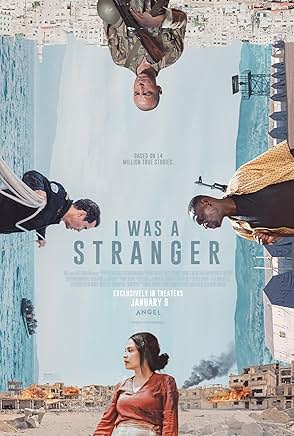

“I Was a Stranger” (2024) opens with a quote attributed to Shakespeare, but the title of Angel Studios’ first international film, “I Was a Stranger” (2024), is a quote from Matthew 25:35, “I was a stranger and you did not invite me in.” Now that mainstream Christians adhere more to the gospel of Presidon’t which hates immigrants unless they can pass the paper bag test and would better be known as Christianists, it appears that the Mormons have picked up the mantle of Christian abolitionists in the eighteenth and nineteenth century, the Social Gospel Movement of the late nineteenth century to early twentieth century that protested working conditions, the Civil Rights Movement starting in the mid twentieth century and the contemporary Progressive Christianity movement, which includes advocacy for immigrants. It makes sense since the Church of Latter-Day Saints often has missionaries involved with humanitarian work, which would be more heartwarming if it did not take until 2013 to first disavow its teachings on race, specifically Black skin as a curse in the Book of Mormon, but please recall that also around that time, the rest of the world began to return to their original settings racism, particularly with the fallout from the murder of Trayvon Martin, so let’s get them at least a cookie and some gold star stickers for some positive reinforcement, but some further deconstruction of how those earlier teachings and society as a whole could subconsciously affect their work is likely still needed. The good intentions are solid, but the execution still needs work. Fortunately, I grade on a curve. Good start.
Using the refugee crisis that ensued because of the Syrian Civil War, writer and director Brandt Andersen expands his twenty-three-minute short film, “Refugee” (2020) to the feature length “I Was a Stranger.” The website devoted to promoting the short revealed that Andersen opened a film school at an Azraq refugee camp in Jordan so refugees can tell their own stories. In the vein of such films as “Traffic” (2000), “Crash” (2004), “Syriana” (2005), and “Babel” (2006), it tells a collection of stories told from different characters’ point of view with the viewer trying to discern the overall story. The noble motive is to create empathy for Syrian refugees and people immigrating to other countries. At the end of thirty-seven minutes or the first two parts of five, the well-intentioned monotony and emotional manipulation set in because there is no mystery regarding the final outcome and what ties the stories together. Sacrificing character development for sensationalism, the actors imbue each situation with more humanity than the narrative offers.
Very few films’ momentum can survive if they start at the end. The film opens on April 24, 2023 in Chicago, Illinois before rewinding to eight years prior, 2015. It is another pet peeve when films use increments of time instead of just using the date; thus, making it harder to keep track of when the story’s events are occurring. A cynical person understands why “I Was a Stranger” starts in the US because most Americans do not want to watch a movie with subtitles, but it is a bait and switch. Most of the movie has subtitles, and word of mouth will tank viewership after the first set of people see it and report back to their friends. Foreign films do not get a lot of love because if most people wanted to read, they would not be at the movies.
The first part titled “The Doctor” is around eighteen minutes and introduces Dr. Amira Homsi (Yasmine Al Massri, who had the original role in the short) at work and home in Aleppo, Syria. If Andersen makes a fatal flaw, it is not committing to Al Massri being the protagonist for the entire movie. Every subsequent scene feels like a cinematic version of “Where’s Waldo” except with the doctor and her daughter, Rasha (Massa Daoud). During times of war, women protagonists are more interesting because they are forced to abandon their civilized nature and face the possibility of resorting to more primal rules to protect themselves and their children. Unfortunately, just when moviegoers are settling into her plight, it switches to another perspective.
“Soldier” is nineteen minutes long. In the interest of full disclosure, I know nothing about the Syrian Civil War except that everyone seemed like a bad guy for dramatically different reasons. Fortunately, Andersen does not depict any sexual violence though it was endemic to this conflict. The soldier is Mustafa Faris (Yahya Mahayni), who seems to work for the Ba’athist Syria, i.e. the state. It is obvious that “I Was a Stranger” believes that he is on the wrong side because they are depicted as extrajudicial executioners; the head drives around in a black vehicle; and they are anti-Zionists. It probably was not the intention of “I Was a Stranger” to imply that their opposition, Daesh, better known in the West as Isis, or other problematic rebel groups were better, but it is the danger of having an outsider make a film about a nuanced conflict with very few good guys with guns. Americans are not great at fighting more obvious bad guys at home so going outside our borders means we are already outside our element and bound to make some faux pas. While Andersen tries to distill the story to the human element, unlike “The Voice of Hind Rajab” (2025), he probably manages to trip a few metaphorical land mines for more sophisticated movie goers with a deeper knowledge of the conflict. In a later section, someone asks if Faris was on an unnamed side that saves lives. Which side was that? Crickets.
Fortunately, Mahayni is such a good actor, especially his physicality and ability to project conflicting emotions silently on his face, that it may be easy to get absorbed into his character’s story, which probably features the most complex internal emotional journey. Over the course of this segment, Mustafa begins to question orders and his devotion as a soldier to the cause. It is a lesson that sadly every generation must face. The segment shows how soldiers are brainwashed into dehumanizing people and call anyone terrorist (or a thug), so it is easier to execute unarmed people. “I Was a Stranger” could have been a better movie if more time was devoted to Mahayni and Al Massri onscreen, but they get relegated to the margins for the remainder of the film.
The third part, “Smuggler,” is twenty-one minutes long and stars the most famous actor in “I Was a Stranger,” Omar Sy, who has been in a couple of “Jurassic World” films and most recently “Shadow Force” (2025). Before he appeared on screen, I was already checked out because the rest of the story became predictable. Andersen decided to profile every step of the refugee’s journey, even people who seemed like villains, and often uses children in danger to raise the stakes. It also introduces race as an issue and nails that nuance with an Egyptian man claiming African solidarity with Sy’s character, Marwan, who is evidently from an African country, but may be using his obsequiousness to hide his true intentions. The main problem with this segment was that it was not bleak enough, and at the denouement, there is only one dead body on the shore when the scene called for at least two. It feels more like a judgment than a cost of doing business.
The fourth part, “The Poet,” is seventeen minutes long and follows a family of five making a perilous trip on the ocean from Turkey to Greece. This section should have just been called “The Family” since each member takes turns wearing the metaphorical red shirt. The fifth part, “The Captain,” is sixteen minutes long about one person instrumental in rescuing refugees before four minutes are devoted to showing what happened at the end of each segment before returning to Chicago to make a reveal about a character that any New Yorker who takes cabs knows. Most immigrants and refugees are better educated than most Americans but lack the credentials to do more than menial labor so they must choose between their life and their calling while we suffer from a shortage of doctors. The performances are heart rendering, especially considering the harrowing circumstances, but it is superficial teeth gnashing that has more faith in the humanity of the viewers than the polls indicate.
We are in a drawbridge era where Americans do not care about their own kids thus are unlikely to care about others: mass shootings, the Epstein files, refusing to vaccinate their kids then doubling down when they die, etc. When a country was founded on leaders enslaving and raping people then raping the enslaved descendants, i.e. their children, it is not the worst of times, but before evil was hidden or denied so leaders could cos play being enlightened. Now there is no shame, and people are proud of their insensitivity, ignorance and lack of empathy. The classic Civil Rights Movement partially worked because the images on the television moved people. That never happened during the Syrian Civil War, and “I Was a Stranger” is unlikely to change any hearts and minds despite a solid ensemble cast and excellent production values, which is why it is important to make a movie that is a substantial tapestry, not a superficial Cri de Coeur. If you cannot convince, you can at least move and/or entertain.