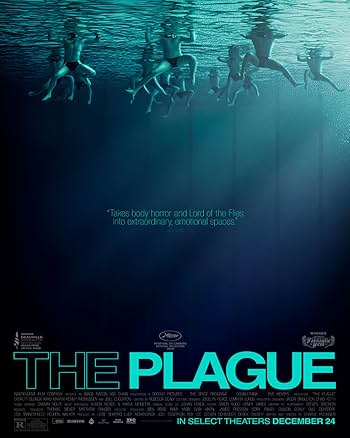

“The Plague” (2025) is set in the summer of 2003 at the fictional Tom Lerner Water Polo Camp as a Boston newcomer, Ben (Everett Blunck), gets thrown into the deep end of the social pool with of a bunch of young teen boys and uses context clues to figure out how to find a comfortable spot in the pecking order. Spoiler: there is no such thing if Jake (Kayo Martin) is keeping a perspicacious eye on everyone’s flaws, points it out and keeps everyone in check lest he direct his cutting observations on you. Ben is almost desperate to do anything to not get cast out with accusations of having “the plague.” Will Ben fall in line? Writer and director Charlie Polinger’s feature debut is a confident, controlled exploration that decides to eschew the exotic isolation of “Lord of the Flies” and return the horror of being an adolescent boy to more familiar territory.
If you saw “Griffin in Summer” (2024), then you will correctly expect Blunck to be a powerhouse and able to take Ben along the entire spectrum of human character from the best to the worst without missing a beat. He even seemed to surprise Polinger at times when he switches gears. Ben is observant and just wants to belong, but that desire gets twisted into something more craven as he tries and fails to smother his eagerness and anxiety at not being comfortable. He knows better, but his reptile brain kicks in with a desire to be feel powerful over the only person lower than him in the hierarchy, Eli (Kenny Rasmussen). When Ben listens to the better angels of his nature, he actually can enjoy Eli’s company and maybe happier if he just followed his instincts to accept his weirdo status, but he wants to achieve more.
Martin is deft at micro expressions and shows how Jake, a pint-sized Manson, knows how to direct the boys around him as if he is a conductor. The cacophony of Johan Lenox’s horror soundtrack and the boys’ excited chatter heighten the tension, add to the confusion and ever-changing landscape that is impossible to navigate unscathed. Editors Henry Hayes and Simon Njoo cut the film in a rhythm that mimics the energy of the group so when it gets still, stops alternating on different boys’ faces and lands on the target of ridicule, it is the visual equivlent of a record scratch. “The Plague” depicts Martin as a mastermind, but also like Ben and Eli, someone different from most of the group except he cloaks his difference with an entourage of puppets. The movie shows and does not tell so if you are expecting any insights why some people who are outliers are able to weaponize insight and others are their victims, keep it pushing. It is an immersive experience where Polinger puts us in the shoes of these kids, and no one comes out unscathed.
Rasmussen could play Damien in a reboot of “The Omen” (1976). Eli is an odd and often unsettling kid with a skin condition. The implicit message is that none of these kids are at this camp because their parents need to keep them busy while they work. They want a break, and Eli is in his own world either diagnosed and thrown to the wolves or undiagnosed and in need of more adult insight and sensitive surroundings. He is not clueless and internalizes the cruelty in unexpected ways. The other children are only visually distinctive but are otherwise barely individuated. Lennox Espy is so stunning that it feels as if his character would have been forced to cut his hair or do something to be turned into a normie, especially since the boys were interested in girls. Also, it is a diverse group of kids, and it feels as if it would not be as chill especially since anyone different is targeted.
Visually, “The Plague” looks a lot like “The Teachers’ Lounge” (2023) with the blue palette, but it is a stark contrast because of the chaos within its walls and just outside. The red light at the cafeteria line reflects the pressure of choosing a table and seeing whether the already seated diners will reject the bid for attention. Every moment is an audition. There is no explanation how the kids can leave the facility without notice. In one scene, they treat an alley like their personal rage room with no repercussions. The voices in the dorm room at night are more like hearing the critical voices in Ben’s heads but also like an alternative form of a black box stage to impress the other boys and gain some clout with his best proximation of verbal porn.
In the interest of full disclosure, I had an opportunity to see “The Plague” on the big screen and had no desire to see it because I have no interest in going to a familiar well even if it is well done. Who does not know that kids are mean, and boys are rough? Sadly, it could have been worse, and it felt strange that the physical violence was fairly tame. I gave it a chance because of the performances, especially as a newly minted admirer of Blunck’s work and watched it using a screener on my television, which probably did not help. Intellectually I found it accurate and well done, especially the insight that people who know better can be crueler than the instigator intends, and once a dynamic is put into motion, it does not stop with the exit of certain players. I still struggled to stay engrossed with the film. It is rare for me to find movies focused on little boys interesting, and this movie did not escape the gravity of my personal tastes, which has happened. A movie can be good, but not for me.
If you decide to watch it for Joel Edgerton, do not bother. He is a great actor, but his role as the boys’ coach is not enough of a reason to commit to the entire movie. His character and the dialogue devoted to the Siths and vegetarianism suggest that there is no way to stop this cruelty even if someone knows better. While it is a relief to not see the boys terrorize girls except in limited ways, it also seems unrealistic. The needle drops may evoke the era, but it feels forced, not organic, but “The Lord of the Rings” reference worked. The denouement occurs at the dance, which feels weighted with “Carrie” foreboding. If you hate an ambiguous end, you may hate the resolution, but tonally it feels fair.
Movies like “Die My Love” (2025) and “If I Had Legs I’d Kick You” (2025) are not watched for fun, but the ability to replicate a human experience then convey it to an audience so moviegoers can have empathy for the characters on screen and/or recognize their story in it. While “The Plague” succeeds in its mission, it is not exactly how anyone may want to spend their time watching the wings be ripped off flies. It is an uncomfortable viewing experience, which is a good thing, but also feels as if it is almost too restrained and stylized to feel all absorbing. If you enjoyed this film, then check out “The Hole in the Fence” (2022), a film that touches on individual experience and collective societal impact, for a more thorough experience.