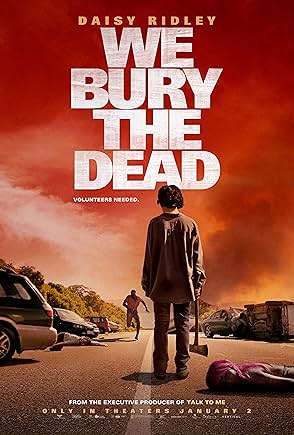

If “Annihilation” (2018) meets the “28 Days Later” franchise, you would get “We Bury the Dead” (2024) so if you watch too many movies, keep it pushing, but if you are new to the zombie game, come onboard. When Americans accidentally deploy an experimental weapon off the coast of Tasmania (with recent news of the bombing in Nigeria and the history of Vieques, Puerto Rico, this premise is particularly harrowing), it obliterates life within the blast zone, but as bodies are recovered and disposed, some bodies get reanimated. American Ava (Daisy Ridley) is determined to find her husband, Mitch (Matt Whelan), and find closure. Will she resolve unfinished business?
Australian writer and director Zak Kilditch owes his casting director Megan Carpenter big time because getting Ridley to play the protagonist already elevates the material. Too bad that “We Bury the Dead” will not do the same for her. It is weird that some actors like Ridley or James McAvoy are excellent but seem to be stuck in movie purgatory where the material is fine, but nothing to write home about. Ridley does not care and excels at projecting emotion and calculation in her face in every shot that you do not even need dialogue. Which came first, “Star Wars” or her demeanor that indicates she can handle business if crap goes sideway despite not being physically imposing and registering as normal? Probably the latter, and in her first scene where she enters a home to retrieve and identify bodies with her first partner (Deanna Cooney), it is the unnamed woman who seems more ready to handle the job, but Ava has the no fuss staying power. Ava is no saint. She manipulates her second partner, Clay (Brenton Thwaites), into helping her, which puts him at more risk than needed.
Before his final scene on screen, Clay gets to spell out his backstory, which is fine and amplifies the theme of couples trying to connect and failing, which is tres Alex Garland-esque, but it feels redundant at that point. There is another man, Riley (Mark Coles Smith), who tells the mirror image of Clay’s story. Riley is the kind of character that if written well, could move the entire momentum of the story forward, which Smith could do, but Riley is just another steppingstone in Eva’s journey, and in retrospect, is too pat a resolution considering Eva’s destination. Both men hold pieces of Riley’s story, but it feels redundant since it does not reveal anything new that cannot be discerned from watching Riley’s story play out in the present or in the flashbacks, waking delusions or nightmares that Riley has. The supporting actors are great, but the supporting characters are sketches and impressions.
“We Bury the Dead” is impressive because everyone in the cast acts as if this movie is the first of its kind. No one is phoning it in. I love horror movies that use the scares to tell a deeper story about the nature of relationships, what it means to be alive and how we handle losing someone, but I’m going to need some horror otherwise just give me a straight drama that tackles these issues without insulting my intelligence with a periodic jump scare that goes nowhere. A horror movie needs real life or death stakes. This movie starts strong with what looks like a nuclear apocalypse that rises to the level of “Terminator 2: Judgment Day” (1991), but after that, it is more atmosphere than substance. While moviegoers may use the word zombies, they are not so in the traditional sense. There is a lot of teeth grinding, but when they attack, which is seldom, it is more out of frustration. It is interesting to see reviews referencing flesh eating, which absolutely never happens. They attack. They can run. They never catch anyone on screen, and it gets downright frustrating how close characters get to these reanimated people without showing any concern despite knowing what could happen. So what happens if the reanimated get their hands on someone? Dunno. It does not matter. If you are watching “We Bury the Dead” for blood and guts, consider yourself warned. It is not that kind of movie. Bad news: it is also not the other kind of movie which will make you care more about the philosophical musings.
“We Bury the Dead” has two weighty things going on: how couples get derailed from happiness and how handling the loss may exacerbate the relationship with themselves and others, a very specific point which is a major spoiler. It may be too much to handle both issues in a way that does not seem pat. French movies have a tendency in “Titane” (2021), “Driving Madeline” (2022) and and “Emilia Perez” (2024) to allow characters to exist, die and give a ridiculously generous or priceless gift so another character can finally be made whole. Hilditch is not ready for that jelly, and it feels like he emotionally resonates more with the side of the story told from a man’s point of view as opposed to a person with a womb, which is visually the most evocative and powerful point that does not get enough of a through line as the relationship theme, but is arguably more important.
Will it work for some people? Yes, because not everyone did a deep dive into every zombie movie and television show then emerged with the equivalent of a PhD. The movie is fine, just not original except for the location, the resplendent cinematography (cinematographer is not credited so is “We Bury the Dead” born with it or maybe it is Maybelline, aka AI?) and the acting, both of which are superb. Zombies are the refuge of filmmakers that do not want to deal with the quiet tragedy of quotidian life or the senseless realities of war or systemic abuses that lead to scores of human suffering. If you want to see a nontraditional zombie movie that surprises and makes you think, check out “The Cured” (2017).
S
P
O
I
L
E
R
S
I absolutely do not think that it occurred to Hilditch that one storyline is problematic. Smith is indigenous so presumably Riley could be also. I already hate storylines where someone loses a baby then later gets someone else’s baby, which magically makes everything cool. Giving indigenous babies, even if they are mixed, to another person to raise feels icky. It was literally state policy 101 on how people try to commit genocide on the indigenous by taking their babies and giving them to the majority culture. Was “Rabbit-Proof Fence” (2002) not required viewing? Guess not. Come on! I’m an ignorant American, and I should not know more about someone else’s history. To do horror well, it helps to have a deep understanding of the socio-political-economic world around you before you start wrapping that reality in a horror metaphor. Hilditch wants to tell one story and inadvertently wanders into deep waters, which is what happens when filmmakers are not voracious and curious about their surroundings.