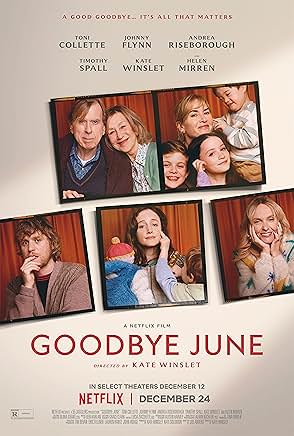

June (Helen Mirren) loves Christmas, but she is dying. Will she live long enough to celebrate Christmas with her family and heal family wounds? The real question is how many times you will attempt to watch “Goodbye June” (2025) before you are able to finish it or give up. For me, it took two times. Amazing actor Kate Winslet’s directorial debut will not be the next Christmas classic, and she should probably stick to her day job unless she is interested in doing straight to streaming or television movies.
During my second attempt at watching “Goodbye June,” I decided to do research because it made no sense why so many resources were going to such a middling story. The writer, Joe Anders, is Winslet’s twenty-two-year-old son. Good parents love their children and want to make their dreams come true so without Winslet, Anders’ screenplay would likely never see the light of day. To put it bluntly, it is not good, and I liked “Anemone” (2025). If you can judge a person on their work, then after watching “Goodbye June” (2025), you would conclude that Anders knows nothing about people, family dynamics or death, but you would be wrong. He wrote it based on his maternal grandmother, Sally, dying of ovarian cancer when he was thirteen. Likely for Winslet and Anders, the screenplay that he started at nineteen is a masterpiece because they are filtering it from having front row seats whereas a stranger without a groundlevel connection to the backstory may be left feeling at sea about this scattered work even if they are coming into the movie with their thumb on the scale.
As critics go, I’m pretty easy. I love movies about dealing with death and family issues such as “A Christmas Tale” (2008) to “His Three Daughters” (2023) so it just had to resonate a little to get me, and it absolutely did not. There is nothing harder than putting an inner, emotional life on the page then the screen, not even brain surgery or rocket science, but it is why not everyone needs to become a writer or should have their early work writ large for everyone to see. If Anders had the chance to fail, he would also have the chance to learn, grow and improve so he could write a story that reflected what he was feeling and convey that experience to strangers.
What does “Goodbye June” get right? A superb ensemble cast that does its best to bring the material in for a safe landing. The glamorous, gorgeous Mirren really make it seem as if June is dying. Did Timothy Spall have a body double play June’s husband, Bernie, while in the bathroom? Spall does more with zero lines when Bernie glowers up at his son, Connor (Johnny Flynn), the parents’ caretaker, then lets it all go to express his emotions in a different environment. Up to that point, Bernie is just a self-involved person who acts like a child that treats everything as if it is his toy. Flynn has a heavy lift since Connor is introduced as if he is useless and hysterical, but Flynn manages to subsequently convey that Connor is overwhelmed, not someone living with his parents and failed to launch. Anders seems to conflate mistaken first impressions that the film gives the audience instead of his characters actually evolving during an emotional experience.
The average moviegoer does not care who wrote or directed a film if it is not a big name. If people decide to watch “Goodbye June,” it will be because Winslet stars in it as Julia, the second oldest daughter who gets calmer and quieter as more stress piles on but never slacks on her responsibilities. Julia has a good paying job doing (vaguely waves hands in the air) and has somehow incurred the wrath of her sister, Molly (chameleon Andrea Riseborough), whose love of organic food is at odds with her high strung, ill-tempered demeanor. In the most interesting plot twist, eldest daughter, New Ager Helen (Toni Collette, who may be the best of the whole lot and is definitely the scene stealer), is the only one who personally handles her family well despite June’s constant jabs at her looks. June never passes up a moment to criticize Helen for wearing yellow, and Helen practically drips in yellow while smiling serenely. Point, match. Helen never seems tense or angry, but her rage gets channeled into her clothing. If she had walked in wearing a giant banana costume borrowed from “Arrested Development,” I may have loved the movie, but then the Magical Negro role of the only floor nurse, night or day, Nurse Angel (Fisayo Akinade, who must be a saint for performing without rolling his eyes), would have cancelled it out. If he was a literal angel, it would have made the whole thing a bit easier to handle, but an eleventh-hour match will have to do. Guess which sibling snags him?
It is challenging to tell whether Anders was consciously trying to depict and implicitly critique the internalized misogyny of June, Julia and Molly or just thought it was normal and using the lines for filler. Both Jullia and Molly parentify their oldest daughters and coddle their younger sons. Connor is depicted as the best child, which is only obvious when he is in the room with his sisters. All the sisters are somewhat at odds though it was a relief to see Julia and Helen have some sort of sibling dynamic that was not hostile. June is supposed to be a bit of a horrible person who cannot resist insulting her daughters when they are not expecting it and has trained them not to defend themselves, which leads them to griping with each other while June wonders how to fix the ensuing melee. Have you tried not being an ass? The adult children just adore her and have no nuanced, mixed feelings about June despite June’s wounding parenting style, which seems like a missed opportunity. When Molly finally reveals her beef with Julia, and Julia shares her inner torment, it is baffling how the two reconnect instead of Julia getting a lawyer to get a restraining order and a therapist to teach her boundaries and self-worth, and Molly did not get more offended after Julia’s revolution. If Anders was not depicting these foibles as ultimately heartwarming and leading to more family togetherness, it would be less troubling. They are not acting for the sake of June but genuinely thrilled to be together despite still being largely the same. Some connective tissue is missing in these characterizations and interactions. It feels forced because they must be happy before the end, but it is unearned.
Winslet’s directing is functional. She made no egregious errors, but in terms of personal taste, she is unfortunately from the school of more is more favoring cacophony and chaos while aiming for intimacy and missing. She has the characters dancing as fast as they can and montages galore to hide the missing substance in the story. When the date stops being shown on December 18th, it was annoying because no one asked her to keep track of which day of Christmas it was, but stopping abruptly ruined gauging the story’s central tension of the sand running out of the hourglass. Did we need so many overhead shots of Mirren in her hospital bed? Apparently.
“Goodbye June” made death seem like an awkward, noisy family gathering, and if that sounds comforting to you, have at it. I was just shocked that June did not have a roommate, and the hospital room had an adjoining bathroom with a bathtub. Is this movie magic or the norm in the UK? I need to know because maybe the real divide is health care differences.