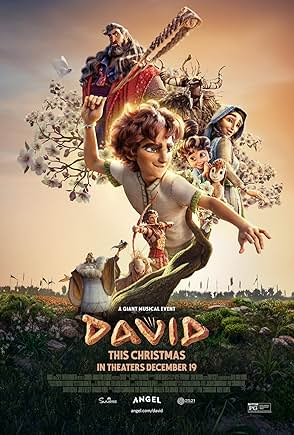

Angel Studios’ first animated feature “David” (2025) is the sequel to the television mini-series “Young David” (2023-2024), which consists of five episodes totaling roughly twenty-nine minutes. The movie claims to adapt 1 and 2 Samuel, but it only covers a heavily edited version of 1 Samuel 16-30 with some artistic liberties. David (Brandon Engman) is a lone, young shepherd keen on protecting his flock and relying on God to protect them. When he comes home, he gets unexpected news which sets him on a path that he does not want. He leaves his family to serve King Saul (Andrew Michael Gold), which unintentionally lands him in the spotlight of the people’s favor and in the crosshairs of Israel’s enemies, the Philistines and the Amalekites. When Saul turns on his most faithful servant, David, his family and others face dangers on all sides. Will David’s faith in God be rewarded with saving his life and those whom he loves? Yes because technically the movie does not show what happens to Saul and Jonathan (Mark Jacobson).
A few disclaimers before we get started. I watch movies, not studios, but I do not live under a rock. Mormons may have founded Angel Studios so while they are not a monolith, they are a bit too close to my tastes to Presidon’t while not explicitly associated with him except for one movie from a convicted felon who openly shared a hotel room with his fiancé while still married, which seems contrary to the family values that I was taught when I was still a fundamentalist, but values change and fundamentalism has too. I still watch Roman Polanski movies, but I do not pay for them so that is my standard. If I’m interested in a movie, I hold my nose and hope for the best while warning people of possible pitfalls so if they have different standards, they can exercise their best judgment on what they choose to view and how they choose to spend their money at the box office. (See my 2025 reviews of “Good Fortune” and “Tron: Ares,” which I praised, but both movies bombed in the box office. The people have spoken.) “David” had some controversy regarding lawsuits over distribution disputes, which hopefully are resolved since the movie is now in theaters.
I think the marketing and positioning for “David” is brilliant. During For Your Consideration season and a busy movie season, Angel Studios picked the one weekend where it is only competing with three new releases in major chain theaters: “The Housemaid” (2025), “Avatar: Fire and Ash” (2025) and “The SpongeBob Movie: Search for SquarePants” (2025), which I was planning to see but the best laid plans of mice and men. Basically “David” got lucky (or blessed?) because normally I’m swimming in options, and if I had seen the latter, I would have still watched “David” but maybe would not have covered it as much as I am. A lot of other movies with more seasoned PR teams and strategists have been swallowed up being adjacent to bigger movies, but “David” found a sweet spot. It is literally a David and Goliath story. Also, it seems like more than a coincidence that it is being released during Hanukkah week but remember that the people who made the movie do not seem to practice Judaism so while they may be trying to get that market, it may not land well with that audience.
So before talking about the actual movie, let’s talk about Biblical accuracy so you can judge whether the major changes are deal breakers or not. The film borrows elements from Joseph’s story to ramp up a conflict with his brothers, specifically Eliab, as if it lasted longer than a flash during the Goliath conflict, but never reaches explicit homicidal levels and stays at a cartoonish level of conflict. It oversimplifies the conflict with the Philistines and the Amalekites and omits the times when David hid and worked with them so he could remain safe from Saul. King Achish was solid with David, and David never planned to betray him with the embed turncoat plan. Also after the Goliath battle, “David” completely changes the Philistines reaction from the Bible account because it is more satisfying dramatically. The Philistines’ aesthetic is depicted as very Roman and even European, which shocked me. The Amalekites are portrayed like figures from a horror movie, which was evocative. In a showdown with the Amalekites, it visually alludes to crucifixion imagery as if David faced them alone and did not bring his men with him to rescue the people kidnapped from their camp. David often rolled deep. Also I could be wrong about the following, Israelites did not build statues of their leaders because it could be seen as idolatry so this storyline could be symbolizing that inherently problematic function, but the reality may not have gone that far.
David’s first two wives are omitted, which includes Saul’s daughter, Michal, and means that the women who saved his life are not getting any praise. It will be interesting to see if it was a choice because the movie is being geared to kids or because David’s love life is not seen as kid friendly. The franchise may omit Michal entirely if there are further sequels because her story gets awkward and awful and does not paint David in a good light. My version of being a fundamentalist was reading the whole Bible, the good, the bad and the ugly and wrestling with it, and kids today do not read as much and are raised on screens. They may not be ready for mature content without sex, but it is interesting what is changed and what isn’t.
Setting aside Biblical text accuracy, how was “David?” “David” nails the indomitable spirit of David undeterred at any obstacle because of God, not because of his own abilities. The opening is the most powerful part because it takes the tropes from other kids’ movies with the protagonist cheerfully talking to animals then puts them in danger with real stakes. It does seem like David’s sheep are going to die, and David is not doing great either. As the movie covers more familiar stories, it is still able to retain that frisson as if a story is coming to life and vicariously knowing what it feels like to win against the odds; however, if you are very familiar with the story, you may check out and get bored while waiting for the good stuff because you already know how it goes. The run time may be too long.
For secular viewers, the God stuff may be too much, but it does have the idea of no kings and retains the Biblical principal that having a king is a bad sign of collective health and strays from the way things were originally intended. David is not strong, big, wealthy, a do gooder. He is always himself. He also gets punished when he does not deserve it, which makes him completely relatable. David does not rely on his strength or any human beings, but “David” does depict him as rallying the people to resist despite being afraid, “Stay close. Stay tight. They can’t single you out.” David is special because of his return to collective action against the giants of his day whether it is a mad ruler bent on destroying anyone whom he perceives as a threat or an outsider seeking to subjugate/enslave and financially exploit the masses. Engman resumes the role, and he does a great job, but it is sad that the character is less textured than the one in the book. It is important for everyone to realize that just because a person is in the Bible, it does not mean that all their actions are meant to be admired or emulated. If this film found a way to reconcile David’s good and bad characteristics, it would be better preparation for confronting personal failings and interpreting the Bible.
Are characters American, from the Middle East, or Eastern Europe? The characters’ accents are all over the place, and the filmmakers needed to decide like “Wonder Woman” (2017) how to direct the voice actors and draw the characters. Everyone got Gal Gadot’s accent if they were Amazons. The animators make David look like he has dirty blonde hair, and Goliath is pale and blonde whereas everyone else is all over the map. If everyone had looked vaguely Middle Eastern or European depending on their group, it may have made sense. It may be confusion over conflating Israelis now with how people would have looked like in that region in the ancient days, but whatever. It is an issue that affects live action Bible movies too so it tracks that it would happen in animation too.
Saul gets depicted accurately, but it is mostly diluted except for when the character explicitly lies about David and how he urges people to do his bidding. “David” sidesteps the supernatural issue and only alludes to Samuel’s disapproval during a post battle victory when Saul did not kill everyone as the Lord commanded. Saul’s relationship with his son is way better in the movie than the book. Similarly, Jesse, David’s father, gets better treatment than in the Bible, where he treats David like an afterthought and workhorse. Jonathan does not age, but David does so it may have been a mistake to draw and introduce Jonathan as a grown man when David was a boy.
Zeruiah (Sloan Lucas Muldown), David’s sister, is introduced as the rascal little sister. She is not mentioned in the Bible until she is a grown woman with sons so “David” writers had more flexibility and creative freedom without worrying about clashing with the text. It is possible that she was only David’s half-sister since her genealogy suggests that they did not have the same father, but reading the genealogy in the Bible is for the select few so do not consider it a criticism. Similarly, David’s mother, Nitzevet (Miri Mesika), is never named in the Bible, but Jewish tradition uses that name, so the film’s writers had more freedom to work with her. Her role in the movie is impactful and moving with one of the best songs. Also, if ranking characters based on their closeness with God versus the impact of their lived experience, David, Jonathan and Nitzevet definitely would be in the top three.
If “David” has a flaw, it is that it did not use more Bible quotes, especially from the Psalms for the songs featured in the movie, and it would have been cool if they only used instruments available to David, which is hard to recreate, but not impossible. If you have ever been to a Protestant denomination service where it looks more like a conference room, nothing ornate, and the lyrics are projected on a screen or played on a big flatscreen television, then imagine that music Disneyfied. (I can talk like that. They are my people. I am them. I’ve jammed to some of those songs.) The songs are fine, but not earworms that you would want to sign all the time. They probably won’t even make the rounds in the average church looking for new tunes.
Side note: if you are wondering why Christians are so into the story of David, based on my anecdotal observations, there is a good reason and a venal one, and I’m not attributing either to the filmmakers. The good reason: David’s genealogy with respect to Jesus and fulfillment of Biblical prophecy. The bad reason: a lot of leaders in the community use David’s story to excuse men’s sexual sins, especially infidelity, while denigrating women thus ignoring Jesus’ admonishment to pluck out your eye and granting forgiveness to women as much as men. Everything is connected to Jesus unless it is inconvenient and clashes with Empire’s ideology. Remember: Jesus is countercultural, which is what makes David’s story interesting too.
“David” does not dilute those elements. David eschews the idea of killing his enemies if God has blessed them whether it is a creature threatening his flock, but is a symbol of tribe of Judah, which is David’s tribe (there are twelve), or Saul threatening him. David also fears nothing and does not care about his reputation, only God’s and the safety of the people and animals that he loves. Similarly, Jonathan does not care that David could supersede him or even if he dies. He filters knowledge through God’s values. When the Amalekites see him as standing alone, he sees himself as one among many, including the ones seen as captives or potential slaves. He never carries his tools but improvises: no armor, no weapons, no fine clothes, no attachment to fine clothes. Again, it would have been radical and countercultural to show David’s loyalty to Philistines who protected him, but it would have required a nuanced Biblical take that is sadly missing in most Christian discourse nowadays.
When “David” is aiming for replicating the spirit of faith and determination in the face of unfavorable conditions, it soars but its more quotidian moments can be dull as dishwater. Visually it is detailed and arresting, but startling in terms of creative choices and inconsistency regarding how certain characters and groups should look. The music is forgettable, which is a shame since David was the number one singer of his time. Overall, it is a middle of the road film that plays it blander than the actual text, which should make most families relieved to have a choice, but are ultimately kicking the can of inherent controversy and conflict down the road that kids will have to tackle when they start to wrestle with the text if ever. Maybe the adults never did, which is why we are here.