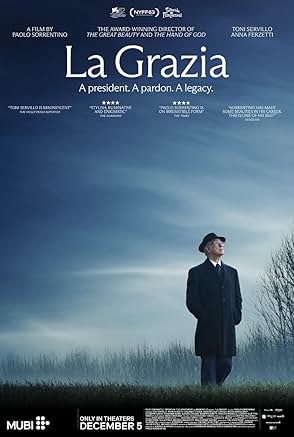

In “La Grazia” (2025), fictional Italian President Mariano De Santis (Toni Servillo) says, “Behind the cultured and serious appearance, I have but one goal: love.” He spends his last six months in office missing his wife, who died eight years ago, obsessing about the identity of his wife’s affair partner, listening to EDM, smoking cigarettes, trying to evade dietary restrictions, and avoiding making decisions about whether to pardon two murderers and/or sign a controversial euthanasia law. If I had known that Paolo Sorrentino had directed it, I probably would have skipped it because I was not a fan of the gorgeous, but superficial “Parthenope” (2025). Maybe it is just something lost in translation as an American watching an Italian film. Come for the ethical argument, stay for the fantasy of imagining life in the Quirinal Palace, the official residence of the President of the Italian Republic, when a jurist, not a showboat, occupies a high office.
Once a movie goer accepts that “La Grazia” is an all-forms-of-love-story about a man beloved for being cautious and thoughtful, it is easier to get into the rhythm of the film. Even sulky, Servillo is fascinating and makes De Santis into a human first, not a position. De Santis is facing his mortality, reflecting on the past and still capable of expanding his horizons to a degree. When he finally is ready to jump into action, he still reflects a sharp, swift mind, which makes it more frustrating when he delegates his requirements to others instead of drafting a proposed law himself to meet his exacting specifications. His indecisiveness reflects his reluctance to act unless certain.
The EDM contrasts with the pomp and circumstance of the office, the appearance of the men who occupy high positions and the speed of his decision making. It also reflects that De Santis is preparing for reentry into civilian life, which explains the thread involving an astronaut, Engineer Giordano (Fabrizio Bordignon), experiencing the full range of human emotions alone. In De Santis’ current life at the Quirinal Palace, every move, regardless of how casual, feels like a matter of state. Sorrentino’s visual style feels reminiscent of “Conclave” (2024). The forces of nature, specifically weather, takes people down a peg whether it is blowing a red carpet out of place or tossing off a hat while waiting in a reception line while the people try to appear untouched and composed while getting tossed around.
De Santis seems to strike the balance between life and pomp and still hangs out with his childhood friends, art critic Coco Valori (Milvia Marigliano) or Ugo Romani (Massimo Venturiello), the Minister of Justice, whom De Santis treats like a frenemy in part because of his ambition to become his successor and a baseless suspicion. He works with his daughter, Dorotea (Anna Ferzetti), who is practically his right hand and in charge of the major tasks. Sorrentino composes scenes where there could be more people in the room, but he only focuses on the relevant players so when someone finally pops up, it is hilarious (if it was horror, it would be a jump scare).
Dorotea is likely the second person who appears the most onscreen after Servillo, so it is shocking when De Santis says that he does not know his daughter. With seemingly no personal life, she becomes his foil but is more devoted to work than he is. The way that father and daughter individually visit their respective pardon candidate becomes a case study in their differing personalities. Dorotea’s visit with Isa Rocca (Linda Messerklinger) becomes a passion off with Dorotea found wanting for being an intellectual and not fully participating in the madness of love.
De Santis’ brush with death When De Santis’ horse, Elvis, collapses and dies. De Santis explains, “Today, I happened to see the truth up close. The law always shows it from a distance.” Instead of making decisions in a vacuum, there is an effort to infuse judgment with the fabric of life, which is an important quality in drafting and enforcing laws. Similarly Messerklinger’s defiant performance throws this world off its axis for the moviegoer and Dorotea. Father and daughter are startled from the routine and enter the real, feeling world. Hopefully, it is done in a different way in the real world because those unfamiliar with the law may be concerned that “La Grazia” is accurate, especially considering how the two determine a character’s positive qualities. The resulting decisions seem random and only correlate with the intensity of the murderers’ love but are actually granted based on who made the request, not the worthiness of the requestor, so it parallels the President as a Godlike figure, who communes with the Pope (Rufin Doh Zeyenouin) as if he is his parish priest. They are Jesus figures with the cross of public scrutiny and demands.
“Beauty of doubt” is how De Santis describes grace. Of course, let’s not forget the meaning of the title, “La Grazia,” which means grace, elegance, mercy, a divine blessing or favor, or pardon. It is how Sorrentino ties together the multiple themes in the story, which includes the simple, elemental elegance of the President’s appearance, which reaches back into the past as monochromatic compared to his wife and reaches into the future as a possible love interest with a younger woman, the editor of Italian Vogue (Alexandra Gottschlich). He also describes his relationship with a hated colleague, Secretary Domenico Samaritano (Roberto Zibetti, who looks like Mads Mikkelsen’s baby bro) as elegant because their animosity was not out in the open. By conflating euthanasia with murder, Sorrentino does a disservice to the globally much maligned and taboo practice. The murderers describe their crime as if it is euthanasia when it is more like reactive abuse if viewed in the most merciful light. A filmmaker such as Pedro Almodóvar could probably pull off the hat trick in a more scandalous way, but Sorrentino’s measured and deliberate style undercuts the whims of humanity’s emotions and affairs of the heart.
There are a few scenes that were obviously meaningful, but the true significance was elusive to a non-Italian who does not know how things normally operate. He is at a dinner with the Alpini veterans, and they sing a song, but it was unclear if they normally sing it, or they were singing it to him. Then he sings a solo verse to them, which makes it seem as if they were singing to him. A cursory search suggests that instead of singing about the glory days, they sing about the cruelties of war. Later when he visits La Scala, an opera house in Milan, he gets a standing ovation, and one audience member shouts an approving cheer. Obviously, it signals approval but is it for him and/or the office? During the movie, he starts getting into Gue Pequeno’s rap music, and later possibly gives the Italian Medal for Culture and Art, but it is never shown. In the US, it is not unusual for popular artists to get high honors. Is that unusual in Italy? Is that rapper actually popular or not? The robot dog law enforcement sentry was so odd, especially because it made the mechanical equivalent sound of a horse. Do they use those robots in Italy or was it a sci-fi moment?
I loved the end of “La Grazia” when Sorrentino finally shows De Santis in quotidian surroundings. Why is he so good at endings? Does he ever make movies that are not at people’s high points and are more ordinary? Overall, the film seemed like a positive, functional reprise to “The Shrouds” (2025) proving that you can be stuck in the past and move forward.