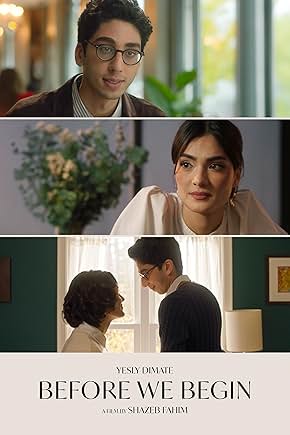

Set in Boston, “Before We Begin” (2024) follows Olivia (Yesly Dimate), an abstract collagist, who is experiencing a contemplative, quiet, quarterlife crisis. Contemplating moving to Manhattan with her roommate, Izzy (Jamie Eddy), she still feels like staying, and one factor is meeting Phillip (writer and director Shazeb Fahim), a PhD student described as “peculiar.” Like Olivia, he lives in his own world. With everyone engaging and finding their life path, Olivia feels as if she needs to be decisive. What is Olivia’s next step? Fahim’s second feature film after the unavailable, unlisted “First Fall” (2021) is “Girls” if every character was responsible and driven with old-fashioned sensibilities, i.e. nerds.
It is hard to convey an interior life, especially for reserved characters. If “Before We Begin” has a problem, the characters are underwritten, which is somewhat understandable because the premise of the film is that they are at a stage in their life when they do not know who they are, what they want to do, how they want to do it, where they want to live and why they cannot decide the next step. Though jobs, family and more are referenced in their exchanges, every character lives in a vacuum except in relation to their friends. Ever the New Yorker, I often found myself wondering how a collagist could live in the South End and move to Manhattan on a whim. Though all the characters are instantly recognizable, there is not a lot to hold on to. This is not the lived in Boston. Shoot this film now, it would unfold in the Seaport area. These are transient people whose ties to each other are well intentioned but temporal, which is a realistic issue to temporary, privileged residents in Massachusetts, which adds to the feeling of being unsettled. No local will speak to them until they are certain that they are committed to the area, and they do not even know about another side of Boston that existed before gentrification.
In her first feature film, Dimate is reminiscent of a delicate Mariska Hargitay type and is affable. Fahim often shows Olivia alone reading in bed or on the couch, standing over her beloved table working on her collages or having tete a tetes with people, but the conversations gradually feel less meaningful as “Before We Begin” unfolds. Her most sincere relationship appears to be with Madeleine (Monica Giordano), who is a writer from DC, Madeleine is also considering moving to the Big Apple. They are each other’s fiercest fans and probably have the most chemistry. Fahim occasionally shoots Giordano alone staring at her printed draft of her latest work. There is one heartfelt scene between the friends that feels as if the actors were not in the same room. The editing just cuts back and forth between them like a tennis match where the swivel broke on the tripod. Meanwhile Izzy is intense with a strong personality. Olivia allows herself to be swept away until she is willing to face what she really wants: keeping her worktable. Eddy brings the most energy to her character and feels tangible, which correlates with the stage of her character’s life. Izzy knows exactly what she wants and has mistaken Olivia as being likeminded when she is simply seeing her reflection in her. It is an underexplored idea.
Fahim remains a supporting character. As Olivia and Phillip’s relationship develops, it still seems incremental and lacks chemistry, but not for lack of trying. When Fahim shoots characters, he favors using montages of their well-placed belongings, and Phillip is no different except it is more puzzling because he lives with his family. While a person’s cultural, ethnic, religious and economic background can be irrelevant, the dialogue suggests that his family is integral to his life and still has expectations of how he should participate with his home life. Someone is not just peculiar for wearing odd colored socks. He is out of step with his time in the way that he chooses to live his life, and it is a choice, not financial, since he also has access to an international life at his fingertips. If Fahim as a writer thought of people as more than just two acquaintances meeting for a few seconds, but considered the rhythm to each life besides work, the story would be more substantive. Some people are solitary, but Phillip is not, and “Before We Begin” does not reflect it.
Because Fahim does have a soul, “Before We Begin” is not shot in the Seaport, but predominantly in the South End, especially the Boston Public Library. Fahim understands the golden hour, and cinematographer Gabriel Carnick makes every scene, whether interior or exterior, feel warm and romantic. There is no better place in the world besides Massachusetts in the fall. The nighttime scenes are perfectly lit. While it is not glossy and commercial like a tourist video, show anyone this film, and it makes sense that Olivia does not want to leave. No one would.
The editing can be puzzling because one minute, the couple are inside, a sliver of walking is inserted then back to the apartment. Why? If all the walking scenes were taken out of order and put in a film, would the viewer see a progression in the character arc? See “The Baltimorons” (2025), and the answer would be yes. For all the nerds, Fahim needs to find a way to depict the dynamism of an interior life for characters who are only a mess on the inside. Composer Grace-Mary Burega’s elemental, understated score is sweet and plaintive, but in the last half hour, there is a scene when it gets mournful before Olivia goes outside, and it is plucky for a few seconds before resuming its usual refrain. Again, the mood is not sustainable. These are not flaws that originate with the editor Junaid Khan or Burega, but Fahim’s story.
Without the romance angle, which I was actually rooting for going in, “Before We Begin” is really a story about an artist who believes that if she gets the spot in the big show, it will mean something, and the relationships are just time fillers. If Fahim was more ruthless about her laid-back ambition, the movie may have worked better. Side note: I do not know anything about collage work but was it the best? When Olivia talks about her work, Fahim does not let the viewer hear it, and this omission is the biggest mistake. Visual artists choose a specific medium because they do not feel that way about words but just showing and not telling did not help understand the progression in her work, why she felt strongly about considering that particular example as her piece de resistance. It felt indistinguishable from all the other work that she did.
See “Before We Begin” if you are interested in the coming-of-age story of the temporary Massachusetts resident who uses the area as a way station for their next destination, but be gentle and lower your expectations because Fahim is still growing and needs to work on his storytelling. Then see “Peter Hujar’s Day” (2025) to see how artists used to live and ask yourself how that would translate to today.