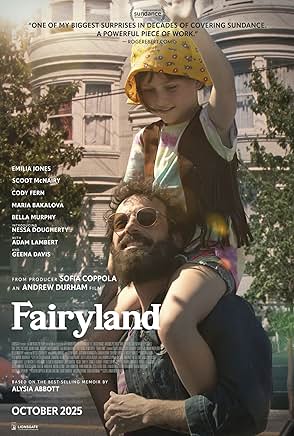

“Fairyland” (2025) adapts Alysia Abbott’s memoir, “Fairyland: A Memoir of My Father.” Alysia’s mom, Barbara, died on August 28, 1973, and her dad, poet Steve, died on December 2, 1992. The movie starts in the Midwest 1974 and ends in San Francisco, where the father and daughter moved. Actor, aka professional chameleon Scoot McNairy plays Steve, and two actors play the author: Nessa Doughtery as a child and Emilia Jones as a teen to an adult. Alysia’s story is about the ups and downs of living with her father and her ability to move in and out of queer to heteronormative spaces as a cis girl and woman. The poignant film loses momentum in the middle, but a life story is not meant to follow the traditional beats of a fictional story.
I do not remember what put “Fairyland” on my radar, but I try to know as little as possible about a movie before watching it. My dumb ass was surprised that it took place in San Francisco, and Steve was gay. Seriously, sometimes you grow up not making any assumptions based on the obvious that you miss anything that lacks subtlety. Duh. My bad. Writer and director Andrew Durham in his feature film debut is off to a terrific start. A lot of filmmakers lay it on too thick when filming a period film, and this film feels lived in, not precious or engineered to push buttons. I was alive on the other coast in Manhattan, and it was like this. He really nails making the audience see young Alysia in her environment like a kid would. A hand changing the station knob on a car radio fills the screen. The camera looks up a lot or looks down if something is lower than usual like a mattress on the floor.
Durham also makes San Francisco into a separate character, and little details reflect how the neighborhood is changing. Initially it is a paradise for queer people, but as the tide begins to turn in the nation, the world becomes a little less safe for Alysia. Fewer gay men mean more straight ones, and suddenly adult Alysia is not safe walking home. The graffiti turns homophobic. Queer people are only the canary in the coal mine. When queer people disappear, everyone is not safe, and straight white women like Alysia are next on the menu.
In the interest of full disclosure, my mom was an all too strict, straight arrow, who brought me up fundamentalist, but I was also a latch key kid who loved it. Abbott’s story and Durham nail the emotional reality of the normal world of independence and the resentment when a parent wants to revert to a traditional model where a child spends more time with the parent, and it is the parent who demands more care than was available to the child in their formative years. In Alysia’s case, she lashes out with embarrassment and dabbling in homophobia, which was a horrific betrayal to watch but was a really brave thing to reveal. Her dad’s latest lover, Charlie (Adam Lambert), calls her on her crap, and if her father failed, it is his refusal to parent. Before that moment, when she confronts him with his deficiencies, he threatens to kick her out. Because he has a tragic end, he never becomes accountable, and she must parent him because the alternative would be cruel even though she has a right to express herself without worrying about his feelings. There is more room for homophobia then an airing of true grievances.
McNairy and Durham treat Steve like a human being, and in the wrong hands, he could be a villain. There is always going to be leeway for someone whom society abuses and stifles because Steve never had a chance to be an adolescent at the appropriate time, so the delayed development renders him into being a bad father. Durham also shows without judgment all the ways that Steve fails, and Alysia is really lucky that he belonged to a queer community because if he was not, she would have been more at risk of getting on the radar of a pedophile. Because Steve does not understand anything about the risks that girls and women face, he is clueless when a concerned woman (Colleen Ann Bowling) upbraids him for his negligence. From Alysia to strangers, accusations of neglect roll off Steve’s back, but they are fair.
Similarly, Alysia has the option of passing in a clueless heteronormative world thanks to her maternal grandmother, Munca (Geena Davis), who lives a normal middle-class existence, but Steve is so poor that JC Penney’s sounds like high fashion to Alysia. If you are worried that “Fairyland” is suddenly going to become a cheesy courtroom custody drama, don’t. Abbott is better than that. Think bargain basement “Gilmore Girls.” With her high school friends, she dabbles in the exercise as an edgy girl, and in a college study abroad year, she does drag as a normal French girl. Again, does she deserve to rebel in her own way and do what she wants instead of taking care of her father? Sure. In the reverse, he would not have let Alysia drag him away from a Theo (Ben Attal), but this care is a last stand, and he has more lessons to teach her before she can graduate to adulthood.
For all of Alysia’s maturity, she does not understand some basic truths, and these are the best father-daughter moments where McNairy and Jones’ chemistry shines. When Alysia is understandably angry after a book reading, Steve teaches her a valuable truth about what a writer does that has obviously influenced her for a lifetime. Alysia is walking home with Steve after he visited a friend in hospice, and she just suggests that this friend should go to Paris. Even though the world of AIDs is encroaching all around her, and she knows it, she still does not understand death, so Steve must teach her that death rules out things like trips to Paris or pursuing career goals. Then Alysia is confident of a cure coming, and he explains the relationship between American politics and scientific advancement. If you were not around for the AIDS pandemic, and you are not one of those people willfully forgetting the COVID pandemic, most leaders do not care if certain people live or die. These moments make the movie feel urgent and timely since soon, more preventable deaths will occur because people no longer believe in science. It is as if the new political slogan is “Make Baby Graves Great Again.”
Also Maria Bakalova only appears a handful of times in “Fairyland,” and she owns the scenes. Bakalova is such a good actor. She literally sets the tone and pace of the movie and sets it up for success. This movie is so good but probably will not speak to people who cannot relate to the characters. Will normies get it? We are in a time when there is lack of empathy from people in the mainstream, but I hope so.