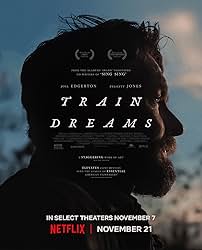

“Train Dreams” (2025) adapts Denis Johnson’s 2011 novella and what try-hard “The Life of Chuck” (2024) failed to do. Only artsy fartsy film lovers who see it on the big screen will appreciate the latest film from director and cowriter Clint Bentley and cowriter Greg Kwedar, part of the filmmaking team that made “Sing Sing” (2023). Everyone else will fall asleep on their couches at home if they wait to stream it. The film chronicles the life of Robert Grainier (Joel Edgerton), a person who was born in the late nineteenth century and lived and worked in the Pacific Northwest logging and building railroads. Will Patton narrates.
Edgerton is a fine actor who has always been attracted to challenging roles of men who are more sensitive than expected, but still culpable for the sins of their time. Robert is one such man. He chooses to live in a forest near Bonners Ferry, Idaho, but when he works, he leaves to cut down the forests that he loves. “Train Dreams” has almost no dialogue, and when there is, Robert is rarely uttering it. Not many actors could be quiet or alone for most of a film and still be captivating without being a showboat, but Edgerton fits the bill. He plays an ordinary every man who is also a unique, gentle soul who has a front seat to the birth of modernism and every personal tragedy that an individual can experience.
Editor Parker Laramie stitches together a montage of scenes that are part memories, part subconscious, the ingredients of Robert’s dreams. When “Train Dreams” begins, the context of these images is not obvious, and as the film unfolds, images repeat and reveal additional details or change over time like the area where Robert lives and works. There is a sense of time passing, but at a variable rate until it is positively barreling to the end. There are constant references to a time before human beings even populated the area, and how witnessing that change makes people think it is the end of the world, but in the geological scheme of things, it is the blink of an eye, nothing, and a new beginning. People try to superimpose a story regarding the lesson of why bad things happen to people or the meaning of life, but that deeper meaning is always elusive and out of reach, intangible and unable to articulate. It is kind of like this movie. It can be felt.
One line says something to the gist of a tree being a friend until it is being cut, then it is war. It would be easy to mistake “Train Dreams” for being a movie with an environmental message, but it is also in awe of what man can accomplish while acknowledging that the impact of man’s actions can be harmful. For instance, regardless of the quality of the connection between Robert and others, it is always transient. The film often feels like a silent, somber ghost story where it is impossible to tell the difference between the living and the dead.
“Train Dreams” is lyrical. Movie lovers will only see the bits that were important to Robert, not the logistical details, but it is a world after the fall. The scenes between Robert and his wife, Gladys (Felicity Jones), are shot like an American Adam and Eve with no one else around when they become committed to them. Their courtship is like a bucolic Mozart’s “The Magic Flute.” When they talk about a marriage ceremony, it is not shown. For once, Clifton Collins Jr. is recognizable in a blink and miss it scene with a teenage Robert discovering Collins’ character dying and granting him a final mercy. Fu Sheng (Alfred Hsing) is in perfect harmony as Robert’s sawing partner. Arn Peeples (William H. Macy), the explosives expert, is an old timer on the crew who is a sneak preview on who Robert and all the loggers will become if they continue this work. Macy makes him into a sage who realizes that endless consumption is impossible, and one confident listener who scoffs at his cautionary words, the younger man looks stricken as if he already knows the truth of Arn’s words. There is the concept of knowing things even if you do not know things. Robert never knew his family, but in his first time in a plane, it seems as if there is a flash of his mother’s arms around him. That young man also has a deep knowing, and “Train Dreams” suggests a connection between all living things that go beyond conscious, waking life. Billy (John Diehl) asks Robert about a mutual working acquaintance and instead of telling him bad news, Robert lies about not knowing so he does not feel survivor’s guilt as if he was killing him again.
Ignatius Jack (Nathaniel Arcand), a kindly indigenous shop owner, befriends Robert. Claire Thompson (Kerry Condon) in lesser hands would become someone’s love interest, but she is a kindred spirit also reckoning with outlasting others. After awhile, outliving people feels like a curse not an undeserved blessing. “Train Dreams” also has some humorous moments such as when Apostle Frank (Paul Schneider) drones incessantly regardless of how much time has passed, or Arn singing, considering stopping so others can sleep, then doubles down when he busts out a harmonica, with every move delighting Robert. Music was rare and special in those days, not widely available at everyone’s fingertips.
Some adaptation details get lost in translation. I have not read the book, but it seems like Wolf Boy (Cisco Keanu Reyes) actually had deeper significance, which only gets the curiosity treatment in the film. Also “Train Dreams” makes Robert more innocent than he is in the book. The movie instills a progressive racial sensibility into Robert that is diffuse through the era’s depiction, which seemed unrealistic, but also was surprising. Chinese people’s treatment becomes the dominant marker of a society’s civic health, and it is impossible not to draw parallels with the present day though the initial scene when a young Robert sees people carried away passes so quickly that like Robert, it is hard to register. When man lands on the moon, it becomes a society where an Asian woman can exist unmolested and appreciate the sight without fear. Spoiler alert: if you took the temperature of our society around and after 2020, the scenes would have more in common with Robert’s pre-media age era than the Sixties.
“Train Dreams” feels like the kind of movie that needs repeat viewings to fully register its elegiac beauty. “Nickel Boys” (2024) is superior so if you enjoyed that movie but are looking for a more digestible film, definitely catch it during its limited two-week theatrical engagement. As life on Earth begins to die, starting with specific species and expanding to the ocean, films like these feel like necessary memorials for anyone who survives to understand what it was like and how it was possible to know and not know about the fire next time. We kill what we love and need thinking it will give us more of what we love and need.