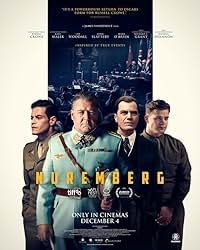

“Nuremberg” (2025) adapts Jack El-Hai’s 2013 book, “The Nazi and the Psychiatrist.” Rami Malek plays Dr. Douglas Kelley, who wrote “22 Cells in Nuremberg” after his experience serving in the US Army Medical Corps in World War II. Assigned to ensure that none of the Nazi High Command prisoners commit suicide, Dr. Kelley must earn their trust starting with Hermann Göring (Russell Crowe). Meanwhile Supreme Court Justice Robert H. Jackson (Michael Shannon) is determined to put them on trial instead of just executing them to prevent the resurgence of Nazism. Did they succeed? You decide. Writer and director James Vanderbilt uses the film to warn moviegoers that what happened in Germany could happen anywhere even in the US.
If “Nuremberg” has a flaw, it does not make it abundantly clear whether these men, especially Kelley, were actually good at their jobs before accepting their assignments and the toll of dealing with the Holocaust’s atrocities wore them down, or they were always off, but just had enough chutzpah to believe that they could pull it off. The central relationship is between Göring and Kelley with Jackson in more of a supporting role. Kelley comes off as dumb, especially when he writes in his notes that a prisoner reached out to him because the prisoner literally reached out and touched him. Göring seems to be playing him, and hopefully it is a Hollywood embellishment, but Kelley starts showing him magic tricks that aid Göring in the long run.
Malek is a dynamic, interesting actor, but his take on a hot shot, overconfident doctor who becomes shaken with the enormity of evil was neither a smooth transition nor convincing. It felt heavy handed. My thumb is on the scale because of my unconditional love for Crowe. I’m just happy to see that he is not in a stinker even though his accent work is always less than convincing. Crowe humanizes a horrible man, which hopefully does not have unintended consequences. His take on Göring seems like a man with a lot of jobs: keeping in contact with his family, keeping up morale for himself and his colleagues and trying to get the upper hand to use the tools at his disposal, which includes his psychiatrists. Even his struggle pushups can elicit sympathy. As someone who studied this era, Nazis filming other Nazis do not make themselves look this good while it is a movie’s job to show how Kelley saw his patient, maybe it is not great to get the truth from an unreliable narrator who could be a screwup. Also, someone check on Crowe because there are a lot of fat digs directed at Göring, but it is in reference to Crowe’s body so just make sure he is alright. Other Nazi figures such as Julius Streicher (Dieter Riesle), Karl Dönitz (Peter Jordan), Robert Ley (Tom Keune) and Rudolf Hess (Andreas Pietschmann) are tangentially focused on less favorably, but not given as much airtime as Göring because he was the highest ranking Nazi official at that time.
Of note in the battle over Kelley’s soul is Leo Woodall’s performance as Sergeant Howie Triest, a real historical figure who acted as a German translator. Surrounded by so many big-name actors, Kelley looks like a forgettable extra, but before he gets a big monologue, his physicality and line delivery was attention grabbing in an understated way. Other than Göring, Howie is the only character who gets to talk about his family. Every character exists in a vacuum as if their job is their life, even if the film introduces a character in their home.
If “Nuremberg” is deft at something, it is giving supporting roles more heft than the starring ones. Howie became more interesting than Kelley. If it was Vanderbilt’s intention to deliberately make the central characters flawed and the supporting characters closer to perfection, then he succeeded. There is no question that Kelley will toss over his professional ethics for fame and fortune, but would he do it to serve his country? The suspense is supposed to be there but considering he never seemed too ethical before anything happened, it does not seem like a heavy lift. When Dr. Gustave Gilbert (Colin Hanks) comes on the scene, he appears as a rival which may be a dramatization since they both shared the same assessment of Hess’ condition and Gilbert also worked on the inkblot tests.
The courtroom drama loses momentum since it functions like a classroom to the audience to show archival footage of concentration camps and teach moviegoers about the Holocaust. If “Nuremberg” has value, it is this impulse to educate, which makes the movie longer, but never boring. It is surprisingly funny at times. Shannon plays Jackson as a laconic man with a dry wit, and he seems competent in the way that he battles wits with the Catholic Church, but after that, he is mostly exposition man wearing a snazzy suit. That exposition is useful and makes the historical events seem more germane today, especially emphasizing how the Nazis othered German citizens who were Jewish by no longer considering them as citizens and using “emigration” as double speak for extermination. Messing with someone’s legal residency is a prerequisite to state violence. International law is still largely more of a concept than a bedrock field consisting of legal principles. The contention that the Nuremberg Laws are the foundation of the Holocaust is a sound one, but the film omits that the Nazis got many of their ideas from the US. A lot of Göring’s allegations of US hypocrisy was not exactly off the mark. When it suited the US, the US government gave sanctuary to German and Japanese war criminals.
Once it is time to boogie, Richard E. Grant’s David Maxwell Fyfe, who fancies taking his brandy in teacups, steals the show, which thank God because it would have been criminal to have Grant just drinking an entire movie. John Slattery’s put upon Colonel Burton Curtis Andrus Sr. is another scene stealer who gets a lot of laughs over dealing with professionals who act like children.
Visually “Nuremberg” is surprisingly creative in the way that it depicts historical events. During the courtroom scenes, it shifts to black and white as if we are seeing actual footage and recreates some archival footage. The danger of making those filmmaking choices is that it makes it harder to distinguish from actual historical footage of the camp and lends credence to Göring’s claim that it can be faked. Also a fellow critic noticed that the film omitted footage from Auschwitz, which is arguably the most impactful. On a lighter note, Hess’ capture is depicted as an old Technicolor silent film and provides comedic relief.
If prior films about the Nuremberg trials are still at the forefront of your mind, “Nuremberg” will probably not be your cup of tea, but if one person watches this movie and walks away knowing more about the dangers of Nazis, fascism and dehumanizing fellow citizens to manipulate the masses, then it is a net positive. While it is more entertaining than edifying or artistically rigorous, whatever makes the medicine go down.