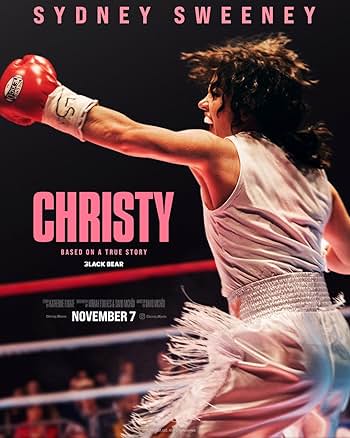

“Christy” (2025) is a sports biopic about professional boxer Christy Martin born as Christine Renea Salters and known as the Coal Miner’s Daughter. Sydney Sweeney plays the titular character. The story predominantly focuses on how her birth family and husband/trainer exercised coercive control over Christy to benefit from her talent and money while disempowering her. While Martin’s story is inherently riveting, the sluggish run time makes it challenging to stay invested for the entire two hours fifteen minutes. If you are interested in learning more about the signs of abuse before they reach the point of no return, then this movie is for you, but if you are looking for a movie that conveys the excitement of the ring, keep it moving.
For all you pervs, Sweeney does not whip a tit out. Christy was a closeted lesbian, and Sweeney is styled to look like a lesbian boxer trying to appear femme and heterosexual. If no boobs is a dealbreaker, then read no further. Sweeney’s physicality as a boxer was lacking. She is never convincing as a world class athlete and pioneer although she is better in the earlier scenes when she is a scrappy fighter learning the rules. She does convey a determined pugnaciousness and youthful vivaciousness that makes up for her lack of skill. Once Christy is supposed to be more skilled, the recreated fights do not reflect that Christy is the clear champion. “Christy” does not carry the same thrills as a typical sports movie, and it seems as if it wanted to. The scenes of backroom dealings with Don King (Chad L. Coleman) were as close as it gets to exciting. Sweeney occupies the broad emotional beats well, especially when smack talking her opponents, but fails at creating a bridge between the highs and lows. Her depiction of the titular character needed to reflect the internal conflict with the mask that the fighter presented the world, but Sweeney never hits those nuanced notes. She did better work in “Eden” (2025). She is at her best when she plays Christy being herself.
Christy is a persecuted character with no one in her corner. “Christy” does convey why it was so instinctual for Christy to conform, work with then marry an abuser, Jim Martin (Ben Foster). Though Christy is a champion, people react with chilliness or hostility instead of celebrating her accomplishments. “Christy” depicts Christy’s first girlfriend, Rosie (Jess Gabor), as someone who prioritizes relenting to pressure than celebrating her girlfriend’s accomplishments. Joyce (Merritt Wever), Christy’s mother, uses the victory as a perfect time to threaten her daughter with gay conversion therapy, which has since been debunked as not a form of therapeutic treatment, but abusive and harmful. Her only cheerleader is her brother, Randy (Coleman Pedigo).
Foster is unrecognizable as Martin and completely transforms. Martin becomes a symbol of everything that Christy wants out of life: acceptance from her family and professional success. By now, most consumers of popular culture are aware that when a talented woman in any profession comes along, some older man with a few professional credentials to disguise his gold-digging ways secures the bag, marries and manages the woman, and it becomes challenging to leave because of the enmeshment of professional and personal lives. Martin starts with controlling her appearance, monitoring her every move and communication, and threatening her. He then isolates her from people that he normally deems acceptable. In bad cases, there is physical and sexual abuse. The film makes strong inferences regarding what happened, but it is not explicitly shown on screen.
“Christy” is like “Lovelace” (2013) in the way that it captures how punishing normal consensual sexuality makes women vulnerable and unable to protect themselves when the predator is someone whom society deems as acceptable as a husband. Wever, a fan favorite from “The Walking Dead,” plays Joyce as a softspoken, withholding, judgmental, exploitive, domineering figure who had lower numbers of being right than the broken clock rule. Every second that Wever appears on the screen screams jealous, cold op. Joyce is definitely part of the one percent, and she is a textbook example of how women cape for patriarchy. Christy’s instincts repel her from Martin at first sight, but Joyce constantly grooms Christy into distrusting herself. Ethan Embry as Johnny Salters, Christy’s dad and Joyce’s husband, does not get an active role thus the movie lets the real-life figure get off easy and not as a villain who allowed an adult, i.e. his wife, to abuse his child instead of protecting her. Any man who lets a child bear the brunt of battles that he is unwilling to fight deserves no sympathy, but Johnny may just get some with Embry’s pained faces and silent horror constantly projecting on his face, which makes him sympathetic. Still note that Johnny is never depicted as rebuking his wife. He is complicit.
Like her mother, Christy becomes a willing enforcer of patriarchy and heteronormativity in the public eye. By openly deriding her opponents as lesbians and ridiculing their looks, she was just imitating everyone who bullied her. She is not allowed to have women friends because of her sexual orientation, but gradually Martin becomes paranoid about her hanging out with men too despite knowing her sexual orientation because power hungry abusers can never be satisfied. It always escalates. If “Christy” has a drawback, it does not spend enough time establishing the characteristics and dynamics within the training team except for Jeff (Bryan Hibbard). If these relationships were more solid, their role in the denouement would be more resounding, but the collective consoling feels like potentially another mistake.
“Christy” comes alive when Katy O’Brian appears as Christy’s competition and future wife, Lisa Holewyne. From television series like “Black Lightning” to the much lauded “Love Lies Bleeding” where she plays the spirit of She-Hulk, O’Brian never gives a bad performance, and if merit ruled the world, O’Brian would be a household name. Because she seems like such an effortless athletic physical presence, it strained disbelief that Christy could beat Lisa since Sweeney seems labored in comparison. Even though O’Brian plays a pivotal role, it is a small one, but she makes a meal out of a morsel and becomes the much-needed moral center of the movie showing Christy that the world is not as bad as the corner that Christy occupies.
“Christy” feels like a television movie. Director and cowriter David Michôd’s best work was “Animal Kingdom” (2010), and this film only reflects that unflinching psychological and physical violence in the final act. His period touches feel forced, not organic, with pleasing needle drops that signal the era, but never feel like music that Christy or anyone in her entourage would necessarily listen to. The fight scenes are not visceral or effective at conveying the skill required to work as a professional boxer. They seemed like amateurs.
“Christy” is a must-see movie for anyone interested in learning about coercive control, but it felt as if it depicted Christy’s exterior life more than her interior. To be fair, in the denouement, Christy says that she did not know who she was as a person so maybe the movie did its job. It inspired me to see “Untold: Deal with the Devil” (2021), a documentary. I may even read Martin’s memoir, “Fighting for Survival: My Journey Through Boxing Fame, Abuse, Murder, and Resurrection,” which she wrote with Ron Borges.