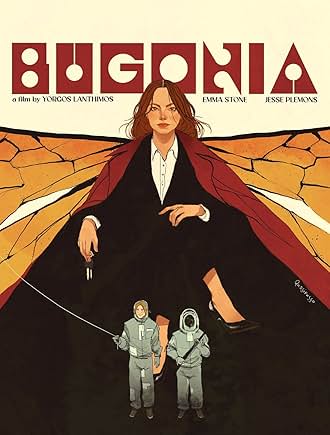

“Bugonia” (2025) is an English adaptation of a South Korean film, “Save the Green Planet!” (2003). Cousins Teddy (Jesse Plemons), an employee at an Auxolith fulfillment center (think Amazon) and a beekeeper or apiarist, and Don (Aidan Delbis) kidnap Auxolith CEO Michelle Fuller (Emma Stone), whom they believe is an Andromedan, i.e. an alien. They have three days until the lunar eclipse to get her to let them talk to the alien leader and negotiate a complete withdrawal of their species from Earth. It is a battle of wills with virtually no room for common ground or compromise. They live in completely different existences. Watching Yorgos Lanthimos’ latest film immediately after “Good Fortune” (2025) is a trip because of the similarities of the parallel montage of the haves versus have nots though they take different tone in their approaches.
Of course, bees are just one of many markers that forecast the health of the planet and the future. Teddy is worried about colony collapse disorder. He drones on endlessly to Don about his theories. Lanthimos succeeds in showing how the external world surrounding Teddy does not match the external. While his house is a lived in mess, the surrounding area is peaceful and beautiful, but he insulates himself from his peaceful surroundings by listening to crack pot podcasts while biking to work. The individual, private lives of others is a mystery, and in the case of the lonely, isolated and dangerous men, it is far too late for anyone to intervene. Teddy is sweaty, disheveled mess even when trying to impress, but somehow passes for normal in the outside world. At his employer’s lunchroom, images of Michelle surround him. A framed photo overlooks the area. An armchair psychologist can easily conclude that he got sick of looking at her self-satisfied, smug smile and wanted to take some power back. “We are not steering the ship they are.” Cue her face.
With a plot to kidnap a woman governor and the murder of a Minnesota state rep and her entire family, it is not a leap to associate this plot with political violence and sovereign state rhetoric. More recently, murdering women CEOs is on the rise, and there are not that many of them. There is a common saying: if you are ready to kill on the first day of the zombie apocalypse, there is something wrong with you. Teddy is broken, and it will surprise no one that Plemons disappears into the character without a trace. His performance is unbelievable, especially a scene where he transforms into pure rage and moves in animalistic, rapid fashion that barely resembles human behavior.
Michelle is the other side of the coin. There is a lot to admire about her drive and style. When she initially faces off against a masked Teddy, she kicks off her red bottom heels and goes on the attack. Michelle is fearless and determined. After she hears his demands, her reaction is quite relatable. They share the same language but derive completely different meanings from the same words . He seems delusional, and she sounds rational, but she also uses business school or corporate speak, which makes her manner of speech alien to most people.
“Secret Invasion” teased an interesting an idea. As women and people of color are entering spaces of power and hoping to change it, empire also changes and corrupts them. Working in an empire corrupts the holder of power to a degree, and Michelle behaves like a broken program: trying to make room for humanity in her business because it is the right thing to do but also wanting her business to be fine and considered first. It is double speak. Her only genuine emotion is not fear or a desperation to survive. It is a desire to beat Teddy and Don and for them to know and admit that she is superior to them. The benevolence gets her there, but it is not the motivation. She is unsympathetic because while Teddy may be mad, some part of his reptilian brain is right about her. She is a fancy talker who is good at spinning herself outside of culpability and cloaking herself in good intentions. She promises to be accountable to herself.
Stone and Lanthimos are good for each other. Once broken out of that commercial perfect packaging and love interest limitation, Stone has been relishing each chance to do something new and bold. There is a scene where she uses her sheer presence and body language to cow Teddy into submission. It is such a regal and indomitable move that even though she is wearing the worst dress in the world and is caked in antihistamine cream, she seems like a queen in the vein of a postmodern reimagining of the second coming of the first Queen Elizabeth without the red wig. For those of you who associate Stone and Lanthimos with nudity and gratuitous sex scenes, skip “Bugonia” because the story dispenses of even considering such a scenario before the three are in the same room together.
For Lanthimos, “Bugonia” is kind of predictable and palatable compared to the original. He took most of the weirdness, including implied sexual assault, out of the original and made it hew closer to reality to make a statement about our times. The CEO was a male character in the original. The ending is like the original, but for both films, if the ending was more ambiguous, it would have worked better because there is something avant-garde about having a whole cast of unlikeable characters and still want to see how it shakes out. The environmental and class divide message is more prominent, heavy-handed though topical. The title injects more Greek mythology into the story.
The title refers to a ritual where a dead animal’s carcass produces bees.; thus honey. A Biblical example is in Judges 14 when Samson kills a lion then he returns to the carcass later and finds honey in it. In the Greek myth, Aristaeus, the son of the god Apollo and the hunter Cyrene, chased the nymph Eurydice. While she was running, she stepped on a snake and died. One of her sisters punishes him and kills his bees. His mom tells him to capture Proteus, a shapeshifter, then ask him how to fix it, but would have to kidnap and confine Proteus to get answers and had to ignore all his physical changes. Proteus eventually revealed what Aristaeus did wrong and offered a solution. The bees would never get hurt again. It is a bit problematic to elevate a corporate CEO to godhood though being a Greek god is a capricious thing, not a sign of goodness. In many ways, it is another “Frankenstein” story with a culpable creator.
All things considered, the solution to saving the bees is provocative but also refreshing if you miss good old apocalypses amidst the plethora of dystopian societies onscreen and off. Maybe it is unfair to expect Lanthimos to scandalize his audience in every movie. Most directors, including David Cronenberg, change their style at some point in their career. The bookends of “Bugonia” portend Lanthimos’ next chapter. He is leaving filmmaking temporarily to photograph Greek landscapes. If the planet is really dying, it may be the best way to pass the time before the end, which makes the film more poignant. Maybe he is too tired to shock and trying to prepare us to say good bye.