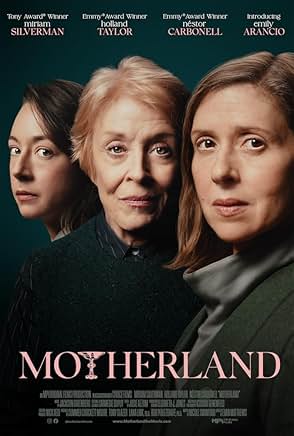

“Motherland” (2025) is a great character study of people in a fictional totalitarian society waking up to the injustice and inhumanity of their existence, but the framework of that system seems fragile and strains disbelief that it could have lasted for one hundred years. A century after the comprehensive theorem of Amma Kane, the leader of the revolution, has ruled the land, all marriage and parenthood created disparities have allegedly been eliminated. Parents are relieved from the burden of raising kids, who are raised at a children’s center. A zealous, strict, incorruptible rule enforcer in region 8, Cora (Miriam Silverman), surveils the children and reports her finding to the head of the center, Toni (Holland Taylor), to determine who gets on honor roll, which determines everyone’s placement as adults. The most ambitious girls are willing to do anything to get into the prestigious women’s department. A pilot program launches to increase population rates and shakes Cora’s faith in the system. More cracks are showing among the residents. She believes with enough research and proof, she can stop the madness because Kane’s society is based on merit and justice. Oh, sweet, summer child.
“Motherland” makes a meal out of a morsel. With the production team transforming a building into a children’s center with the benefit of a mural, some lighting with green and pink undertones, they evoke a broader world that the audience never sees. The nightly TV news broadcasts on tube televisions, and it is always a tube television, no technological advancement to see here, is the cherry on top of the world building. Director Evan Matthews in his feature debut pulls all the elements together. The actors breathe life into that world. Without Silverman’s performance, this movie would fail. She convincingly takes Cora on a journey from killjoy devotee to a woman crumbling at the realization that her life is a lie. Eagle eyed viewers will notice in the background that before her epiphany, others are deviating from their routine like the jittery Natasha (Molly Carden), and a nurse, Alice (Pearl Shin), demanding more access than assigned to her. Side note: it felt as if the character called Natasha was also called Wanda earlier in the film. The strain on the individuals begins to create shortfalls in the system.
At first, “Motherland” is framed as if the society exists to stop an inequitable system that puts the burden of child rearing on women. Guards ensure that boys do not encroach on girls’ spaces. The psychological burden of not being with the baby visibly outweighs that prior burden and requires pharmaceutical measures to ameliorate the effect of separation of child from the mother. Cora remembers that trauma and is horrified that the girls are eagerly signing up to meet quotas without understanding what it entails. Before people could choose to mate with each other, but it was not a pairing in the traditional sense. A pilot program uses anonymous artificial insemination. There is a scene between Cora and Mateo (Nestor Carbonell, who delivers yet another customary sensitive performance) that shows they clearly have a connection to each other, but they do not have the emotional intelligence and physical ease to comfort each other when they are processing negative news.
The strain of this program is reflected in a friend group of three girls, who end up competing for scarce resources: food, better clothes, ideal placement. The rule of fairness governs everything, but desire for more cannot be abolished. Zinnia (Emily Arancio) is an earnest striver looking to get extra points. Willa (Arica Himmel) resents being the only one punished for Zinnia’s mistake. Because Zinnia and Yvonne (Julia Blanchard) are in the pilot program together, they get closer and more benefits, which puts an additional wedge between the group with Willa closely monitoring them to report missteps.
The events that occur in “Motherland” strain credibility that this society can exist for one year forget a centennial. It would have been threatened every time someone gave birth. Everyone glitches like computers when they experience emotions that contradict the propaganda. It may remind some of the sci-fi film “Equilibrium” (2002) except without emotions being explicitly criminalized. The human emotion is there, but the totalitarian vibe intentionally exists in a world that seems apolitical with the only clue that it is to free women from the burden of assigned gender roles. Is this a reactionary movie that is suggesting that the drive for women’s equality could lead to a toxic matriarchy? Well, if it is, it is not clear cut. When Toni brown noses for a promotion, she says, “Sir.” While it is essential to prioritize the human story, the political foundation of this world needs to be developed. How did this world come into existence? The only misstep that writer Nicole Swinford commits in her first film is this gaping, nagging apolitical hole in a story that otherwise feels vaguely visceral.
In the real world, similar programs date back to ancient times and appear on both sides of the divide. In “Republic,” Plato argued for loyalty to the city, not the family, with the promotion of communal living, state-controlled breeding, i.e. eugenics, professional guardians of children and no assigned gender rules. In Sparta, boys were trained to be warriors and removed from families. The British Empire sent poor children or orphans away from their homes to live abroad. Indigenous boarding schools in Australia, Canada and the US did it with genocidal intent. After the Bolshevik Revolution, the socialist state wanted to alleviate the family burden of working parents, especially women, through communal, state institutions, but without eliminating family structures. Polygamous cults like Warren Jeffs’ community behaved similarly. The Nazis tried to pull it off with the Hitlerjugend and Lebensborn programs, but with the goal of instilling faith to ideology and the state, not to alleviate family burden. The Nazis were too busy being anti-Semitic and generally homicidal to stick the landing. Maoist China acted similarly but for leftist ideology. Israeli kibbutzin did it voluntarily so families still could meet each other at limited times. It is rumored that North Korea does it too.
As Toni, Taylor provides a sorely needed example of someone whom the system helped, why it endured and offers a credible reasonable counterbalance to Cora’s distress regarding why mothers and children are better separated to be free to determine their own path. “I have always lived free.” Toni’s reaction to Cora’s pushback reveals that spiritual mothers and daughters have similar problems as biological ones. This society’s main problem is the lack of choice, and that aspect could have been emphasized to keep it plausibly apolitical. Myrtle (Molly Hager), a sour woman who always seems like she is aggrieved, would have been perfect to elaborate on. She is not super invested in the system and just living her life. She does show some awe when exposed to a baby. Instead, it feels like unintentional bad timing possibly wringing its hands over the future that liberal, godless women want to force everyone to have. Or is it the opposite, a reactionary government recognizing that they had to sell women’s empowerment to enslave them and keep human beings from going extinct?
If your plate still has room for another dystopian society, then definitely check out “Motherland.” It convincingly creates a society that fails to live up to its professed ideals and logistics to serve the ambition of a mysterious few whose aims are left a mystery. The personal drama does not eliminate the desire for a stronger image of what is the true nature of this society.