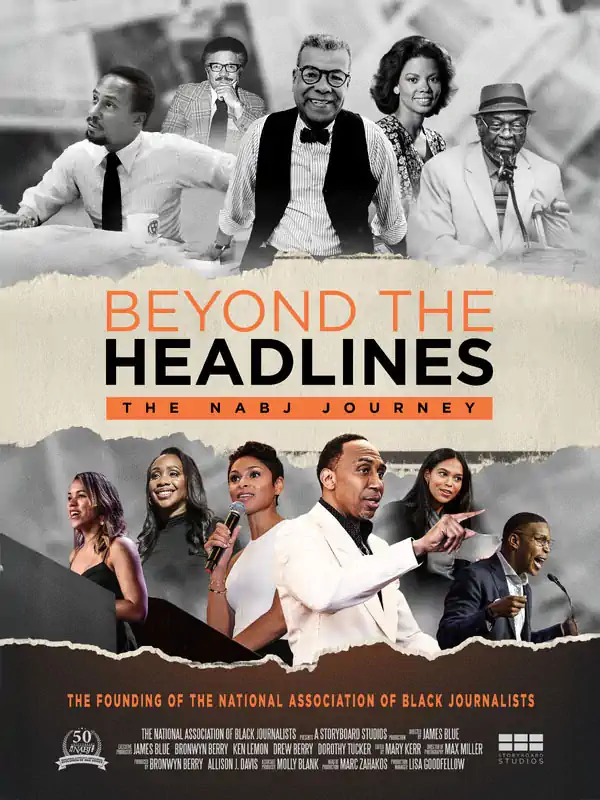

Short and sweet, the forty minute documentary, “Beyond The Headlines: The NABJ Journey” (2025) chronicles the origin and development of the National Association of Black Journalists. Starting in the Sixties when predominantly white newsrooms recognized that their lack of diversity hampered their ability to effectively understand and cover critical events, the film moves forward to the present day when NABJ is thriving despite journalism being in critical condition. Emmy award winning James Franklin Blue III, who is also a NABJ member, applies his over thirty years of experience to celebrate NABJ’s fiftieth year with a film as a gift to preserve its history. The film seems critical at a time when many private institutions are divesting from diversity and would like to ignore reality and the lessons of the past.
“Beyond The Headlines: The NABJ Journey” is roughly told in chronological order, but also thematic order once the founders are no longer the topic. Understandably the documentary prioritizes its members’ morale and the community over the impact to the broader public, which is what most viewers unfamiliar with NABJ are interested in. These values are what make the organization work. The documentary’s impact on outsiders who are trying to learn about the organization for the first time will be proportionate to whether their values align with the ethos of the association. Basically, NABJ is an oasis in a world that needs Black journalists while the industry simultaneously refuses to water that garden and resents them even when benefiting from their existence and work.
Blue’s membership has privileges which grants him exclusive access to members. “Beyond The Headlines: The NABJ Journey” mostly consists of exclusive interviews with living members. T he story of the founders is the main priority. The living founders include Norma Adams-Wade, Joe Davidson, DeWayne Wickham, Sandra Dawson Long Weaver, Sam Ford, Allison J. Davis, Sandra Dillard, and Claudia Polley. There is some humble quibbling about the definition of a founder in a behind-the-scenes gathering at the fiftieth conference. The interviews describe how it went from a literal definition to those who were the first generation assisting the leaders who started the organization in December 1975.
Archival footage of the original founders supplements the tales of the aforementioned interviewees who knew them. There are profiles of original founders: Max Robinson, Chuck Stone, Maureen Bunyon, Les Payne, Vernon Jarrett and Acel Moore. Better to leave viewers wanting more than overstaying their welcome, but it would have been terrific to get more extensive profiles on each founding member. While the documentary is supposed to focus on NABJ, there is an assumption that the audience already recognizes these amazing individuals. For example, while not a founder, there is an exclusive interview with Roland Martin and periodically the film includes photographs of him as a younger person attending the conference, but in the future, there will be people who will not recognize his name or face. More context about everyone’s work would make the documentary timeless.
The section titles do not entirely evoke the actual content. For example, a section about the 2024 student multimedia project starts with how it began. Members Walter Middlebrook and Sheila Brooks discuss how they developed the project with limited resources. Then a range of reporters who trained in that project discuss how it rises to the level of a journalism masters program in terms of experience squeezed into five days with clips of the 2024 class working. It then segues into a story that every American and perhaps every adult alive knows and proves that it is a crucial program for future reporters but every American.
While NABJ may not be a household acronym for ordinary folks not into journalism, you know of the group since the Seventies. During the conference, Presidential candidates sit on their stage. In 2024, they interviewed Presidon’t and Madam Vice President Kamala Harris. Excerpts from Presidon’t alone made international headlines, and Blue uses a montage of news clips to remind viewers of these iconic moments. The proof is in the pudding, and while the merit of this project and this group is undeniable, it deserved its own section title and perhaps should have appeared later in the documentary before the last act. While initially this event was controversial at that time, it exhibits a level of professionalism that is only the tip of an iceberg casually discussed of inhospitable conditions elsewhere. Every member of the NABJ is probably underplaying the indignities that they face as professionals.
The act titled “The Growth of NABJ” felt as if it would have slipped in perfectly before the student conference and presidential interviews, which drill down into the specifics of why younger people without established careers should join. This segment segues from emphasis on founders to members. Dorothy Tucker, who became president of NABJ from 2019 through 2023, describes using her father’s emergency credit card to register, and she obviously has no regrets. What distinguishes “Beyond The Headlines: The NABJ Journey” from an informercial or a glorified vanity project, which it is not, is the impact that the organization has with few resources. Stories like these remind the audience that attending a conference is an opportunity with a financial challenge to overcome. It requires time away from work. Gone are the days of carefree students following their bliss if they ever existed.
The chapter titled “21st Century Challenges” could be expanded into individual documentaries. The challenges are the Great Recession of 2009, which inadvertently feels quaint considering today’s economic realities, and the Covid-19 lockdown. One portion regarding NABJ exiting the UNITY: Journalists for Diversity was too curt for an acolyte to understand the status quo, how it was being changed and the pros and cons of NABJ deciding to impose standards on their membership that fellow associations were not demanding. Was the financing proposal unfair or seen as an act of charity? NABJ was not the only one who stepped in the direction of ultimately dissolving the organization in 2018. The National Lesbian and Gay Journalists Association and National Association of Hispanic Journalists soon followed. It is the only time that the film rushes to a fault. It may be that NABJ had the most members but did not get the most revenue from the conferences, so they decided to retract their energy and invest in themselves.
“Beyond The Headlines: The NABJ Journey” feels like it could be an “Eyes on the Prize” like documentary miniseries, but the audience would be so niche that it may not make practical sense. If “Sesame Street” cannot stay on PBS, who can survive in these broadcast streets? This documentary proves that the health of NABJ and its members is the canary in the coalmine of our nation’s health. If journalism and freedom of speech is thriving, then Black journalists will receive more support, but the suppression of free speech is not an accident. Underrepresented voices such as NABJ reporters hold the key to freedom of every citizen because they maintain the integrity of journalism and distinguish the profession from entertainment.