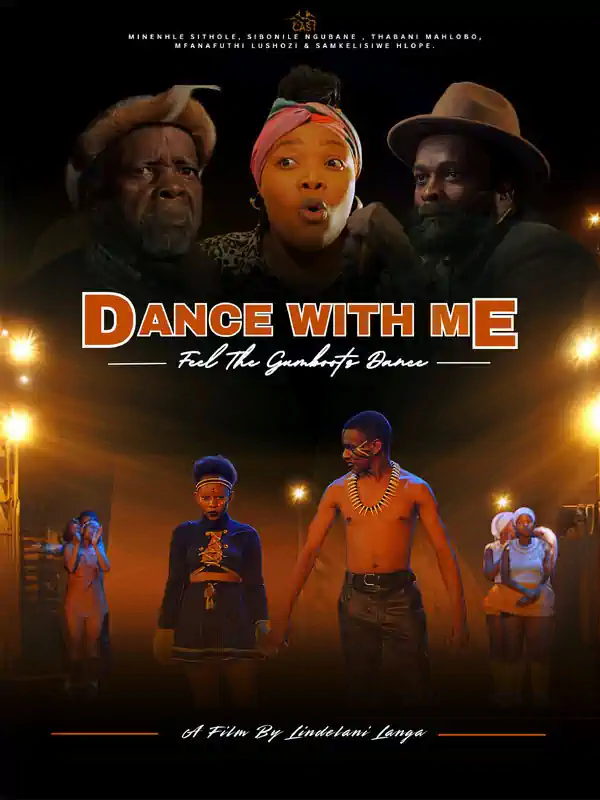

As fifteen-year-old Phindi (Minenhle Sithole) adjusts to living with her father, Mtungwa (Sibonile Ngubane), she decides to join the Glebelands, a gumboots group that competes in an annual dance competition for a grand prize needed to pay for repairs to the community center. There is only one problem: Phindi suffers from stage fright and does not want to be near boys, which includes her dance partner, Sifiso (Mfanafuthi Lushozi). Will Phindi be able to heal and thrive in her new environment? “Dance With Me” (2025) is a well-intentioned film that needed a few more revisions on the page before production started.
“Dance With Me” has a seventy-nine-minute runtime and needed to change the length of each act to properly showcase the characters and the ensemble cast’s talents. As it is, it felt as if it only consisted of two acts when three is the standard acceptable minimum. In the first hour, there is a lot of conflict, and the last half hour is about everything coming together. The first hour shows Phindi as mostly scared, withdrawn and sullen, which makes the characters keep her at arm’s length or completely put off. Their behavior makes sense to the audience because the characters lack the necessary context to react better, but the film takes too long to provide the information to the characters to move the story forward. Inexplicably everyone thinks that she is a talented dancer even though there is no proof shown on screen. There are brief flashbacks to show that she has PTSD and what she is reacting to, but it is not until the end of the first hour that the other characters understand. Hlengi (Minenhle Dladla) is the mean girl, queen bee, best dancer and tyrant, who is even rude to her grandfather, Mphathi (Thabani Mahlobo), who runs the center. The other dancers whisper that he is corrupt though that storyline evaporates.
“Dance With Me” needed to use the first half hour to establish the characters more. While everyone was attractive, there was no chemistry. Stories about survivors of sexual violence need to wait before jumping into romance, especially considering Phindi associated dance with rape. It is never explained why the mother, Thandi (Samkelisiwe Hlophe), needs the father to care for his daughter at the most traumatic period in their child’s life. What was the mother doing that Phindi could not be present for? Phindi does not resent her mom, so it seems like the unstated reason is sufficient. Best guess: lack of money. The father and daughter reconciliation storyline needed to be stronger in the first third with the mother confronting the father earlier instead of the last third so that later, when they are hanging out as a family, it makes more sense instead of sudden. Seeds of Mtungwa’s past glory should have appeared throughout his home so it would not feel as if it dropped out of nowhere. It may be cheesy, but it was aggravating not getting an explanation regarding the reason that he got injured and had a limp.
There also needed to be more proof that this dance crew was actually good, and that Hlengi was the best. Director Romanuse Lindelani Langa filming of the dance routines needed more consistency because when movies only show the feet without pulling back and revealing the whole body without editing, it subconsciously creates doubt whether the actor is dancing or has a body double. To extinguish such doubt, the best approach is the Fred Astaire-Ginger Rogers approach setting the camera down on a tripod far enough away to capture the action and pan as the dancers move in space. Also, the competition should have been referenced or shown more to gauge whether this group had a credible shot at winning. The standard of judging is not revealed until the denouement. It was unnecessary to have a split screen to simultaneously show the dance competition and the audience reaction.
“Dance With Me” did not really have a middle. Phindi reveals her traumatic past two times at the end of the first hour. Both times, her father is present, but the second time, he reacts. It was such a strange approach that it almost felt like a mistake as if the first revelation was supposed to get cut. After the second announcement, Phindi’s recovery is rushed. She meets with the therapist (Swazi Mokena) and immediately starts crying, which seems sudden. The entire middle act should have consisted of more time with the therapist, making friends with other girls and women, and her rehearsals with Sfiso. During the first hour, one of the dancers seems sympathetic to Phindi crashing and burning on stage in front of everyone, but the other dancers are not developed or even named. Instead, the story is more interested in girls beefing with each other. It is more likely for a rape survivor to make friends with girls than feel comfortable with boys that early in the process, especially based on Phindi’s reactions.
The final act of “Dance With Me” rushes reconciliation between Phindi and Hlengi, Hlengi and her grandfather, and Phindi and her dad. Phindi and Hlengi are not at war just for bragging rights, but because they need money for their education. Their financial logistic problem is never addressed. Similarly, Hlengi has been hella rude to Mphathi. If scuttlebutt had not validated Hlengi, she would seem like a horrific person. Mphathi’s compromise passes on more problems to Hlengi, but her ostensible problem is never solved. Hlengi is a character with no rhyme or reason and functions to fulfill whatever narrative gaps need to be filled. Even though the central tension of Phindi’s story is failure of father figures, and Mtungwa is a good guy because of Ngubane’s gentle and patient acting style, his story is never articulated. There is an apology, but it feels empty without him understanding where he went wrong. If a guy has never met his child until they are almost adults, it is too big an obstacle to recover from without developing the character’s story more.
“Dance With Me” is aspirational in terms of how all the characters react when they find out about Phinidi. Oh to live in a world where everyone believes a survivor and acts. There is no victim blaming or disgusting suggestions that Phindi consented or caused it in any way. This film is kind of aspirational because law enforcement does not talk about jurisdiction and thinks evidence can be gathered regardless of how much time passed. People treat rape as a crime in this film, and it is sad that people believing and caring is the unrealistic part.
“Dance With Me” is an ambitious film that seeks to combine the music, dance, crime and romance genres to make a South African, kinder, gentler and culturally richer take on the “Step Up” franchise. The actual story needs a lot more work to better showcase the actors’ and dancers’ talents, but it contains irrepressible seeds of hope and promise.