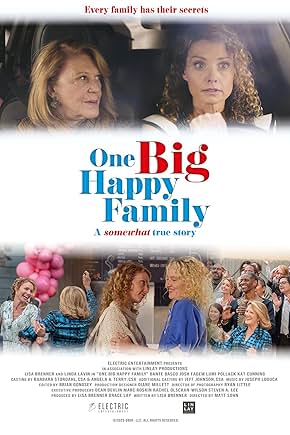

Set in LA, “One Big Happy Family” (2025) stars Lisa Brenner as Rachel, a Jewish mother of two girls who is planning the bat mitzvah of her older daughter, Sammie (Lumi Pollack), and turning forty years old. With her acting career on the rocks, she does not need any more bumps on the road. After her best friend & TV show host, Gerry (Sabrina Cofield), convinces her to take a DNA test, the results lead to a confrontation with her mother, Lenore (Linda Lavin in her final film appearance), nicknamed Lola, that throws Rachel and her younger sister, Sara (Kat Cunning), into a tailspin. Will the revelation ruin everything that came before or make Rachel and the family stronger? The earnest film struggles to find a consistent tone and is basically a sitcom expanded to feature length, but its bland yet comparatively radical depiction of a multicultural, multireligious family who feels as if they belong in the twentieth first century lands in an emotionally resonant heartwarming way that almost makes its audience forget the slog to get there.
“One Big Happy Family” describes Rachel as a “super Jew,” which means that she encourages her children, Sammie and Amanda (Dylan Chance), to practice their Jewish faith, won’t get a tattoo, does not eat pork, etc. The catch is that despite her profession, she gets anxious in big groups and is expected to deliver a speech at Sammie’s bat mitzvah. Her unconditionally loving husband, Dr. Marcus Torres (Dante Basco), is constantly trying to alleviate her anxiety with homeopathic remedies, but the size of their home indicates that he is financially successful and takes a more conventional route with his patients. Marcus also gives her exclusive domain on the issue of religion though there is a lot of talk about his Filipino birth family feeling anxious about participating in an unfamiliar coming of age ritual. Sara is a bit of a hippie, a lesbian and works in a juice bar. Once Cunning sings, moviegoers will probably be upset that the movie was not a musical. Rachel goes to yoga with Gerry, and she and her husband have double dates with Gerry and whoever her latest date is. “Star Trek: Voyager” fans will immediately recognize their yoga instructor, Lawrence (Tim Russ). The entire cast is affable, and the chemistry is functional though some pairings are better than others.
If “One Big Happy Family” has a problem, it is that every actor usually delivers lines in that television singsong affect. While it tames the sound of provocative things, it also flattens beats that are supposed to register as a change of pace whether a relaxing moment that eases the tension or a stressful one that ratchets up stress. If a laugh track appeared, it would not be out of place.
Unlike a sitcom, “One Big Happy Family” introduces important themes that would not ordinarily appear on television. Is Rachel actually Jewish? Does her search harm her father’s legacy or diminish her love for him? Does Rachel take her mother for granted? Nothing really sticks because whether it is a quotidian question at a grocery store or the aforementioned big issues, they elicit the same reaction from Rachel, which enervates the story. Rachel often gets painted in broad terms such as the wine mom trope to keep things light when her actual unique characteristics should shy away from cheap laughs and are more authentically good humored. It results in Rachel only being as interesting as her scene partner.
While initially Rachel’s annoyance that her mother is not really listening to her during their phone calls is valid, eventually Rachel constantly being at a ten seems overdone, which is probably ableist. For example, before Lenore arrives, a problem is literally, “oh no, mom always ends her calls with ‘Love you more.’” Some things should be kept in a journal or reserved for therapy. Lenore had flaws that could have been exploited for dramatic tension but are just referenced before moving on. Lenore rejects being called grandma. Lenore constantly harps on Marcus not being Jewish, blames him for problems that are not his fault and accuses him of cheating. These red flags could have landed, but it feels more like a bit of schtick than any genuine high stakes moments. Outside of the DNA issue, the mother daughter tension felt hacky. Once Brenner and Lavin’s characters were reciprocating love with Lenore acting as Rachel’s admirer and cheerleader, it showed that “One Big Happy Family” was hiding its light under a bushel.
“One Big Happy Family” is at its best when Rachel and Lenore are each other’s biggest admirers. If the story was about a loving mother-daughter relationship that the DNA mystery disrupted and threatened as opposed to an overbearing mother figure who redeems herself and her past actions get reframed, the movie would be more consistent. Better late than never. As the movie approaches the end, it finds its footing. If you suddenly need a box of tissues and are moved for the remainder of the movie, you may doubt your faculties registering everything that preceded as one note.
It takes too long for all the threads to come together in person, i.e. Lenore to arrive in LA and Rachel to start meeting her new relatives. Bobby (Josh Fadem) is introduced as the first of many new relatives that the DNA test connects and becomes a fixture of Rachel’s new life. The opening scene suggests that the story is somewhat based on a true story, and the narrative structure makes that believable because it mostly occurs long distance with fits and starts. A valuable tip for filmmakers is that it is better to improve on reality than depict it faithfully. The shakiness made the movie endearing because it is Brenner’s first-time writing. Also fertility treatment such as artificial insemination feels like a recent development, but it is not, and it is probably overdue for DNA tests to appear as storylines in genres other than police procedural television series and dramas.
Once “One Big Happy Family” arrives at that nexus point of all the family members converging, the momentum picks up. Other notable relatives were Javi (Vincent Vargas), a gentle and warm giant, and Denise (Kassandra Mahea, who was gorgeous and barely had any screentime). They felt like the most organic actors, and Lavin’s work with the newer relatives and Quiet Jimmy (Keri Wade Jackson) displayed her effortless charm and universal chemistry.
It was a little frustrating that Marcus’ family mostly remains off screen and gets zero lines, especially since technically they were there longer than the latest additions, and there was a lot of potential tension about them being a fish out of water. The assumption is that they are a part of the general celebratory feel in the denouement. “One Big Happy Family” excels at emphasizing the characters’ devout faith without making them feel as if they come from a different era or place. The issue of passing is used as a punchline that skewers Hollywood in a clever way. Even though the concept is not new, showing it from the perspective of someone not interested in assimilating, just being practical, makes it lighter and funny, not filled with pathos. Expanding the definition of who is Jewish and challenging the image of what a Jewish person looks like is accompanied with the radical idea of who gets to be a part of that family and not Jewish without diluting faith. It recalled the documentary “Sabbath Queen” (2024) except more mainstream and prosperous.
With the right trying to claim that the definition of family is exclusively theirs, a movie like “One Big Happy Family” may feel like a television movie but also feels like a welcome antidote while showing a family that occasionally curses, is casually feminist and still manages to be tight knit, heartwarming and welcoming. People can have strong, loving, tightknit families without looking like historical reenactors in appearance or in spirit. A lot of filmmakers do not realize that if the ending is strong, then people will leave feeling good about a movie that may not be ready for the big screen yet not feel ripped off for the effort and expense of going to the theater. Fortunately, Brenner is on to something with her approach to family friendly stories and stories about being Jewish in a predominantly Christian and secular world in LA. While Brenner is a veteran actor, it is her first time writing a feature length movie. Everyone performing a new job cannot perfect. After watching the film and doing a deep dive on Brenner’s inspiration, it is obvious that if she had crafted the story closer to her life instead of following a formula, it could have been perfect. Next time, courage! If you are interested in seeing this movie, you can wait until it streams unless you want to support a new Jewish screenwriter who depicts real, loving family or want to see Lavin one last time on the big screen.