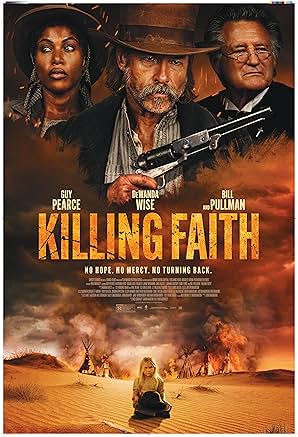

“Killing Faith” (2025) is set in 1849, a mother and freed slave, Sarah (DeWanda Wise), recruits a doctor, Steel Bender (Guy Pearce), to take her daughter, The Girl (Emily Katherine Ford), who has no name (eyeroll), to a faith healer, Ross (Bill Pullman), in another town. Along the way, troubles descend on them almost as if they are a magnet. Stephen King tweeted that the opening scene is a “real shocker,” but only if you never saw “X-Men” (2000) or the movie’s trailer. Plus, the CGI was shaky. This Western feels like a patchwork quilt of tropes with loose stitching not quite connecting the colorful pieces.
The actors are great, but the characters are thin. They can mostly be divided into two camps: those who have a supernatural explanation for everything, and cynical people who exploit that superstition. Bender professes to belong in the latter category, but when he huffs ether, he sees the ghost of his daughter, Annie (Teagan Ireland), whom he lost in the cholera plague that he was powerless to heal along with numerous people in town. “Killing Faith” is supposed to be a battle for his soul and to pull him from despair, but even Pearce’s talents cannot elevate the character who is a poor protagonist to have a film revolve around. Why is Pearce in this film after “The Brutalist” (2024)? Are the blacklisting rumors true? Naturally, after initial reluctance, Bender becomes very invested in protecting Sarah’s daughter and believes what ails Sarah can be explained through science.
Wise is a great actor, and her eyes alone could get her cast in any film vaguely supernatural, but if you are a fan, it probably would be best to skip “Killing Faith.” When she disappears for a huge swath of the story, it is challenging to stay invested leaving the plot feeling more contrived after everything that came before. If it had happened earlier, it would have made more sense. Initially she feels like the protagonist, but the lure of a man in need of redemption was too strong. Sarah Worthington’s story is told in fits and starts so the timeline is a bit convoluted. Too many off screen characters are discussed without being shown to keep them straight. Some appear as indiscernible figures in flashbacks or spectres. It is not the only time that the story feels slapped together with spit and Elmer’s glue. Joseph was her partner, and Mr. Worthington owned her, but made up for it when he freed her, gave her property and instructed Edward (Jack Alcott), aka Id Iot, a man who has a crush on her and prattles on about trivia, a nineteenth century take on “Rain Man” (1988), to protect her.
Sarah and Bender have a complex backstory that gets prose dumped in a couple of fireside chats that pass too quickly to absorb all the details. Their spouses had an affair, and it ended poorly, which set a series of events in motion that put Sarah and Bender on this road trip. It feels as if there was a moment when director and writer Ned Crowley and his story partner David Henri Martin considered pairing Sarah with Bender then changed their mind but forgot to remove all the scenes leading up to this excised pairing. Sarah is conflicted about her daughter and thinks that she is evil.
Naturally The Girl is mute and in a sci-fi movie, would be a mutant called Rogue, but “Killing Faith” talks a big mythological game without much payoff. The final scene reveals what happened to her, but it is unsatisfying. Everyone who crosses their path seem fascinated with The Girl, and Sarah never learns to stay close enough to stop people from snatching her up. Is there an explanation for what is happening? If there is, I missed it, but it is likely deliberate. A lot of the mayhem occurs off screen with her just sitting untouched in the middle of it. Did she cause it or did the people get themselves into the mess fighting over her? If there were subtitles and certain words were spelled, maybe I would do better with spinning a theory. Chief William Shakespeare (Raoul Max Trujillo) is not on screen long enough, but he is a scene stealer with aplomb. If he was in the entire movie, “Killing Faith” would have been more fun even if he was just another in a long line of suspicious people, but if there is a real explanation, he would be the most convincing. Joanna Cassidy also delivered another scene stealing appearance that the movie never quite recovers from.
While making “Killing Faith,” it feels as if Crowley and Martin had several scenes that they wanted to put in their movie but did not spend enough time connecting the dots and crafting a cohesive story. Even if the ambiguity was intentional, it does not work. Instead, it feels as if they spun a wheel to determine the order of the scenes. There is a difference between keeping an audience guessing and just doing things because it looks cool. This story feels like the latter with nothing meatier behind the imagery.
There are stories of indigenous scalpers and white riders, but it never ties together in a fully concrete way to the onscreen characters. A family of characters pay homage to the Donner Party if they were ancestors of the family from “The Texas Chain Saw Massacre” (1974) and obviously feel like a threat though the travelers are not the least bit on guard. There are a couple of homicidal gunslingers, Whitey (Jamie Neumann), who is a cleaner, peroxide blonde, discount Jennifer Jason Leigh from “The Hateful Eight” (2015) and Gibson (Keith Jardine), whose first impression is comedic and sanguine. When Pullman appears as a town preacher spouting a vaguely Christian theory, Willard (Thomas Wingate) interrupts him, and if Crowley and Martin had leaned more on their sharp humor which appears too infrequently, the movie may have been more enjoyable. While it is nice to see Pullman, no amount of talent could make this character less predictable. Ross even has an Asian servant who does not talk (eyeroll).
Certain laws of physics govern “Killing Faith,” and they are good ones, which makes the movie more disappointing because they are not executed well with the stories’ twists and turns. The supernatural may be a bunch of crap that people use as an excuse to do bad things or eliminate what they fear, but if it does exist, it is more inexplicable than anyone can explain. Violence is a given, and it is often gendered or stems in bias.
If you do not like movies that never offer any explanations for mutant powers, then skip it because it is not the point. “Killing Faith” consists of amazing parts that do not add up to a cohesive whole. It needed more work before filming ever started instead of relying on the audience’s generous spirit to be satiated with a lot of shiny, inconsistent distractions that are substitutes for substance. Next time, they should start with figuring out which character should be the main character because they are innately interesting instead of the one that they relate to the most, or make the most relatable one more interesting.