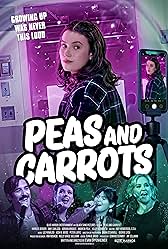

Set in New York (allegedly), “Peas and Carrots” (2024) follows sixteen-year-old Joey Wethersby (Kirrilee Berger), the daughter of two rock stars, Laurie (Amy Carlson) and Gordon (Jordan Bridges), who peaked in 1996. While Gordon works as a teacher, Laurie is working on their next album but is contemplating giving up music. Joey suggests forming a family band, which would include her thirteen-year-old sister, Mickey (Talia Oppenheimer, the director’s daughter), and their little brother, Topper (Callum Vinson). Joey did not expect that they would make her the lead singer but goes with it. When her dad breaks a star projecting machine in the kids’ bedroom, Joey finds herself transported to a different place where everyone says the title. Is she dreaming, going crazy or what? There are plenty of good ingredients, but the story needed tightening because the lesson feels like it comes out of nowhere
Joey’s time with her family is the most entertaining. It is rare for a teen that age to want to hang out with their family and for it to seem believable. Topper felt like an afterthought who exists to be cute, but fortunately not sickly saccharine. Mickey seemed interesting but did not get a lot of screentime. Joey walks to school with her best friend, Nick (Krishna Doodnauth). The teens are convincingly asexual with zero subtext, which is kind of impressive considering that the parents’ band, City Kids, was contemporaneous with an indie movie called “Kids” (1995). The existence of that indie classic’s take on teen urban life would shock and appall anyone in “Peas and Carrots.” In other words, there is no issue that she spends all her waking time with a boy. Instead of spending time in school, the peers that Joey interacts with the most are in this alternate reality, and they are mostly kind and helpful. That world has adults, who are in charge and guide their activities. Eventually Nick introduces Joey to his physics teacher, Ms. Washington (Kelly McAndrew), so they can determine what is going on.
The actors brought their talent and innate charm to their roles though the story eventually loses the plot trajectory. Their ability to convey authentic emotion motivates the audience to stick around long after “Peas and Carrots” should have ended. Berger has a young Kathryn Hahn quality meets Alexis Bleidel. She technically plays multiple roles, but to explain further would be a spoiler. A lot of actors can barely play one, but Berger nails it. Oppenheimer can actually sing, and her performance was solid enough that more screentime would have been warranted. In the alternate reality, Faith Gitchell as Mary was a standout. As the characters in that realm increased, even though it was the point for Joey to feel as if she was losing connection in both worlds and lost whilw just going through the motions, it also had the same effect on the audience, which is a fatal error. While some of these skits are hilarious, more needed to get cut. Andrew Polk as Woody was a nice, acerbic palette cleanser. It was disappointing that the mom did not have a storyline since Carlson has great presence and chemistry with everyone, but after most of her scenes ended up being “make fun of mom” scenes, it was a small mercy.
With no disrespect intended to Bridges, Gordon was the most annoying character. It was like if Xander from “Buffy the Vampire Slayer” grew up and thought he was in a contemporary updated Fifties sitcom doling out crappy advice and doing the bare minimum. Even when his wife asks him to do that, he asks, “Now?” Sure, he just got home, but he should be excited that anyone even wants advice from him. They should not. The minute that dear old dad used The Police’s “Roxanne” as a bedtime story, he lost me. Just put another $1 in the future therapy bank. Because he is always late, even for studio time, and not the primary parent, the parents parentify Joey. Why does she have to tell the bedtime story if they prefer dad’s inappropriate, low effort ones? Why does mom need her to pick up Topper once a month when dad is available and does not seem to be doing anything? He is the one who breaks the machine. Then he wears a ridiculous mustache while performing, which is supposed to be comedic relief, but not a single laugh emerged. Joey suggests the band idea to soothe her parents, which is not a child’s job. She enjoys playing music with them, but a band is another level of commitment that elevates it to becoming work.
In the alternate realm storyline, there was a lot of buildup that something was coming. It feels as if “Pleasantville” (1998) inspired it. That storyline goes nowhere unless it was a shameless dry begging for a sequel or “Peas and Carrots” was supposed to be a pilot for a television series. This movie does feel like a television movie, which is not a bad thing per se, but it will be playing in theaters. It also felt as if the movie was about to turn into one of those Christian produced movies about having faith in the unseen, i.e. God. If it was, it never came to fruition, or they were smart enough to keep it vague, not heavy-handed. Angel Desai plays Bobby, the boss in the other world, and she is a riveting guide.
When Ms. Washington appears, it feels as if the story was making a point about not fully engaging in life and confusing fame and work with having a real life, which consists of friends and family. It also embedded an addiction storyline though it feels as if writer and director Evan Oppenheimer did not seem to think that was alarming or notice it. McAndrew kind of steals every scene, has great timing and often becomes more interesting than the protagonist. Joey is apparently not good at anything but wants more out of life without working for it.
The actual lesson is for Joey to stop trying to be ambitious and be herself, which naturally dad helps Joey conclude. In the way that the narrative is structured, it does feel as if it drops out of nowhere because the lesson gets lost as Oppenheimer plays out the infinite possibilities of that other realm. On one hand, it is a great moral because not everyone should try to be a star because then they will wander into “Charly” (1968) territory and are guaranteed not to be content. Also she scales back helping her parents when she makes that choice. Without a team of people working together, big projects fail. It is a nice story about being a part of community even if it is not flashy.
On the other hand, Joey is sixteen years old, a time of infinite possibility and brain elasticity. This time in her life is to test how much she can do and test what she enjoys. He also tells Mickey to make her voice smaller but if he appreciated talent, he would encourage her to work on it and stand out. He also calls Mickey weird, and seriously, he is the villain. People who encourage people to make themselves small are villains. Joey says, “I just want to do what I was born to do.” “Peas and Carrots” never establishes what she was born to do and instead just kind of throws her somewhere. The parents infect Joey with their feelings of inadequacy because they feel as if the other band members were the stars. Everyone has a thing even if it is collecting cobalt blue glass figurines. Even in her dreams, she can only imagine herself supporting others or working. Everything is work. Her fun little singing with her mom becomes a job. The movie becomes a nightmare.
“Peas and Carrots” started off as a promising, wholesome albeit a little bland and safe for a story allegedly set in New York—not a cell phone in sight. Most of the ingredients are solid, but Oppenheimer lacks the discipline to bring the story safely home. It is part musical, and the music is fine. Fans of The Ramones, Sonic Youth, Guster and Richard Hell & the Voidoids should consider it required viewing. It is probably too young for adults or older teens. Tweens would be the target demographic.