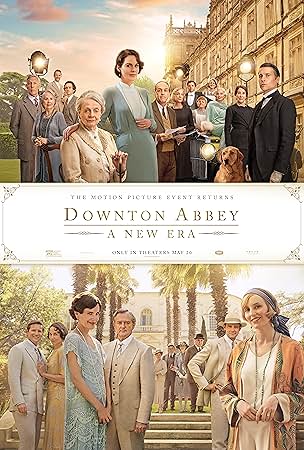

Set in the summer of 1928, “Downton Abbey: A New Era” (2022) is the second of three movie sequels to the television series. Dowager Countess of Granthem Violet Crawley (Maggie Smith) inherited the Villa of the Doves in Toulon, France and most of the Grantham clan cross the channel to get to the bottom of why a French man favored her over his widow and his son. Meanwhile the estate is falling into ruin when producer and director Jack Barber (Hugh Dancy) wants to film a movie at their home, so Mary stays behind to ensure that it goes smoothly and rake in the cash. Instead of everyone preparing for a visit from the king, they are preparing for a visit from the stars of British Lion Films, a real-life film production and distribution company, and the audience will be surprised who acts differently or the same. Will the family continue to live and prosper? There is a third movie so what do you think. Long live the Granthams and their faithful staff.
Lady Mary (Michelle Dockery) and Violet play prominent roles in the home team storyline. Violet gets some of the funniest lines, and the dynamic between her and Isobel Merton (Penelope Wilton), formerly Crawley, is fully restored to its glory from the series. Lady Mary is not just saving Downton Abbey but the film as “Downton Abbey: A New Era” captures the difficult transition that actors had to face when transitioning from silent movies to talkies. It is also hilarious to hear Dockery, a seasoned actor, wonder if she can do a good job as a voice actor when the production needs her in an eleventh-hour pinch. No offense to Dancy but stick to onscreen romancing Hannibal Lecter. His hair is unfortunately styled like Hugh Grant as an Oompa Loompa in “Wonka” (2023).
Elated wife and servant Daisy Parker (Sophie McShera) finally gets a storyline where people do not tell her what she needs to do or manipulate her into living the life that they believe that she should have. She becomes the benevolent puppet master and also plays a decisive role as an unexpected life coach. While Mr. Molesley (Kevin Doyle) still provides comedic relief, he also discovers that he is a man of many talents, which makes up for him being the butt of any jokes.
Meanwhile Robert Grantham (Hugh Bonneville) leads the away team as he tries to maintain the family’s good reputation and dispel any notions of improper conduct between Violet and the former owner of the villa. Bonneville’s appearance has changed dramatically since the first film, and he gets to explore a whole range of emotions while everyone revolves around his dilemma. Mr. Carson (Jim Carter) is sent with that party so he cannot gum up the spokes of the film reel and mostly offers comedic relief at his inability to handle the weather and maintain decorum. Lady Edith (Laura Carmichael, who is married to Michael Fox, who plays Daisy’s husband, in real life and was pregnant for part of the filming and at the end, their baby makes a cameo) shrugs at the scandal and has resumed life as a working journalist. Cora (Elizabeth McGovern) borrows story lines borrowed from Violet and Lord Merton (Douglas Reith) that get cobbled together loosely. Things happen to Tom Branson (Allen Leech), including marrying Lucy (Tuppence Middleton), an underwritten, pleasant newcomer who may as well have been called Jane since she as memorable as Ms. Doe. Any comments about Lucy are directed to the show creator and writer Julian Fellowes, not Middleton. If Lucy is not adjacent to Tom, no one would have any idea who she is.
Even though new characters are introduced, they do not eclipse the central characters. Of course, the movie stars and film crew are regular people with more money and a peculiar job starring in silent films. Guy Dexter (Dominic West, “The Wire”) and Myrna Dalgeish (Laura Haddock) are the actors in “The Gambler,” the film within the film. Of course, their time with Lady Mary and the staff changes their lives forever. There is some class tension when the actors eat with the family, but it did not feel redundant though that issue was explored in Season 4, Episode 3 when Dame Nellie Melba (Kiri Te Kanawa), an opera singer, was banished to her room before hurriedly shuttled to dine with the blue bloods. While there is an implicit bias that a person from a lower class needs to act like the upper class otherwise it is unacceptable and not the reverse, there is room for redemption for even the coarsest players. It is still worth noting that nothing gets stolen when the filmmakers visit whereas there was a rash of missing items when the regent and his retinue visited, which is realistic.
Only have modest expectations from Dexter’s interactions with butler, Thomas Barrow (Robert James-Collier), who plays a less prominent role in “Downton Abbey: A New Era.” It is almost as if there is a chart to see who had more screentime the last time and let others take a turn. While it is nice that there are no loose ends to Barrow’s story, Barrow got more action in every prior similar storyline. While it appears to be a happy ending, it is too ambiguous for my taste. In the movies, James-Collier is a silent, restrained presence and appears in a lot of scenes, but he needs a more storybook happy ending. If the next movie does not begin with him enjoying life, the social media campaign for Barrow to get an adventure, travelogue sidequel needs to begin immediately. Forget “The Gilded Age” crossover for now.
Visually “Downton Abbey: A New Era” is more sumptuous than the series or the 2019 movie and brighter than the latter. While the 2019 director Michael Engler, who directed “The Chaperone” (2018) as his first film, was striving for realism, director Simon Curtis, who is married to McGovern in real life, fully embraces the exuberant, unattainable for most luxury of the Grantham world. It shows that Curtis has more experience in directing features and period films: “My Week with Marilyn” (2011), “Woman in Gold” (2015) and. “Goodbye Christopher Robin” (2017). He is not only making a film from the 1920s but also making a film within the film set in 1875. Curtis also used the camera position to tell the story instead of continuing to shoot the movie like the series. The close up of three concerned faces filling the frame then cutting to Violet added wordless humor.
“Downton Abbey: A New Era” is light, frivolous fun entertainment that did not feel as if it was trying to run the clock like “Downton Abbey” (2019). It felt like a real movie with the exotic, international locations and a storyline that required introducing technology to Abbey in a way that is simultaneously humorous and historically accurate. It also continued the utopian, perhaps unrealistic impulse to imagine a world where the traditions are preserved and treasured with all the classes mixing while happy to be in their place more or less but was less preachy than anything that came before.