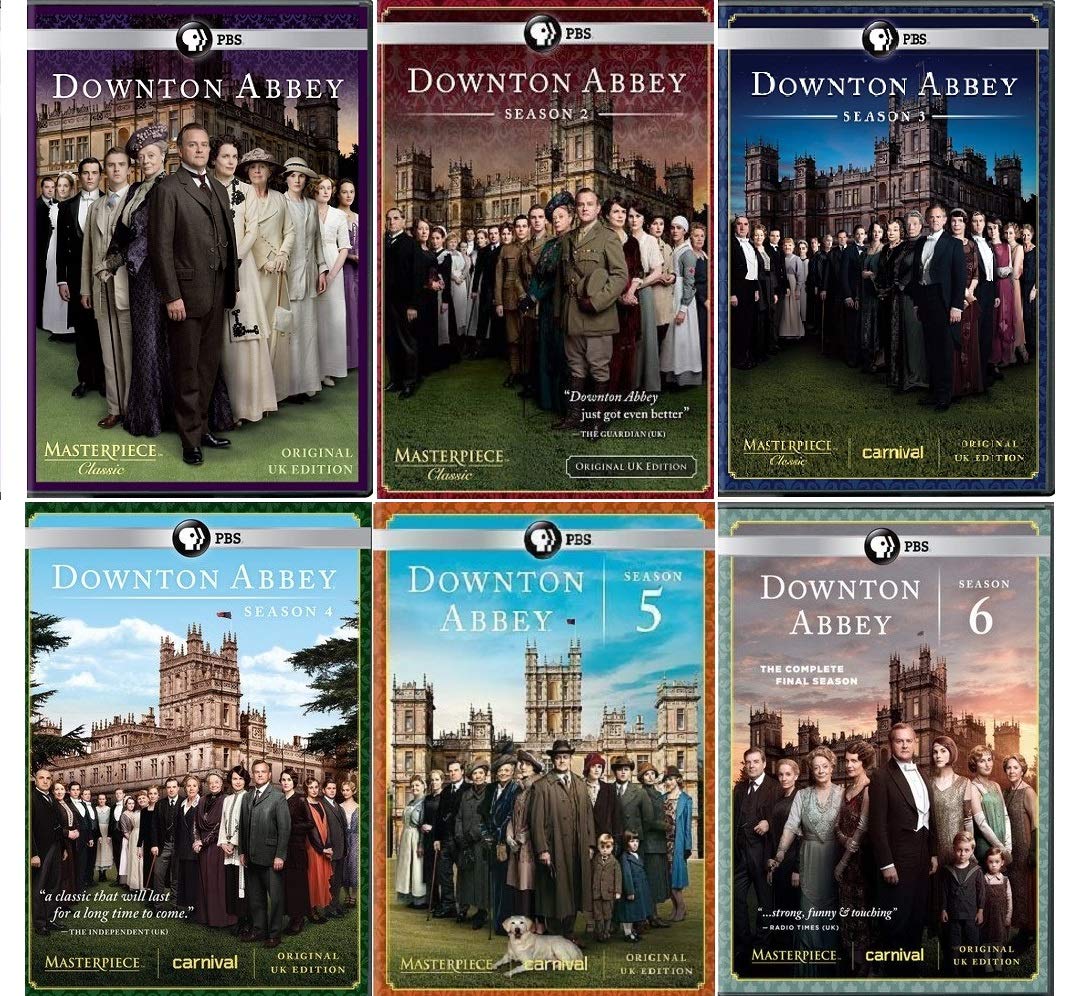

“Downton Abbey” (2010-2015) consists of six seasons with a total of fifty-two episodes. Each episode is roughly a little over or under one hour each except for the ninth episode of each season, which ranges from over one hour to ninety minutes long. The first season introduces the aristocratic, titled Crawley family and the people who work on their estate and focuses on the problem of finding an heir. The second season reflects how World War One changes everyone’s lives forever as the residents contribute to the war effort. The third season focuses on the Grantham estate trying to find a balance between tradition but adjusting to a new future to preserve the estate from ruin with two of the Crawley daughters now married or soon-to-be-married women. The women take center stage of Season 4 as they adjust to the challenges and delights of life in the modern world while upholding the dignity of the Crawley name. In Season 5, the servants and older Crawley women take center stage as they find love, invest in their future while the younger Crawley women deal with the spectre of scandal while focusing on what they want. In Season 6, the Crawley family adjust to the financial reality of the times; the servants consider life outside of service as the need for service wanes with the nobility’s financial prospects;and the Crawley women embrace their careers and find love. This television series had a stranglehold on viewers at the time of airing, and it is still an excellent, entertaining series for multitaskers.
I did not watch “Downton Abbey” when it aired because I prefer to watch television series in one fell swoop after they are complete. I promised to watch it once it was finished, and lo and behold, the bill has come due with “Downton Abbey: The Grand Finale” (2025) being billed as the last movie in the franchise. I have zero regrets though I was spoiled and expected some of the dramatic developments that shocked and surprised viewers at the time of release. It is an escapist fantasy of life in Britain with a devoted staff who live to serve and the lords and ladies who are progressive enough to appreciate their good fortune and are determined to protect their staff and their community instead of just enjoying their largesse.
The first season made it seem as if it was going to be the British version of “Father Knows Best” with the Earl of Grantham Robert Crawley (Hugh Bonneville) gently chastising the old fashioned ways of his staff and family to gently lead them into the future on class, LGBTQ, gender, etc., but as the series progressed, it mixed things up and everyone took turns with having feet of clay and being beacons to the future. Lady Mary Crawley (Michelle Dockery), the eldest daughter, was often the scene stealer since Dockery’s performance as the unflappable, cool, sensible, beautiful, surprisingly empathetic and generous lady was a master class in being unlikeable and still able to win over anyone.
Another scene stealer was the Dowager Countess of Granthem Violet Crawley (Maggie Smith), a woman set in her ways, but was willing to adjust out of love for her family. Though initially enemies because of their societal standing and attitudes on every topic the Countess’ odd couple friendship with Isobel Crawley (Penelope Wilton), the mother of one of the heirs who also volunteered as a nurse, ended up being one of the most fun aspects of watching the series. Their eleventh-hour romances were also welcome surprises since older women do not usually get such storylines. Their effect on each other was a joy to watch as they scandalized each other but were each others’ fiercest cheerleaders. Another eleventh hour romance among the servants was gradually developed and made so much sense that it was like a dream come true even though the suitor was too darn demanding once wed.
Countess of Grantham Cora Crawley (Elizabeth McGovern), a wealthy American whose dowry saved the estate when she married Robert, showed a streak of good nature as she silently rooted for the underdog and stuck a finger in the pie of upper-class pretensions whenever she had a chance. Unfortunately, she often barely got an independent storyline worthy of such a character with so many contradictions. It did give an excellent excuse to meet her family and contrast the moneyed American upper class with the upper echelons of British society with Shirley MacLaine playing her mother, Martha Levinson, and Paul Giamatti playing her brother Harold, a business-minded playboy. Also, Richard Grant plays a character who notices Cora’s taken-for-granted charms.
Cora and Robert had two other daughters, Lady Edith Crawley (Laura Carmichael), who often was the target of torture for most of the series as the overlooked, starved for love and industrious middle child, and Lady Sybil (Jessica Brown Findlay), the good-natured, rebellious, kindest baby of the bunch. Sybil ended up being a gateway drug for Tom Branson (Allen Leech), the Grantham’s Irish socialist later turned republican driver who ends up playing a crucial role every season and is half of another odd couple in an unlikely friendship with Lady Mary. Leech may be the only male character required to take off his shirt while a woman ogled him though others had more romantic hero storylines.
Why the hell was Mr. John Bates (Brendan Coyle) given such a prominent storyline? If he was not one of Robert’s war buddies, no one would tolerate this man on paper. Initially he is sympathetic as a disabled man willing to work under unaccommodating conditions, but he is the main suspect of two murders, sets his cap to the second most high-ranking servant, Anna Smith (Joanne Froggatt), who reciprocates enthusiastically despites Bates still being married to an awful woman, Vera Bates (Maria Doyle Kennedy), who was a fun villain. While “Downton Abbey” framed his surveillance of Anna as caring, his desire to know everything about her activities was one of many red flags.
Also sorry, not sorry, Thomas Barrow (Robert James-Collier) worked there longer than Bates and was right to be pissed that after paying his dues and working through the ranks, serving and getting wounded in the war, stopping child abuse, saving people’s lives, he was always on the verge of losing his job. Justice for Thomas. Yes, he was an asshole, but they started it. When they were short staffed and began to feel the pain, it served them damn right. It was bias, and the series tried to course correct and revise history, but it was not enough. Also, real talk, James-Collier was the hottest man on the television series though he was not billed as such. How has he not grabbed the spotlight or crossed my path earlier? “The Ritual” (2017) has been in my queue for awhile, and I may need to move it up.
According to show canon, the hottest of them all was Matthew Crawley (Dan Stevens), Robert’s heir, a lawyer unaccustomed to the life of a grand man on an estate. As an American, it is hilarious to compare how actors like Stevens and Charlie Cox, who makes an appearance in the pilot episode, look in “Downton Abbey” compared to when they appear in US productions. In the Brtish television series, they are still top tier, but they do not keep it high and tight with Stevens sporting a moderate double chin and Cox’s hair thinning versus Stevens at his hottest in “The Guest” (2014), which is how I was introduced to him, and Cox playing “Daredevil.” American standards of male beauty are unrealistic. People wondered why he did not capitalize on this iconic role. Stevens’ resume indicates that his appearance on the series was the aberration as he has embraced playing mostly weirdos in horror and sci fi films before and after he won viewers’ hearts as Lady Mary’s true love. Other actors such as Matthew Goode, Tom Cullen, Julian Ovenden, Theo James, etc. vied for Lady Mary’s hand. If you want to know the final winner, you’ll have to watch the series.
“Downton Abbey” is a soap opera with amazing production values that will make you fantasize about living in a smoothed-out version of the past. The reason that it makes multitasking so easy, it is because the characters repeat what happened immediately before and to save some money, often recount off-screen dramatic events. If rumors are true that the creator Julian Fellowes plans to make a crossover of this show with “The Gilded Age,” I guess that I can guess which television series I’ll have to check out next. In the meantime, on to “Downton Abbey” (2019) and “Downton Abbey: A New Era” (2022) to continue my preparation for the final movie and installment in the franchise.