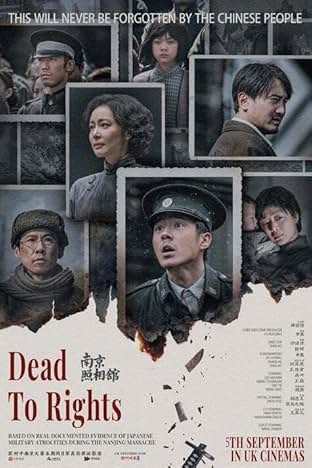

Set in 1937 beginning with the chaos of evacuation amidst attack, “Dead to Rights” (2025) focuses on a group of people living in Nanking, China during the Japanese Imperial Armed Forces invasion. On one side are the locals who are hiding, trying to escape or forced to serve. On the other are the Japanese soldiers whose actions contradict their claims of trying to create a Sino-Japanese friendship. Aware that committing war crimes would violate international law, the invaders use photographs as propaganda but privately memorialize their sadistic treatment of the Chinese people. Who will fire the last shot? If you only have time to see one movie this year that commemorates the eightieth anniversary of the end of World War II or the Chinese People’s War of Resistance Against Japanese Aggression, see this one.
Ito Hideo (Daichi Harashima), an official and photographer for Japan’s Imperial film, needs someone to develop his film. He spots a civilian, Liuchang Su (Haoran Liu), a postman who missed the last truck out of the city. To avoid execution and since he cannot escape undetected, Su assumes the identity of an apprentice, Ah Chang, of the Lucky Photo Shop and offers to develop photographs, which he does not know how to do. (Cameras used to have film that would be turned into negatives that would then get printed onto specific paper.) It is later that he discovers the shop’s proprietor, Chengzong Jin (Xiao Wang), hiding with his wife, Yifang Zhao (Zhener Wang), his older child and daughter, Wanyi Jin (Enyou Yang), and baby hoping to survive until the war ends. Japanese interpreter, Guanghai Wang (Chuan-jun Wang), helps Su with his cover story in exchange for protecting Wang’s mistress, actor and opera singer, Yuxiu Lin (Ye Gao), who in turn proves her loyalty when she reveals that she has snuck in a Chinese soldier, Cunyi Song (You Zhou), who was conscripted into service. Meanwhile outside, their neighbors and loved ones are getting slaughtered or worse.
“Dead to Rights” poses a moral dilemma for each person on balancing the desire to live with the ethics of how to do so. Unlike most movies about Japanese soldiers in WWII, initially they are depicted as reluctant, including Ito, but as the occupation continues, those moral reservations get cast aside, and they throw themselves into their job of dehumanizing people. The idea of a patriotic duty gets redefined through the course of story. Is it enough to shoot with a camera or to be called a soldier, should he shoot with a gun? While this film was unflinching (sobs could be heard from the audience), the reality was considerably worse. While Ito shows that he is biased against Chinese people since he never looks away from the atrocities and often memorializes it in his photographs, there is a sliver of hope because he seems fond of acquiring new Chinese assistants until he grows self-conscious and resentful of needing their help to do his job.
While Wang, an enthusiastic collaborator, talks a good game, the actor projects the emotions on his face. He boasts of his support for the Japanese to convince himself as much as he is trying to convince Lin. It is a great performance because he would be an otherwise unsympathetic character without actor Wang’s ability to depict the internal war within his character’s soul. In one scene where a Chinese soldier gets the upper hand on a Japanese official, the sneer on his face and the stillness of his body are the closest that he gets to fighting effectively. Everyone else questions whether working for the Japanese to survive makes them traitors. For Song, the answer is yes, but for everyone else, they find another way to fight the war in a feasible, scalable fashion, which is where the story overlaps with history. Thanks to photographic documentation of Japanese war crimes, the Nanjing War Crimes Tribunal had evidence to prosecute. “Dead to Rights” does fictionalize these photographs’ journey, but the spirit of the story is true since cowriter and director Ao Shen, cowriter Luyang Xu and cowriter Ke Zhang can use this ensemble cast to individuate the residents of an entire city using a handful of relatable, ordinary characters and tell the story of the hardships that Japanese people faced during a nightmarish time.
“Dead to Rights” is also a story about the triumph of art and skill versus barbarians’ desire to minimize it and claim it as their own. Quentin Tarantino is famous for creating alternate history by elevating filmmaking (“Inglorious Basterds”) and occasionally photography (“The Hateful Eight”) as pivotal to a conflict that improves on actual history. Here the changes are not substantially different or sensationalized. It is a true story about possessing a skill such as taking a photograph or developing one, and how that skill can change the world and result in justice. It is also nonviolent unless violence is the only rational choice then that violence still uses the tools of art and expertise to survive. It is a beautiful story because it is not about flashy heroics, but pure human decency recognizing that something is wrong, showing it and hoping others agree. If these people could do it while facing insurmountable odds, could not we under less pressure?
This idea of image or obsession with how one is perceived is not a social media thing. “Dead to Rights” shows the power of photography to document and show that people matter, a fact that Ito dismisses. He thinks that it should only be used to glorify Japanese accomplishments. There is a sequence that compares the civilians’ photos in better days and compares it with their fate during occupation. It is a devastating sequence because the contrast is stark whereas the Japanese soldiers do not get a better self. On their best days, they are soldiers in a dishonorable cause, but they have mistaken pomp and weapons for worth. As an actor on stage and screen, Lin has many selves that cannot be captured in one or two photographs. This ability to present different faces enables her to survive. Stay for the closing credits to see how the photographs compare with present day China. You do not have to be from China to relate to the feeling of still standing after going through tribulations. The Chinese people have a lot to be proud of as a civilization going strong for around four millenia.
Even though “Dead to Rights” is over two hours long, it does not feel like it. It feels like a sanguine war epic where normal people are the true heroes. Even though it is filmed in color, Shen chooses to keep the colors muted so it almost feels black and white to reflect the historicity and dire circumstances. It also is a huge contrast to water filled with blood whether a puddle or a larger body. It is one of the few movies that uses flashbacks to tell a part of the story hitherto fore unrevealed as opposed to reminding viewers of an earlier scene, which is only necessary in a television series, not a movie. Once the main characters are no longer centered, and the story rushes forward to recreate history, while still cathartic, it felt as if the historical part needed to be introduced earlier so it could blend in more when it took over so it would not feel so abrupt and separate from the rest of the movie’s flow. In addition, if there was Chinese writing shown onscreen, it was not translated thus leaving everyone who cannot read Chinese in the dark.
“Dead to Rights” is a masterpiece in storytelling and visuals with a powerful message reminding the audience that ordinary people can stop even seemingly unstoppable tyrants. Outside of China, xenophobes get scared of the sheer number of Chinese people and cannot imagine a time when they were underdogs whereas this film describes the nation as “scattered sand,” i.e. too diverse, too tribal to come together and unite against a common enemy. Perhaps it was the Chinese people’s diversity that is its strength. Congratulations on eighty years of freedom from Japan’s attempts at colonization. Hopefully you can truly celebrate because you do not have fellow citizens who are pro-Japanese Imperial Army, i.e. the enemy that your ancestors fought.