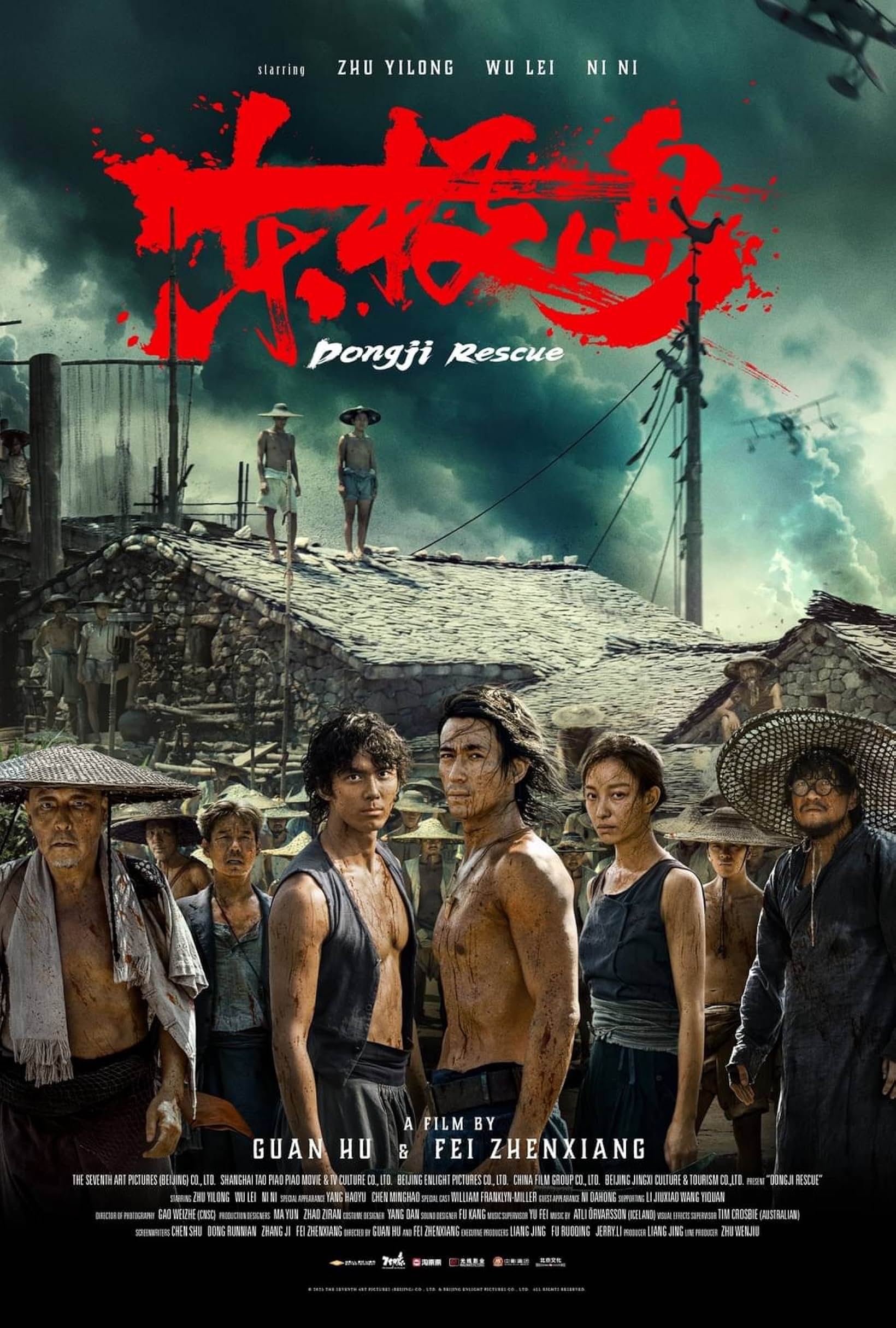

“Dongji Rescue” (2025) is a fictionalized account of the events of October 1, 1942 when Chinese fishermen rescued British POWs from a torpedoed Japanese cargo liner called the Lisbon Maru during World War II. In the hands of codirectors Zhenxiang Fei, in his feature debut, and Guan Hu and cowriters Shu Chen, Runnian Dong and Ji Zhang, the story turns into a lyrical myth about orphaned, alleged pirate descendent brothers, Bi (Yilong Zhu) and Dang (Lei Wu), and Bi’s love interest, Hua (Ni Ni), who inspire the more traditional residents on Dongji Island to revolt against Japanese Imperial Armed forces occupation and adhere to the adage, “all in peril at sea must be saved.” This action movie was probably made and timed to be released to commemorate the eightieth anniversary of the end of World War II or the Chinese People’s War of Resistance Against Japanese Aggression. While a gorgeous movie with a rousing denouement, a documentary would have been preferable so normal people could be centered and praised instead of fictional, conventionally attractive hero types who have more in common with Aquaman.
Because I’m unfamiliar with the historical account, I cannot fact check “Dongji Rescue,” which sets the stage with the Japanese not allowing the islanders to use their ships, but do allow a former Chinese soldier, Mr. Chen (Minghao Chen), to teach the young children on the island. Um, that does not sound like them. The island is divided into parts. North is allotted to the brothers as pariahs for reasons though the universally beloved and respected Mr. Wu (Ni Dahong) raised them. Only respectable people live in the south and do not want the brothers there yet somehow Hua is an exception for the pirate segregation rule. From appearances alone, Hua does not give the impression of ever compromising or going along to get along. For most of the film, she is the only woman on screen, but the others are hiding under enormous hats to not distract viewers and function as sunscreen. The pirate dudes still have their ship, and they have an idyllic life of apparently being able to live under the sea with no problem. Only mildly exaggerating.
The torpedo attack results in Thomas Newman (William Franklyn-Miller) being ejected from the ship’s hold to the brothers’ boat miles away. Dang wants to save him, and Bi does not want these problems knowing that the islanders already do not like them, and saving then hiding a Brit would not further endear them to the community. Bi uses force to deal with his brother, and it is supposed to be amusing, but tying people up and biting your girlfriend is not the pirate life for me. The story logistics get a bit confusing when the brothers separate, but Dang befriends the Brit despite the language barrier and tries to get help in translating.
The Japanese holds the entire village culpable when they cannot locate the missing prisoner then cue war crimes. Unlike “Dead to Rights” (2025), the Japanese are depicted as soup to nuts sadists who do know about and care that no one in the international community finds out about their war crimes so they decide to kill all the inhabitants, which makes rebelling and saving the Brits feel more like a no brainer than a selfless act, which the historical act was. Japanese people have currently criticized the way that the 80th anniversary celebration frames them historically, but if no one invites the military to their island, and military forces land then the islanders can be pissed and talk crap about you. They told a story, and at the very least, you did not pay rent so them’s the breaks. Plus, Nanking and Unit 731. The accusations are not groundless. China’s margin of error and grievance is as big as the East from the West.
It felt as if the writers were running the clock to lengthen the run time until the big rescue and trying to create layers of conflict for the civilians to overcome and unite so when it was time to defy the Japanese Imperial Forces, it would be more impressive, but instead it detracts from the main story and feels derivative. The story does not add up, but the spectacle and innate power of the narrative’s historical origins will still result in a wellspring of emotion nevertheless even though it is completely manipulative. When Dang goes to Chan and says, “Allied forces. People who will help us fight the Japanese,” try not to be misty eyed. These POWs are not in any physical condition to do anything, but it is such a relatable sentence of combining weaknesses to result in strength. Most of “Dongji Rescue” feels like filler and not individuating the villagers with story arcs before all hell breaks loose was a mistake. People are more than their suffering and by centering people who had experience using physical force, it was a missed opportunity to highlight every day, accessible heroism.
I’m famously critical of Christopher Nolan’s “Dunkirk” (2017), but watching ordinary fishermen rescue soldiers and putting themselves in danger always hits hard. There is also a girl power moment because in this story, which is possibly historically accurate because misogyny, women are not supposed to steer ships, but naturally Hua leads the charge with an announcement and other women without lines or names respond to her cry. The rescue sequence at the end of “Dongji Rescue” is quite impressive and probably exaggerates how screen ready and synchronized the actual fishermen were. Still part of the fun of movies is dramatization, and it is utopian to imagine a world where men and women work together for a noble cause and are unstoppable agaist a ruthless enemy and a force of nature.
Visually the directors prioritize showcasing the beauty of the island in Zhoushan, Zhejiang, China. The underwater shots are unreal and could have been ripped from a “Mission: Impossible” franchise before they had money to burn. At night, it is a bit more difficult to tell what is going on, especially because villagers are depicted collectively, not as individuals. It opens with map graphics to orient the viewer, but the same information is repeated later and offered in a different format. There are onscreen written indicators of how much time before the liner sinks and the location on the ship, but it is usually Hold 3. No other hold is shown. At some point, show another hold or stop flashing that particular location.
In a welcome development, any viewers who watch East Asian cinema know that the weakest links are usually the Western actors. Not this time! They actually seem like real actors so “Dongji Rescue” broke out the big bucks. Other than Newman, they are also not individuated. Definitely stay for the end credits when the offspring of the POWs and their rescuers talk about their story. It is absolutely riveting and will leave you wondering where that movie was. If the filmmakers had adapted a more realistic story and combined it with the raw ingredients of this movie, it would have been a movie worthy of history instead of a slightly elevated action movie.