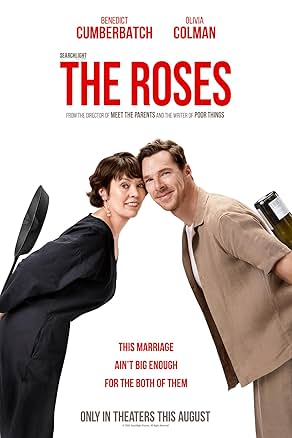

Set in San Francisco, “The Roses” (2025) stars Benedict Cumberbatch and Olivia Colman as Theo and Ivy Rose, a couple on the rocks who once were deeply in love until a freak storm alters their lives forever. At the brink of divorce, he wants the house, and she wants everything. Will they find a way to love each other again? This remake of “The War of the Roses” (1989) and updated adaptation of Warren Adler’s 1981 novel is a quality production but may veer into too serious territory to keep it light enough to leave theaters without a sour taste in moviegoers’ mouths. Be prepared to have a very different experience from the original.
“The Roses” begins in media res with the unhappy couple in counseling unable to complete the most tepid exercise that the therapist assigned then rewinds to the day that they met going through around thirteen years of marriage. With the couple as joint narrators, the structural device is meant to assure the audience that as bad as things may get, this duo understands not to take it too far and are as shocked and appreciative at how low the other can go that it gets them back on track to almost being loving. For the first part of their life together, Theo is on top of his game as an architect with whimsy who likes a dash of personality on his high-profile commissions. He meets Ivy while she is working in a kitchen, not as the chef, but experimenting in the gastronomical arts as a humble kitchen underling. Because they are instant fans of each other’s vision in their chosen area of expertise, they fall in lust/love instantly.
The Brits have chemistry, and some of the funniest bits are a brief stab at Americans’ expense as they are silently appalled at Americans’ favorite past time in their eyes and poke fun at the ironic liberal engaging in bad behavior. Fast forward to ten years later, and the cracks in the relationship become visible with their different takes on parenting. Ivy enjoys baking pastry models of famous buildings, including Theo’s, and the children, Hattie (Delaney Quinn) and Roy (Ollie Robinson), adore consuming her creations. Theo is concerned about their health, which reframes the Eighties issue that signaled vanity and fatphobia. In a knowing wink at the meta, invisible framework that structures our lives, Theo acknowledges how patriarchy has benefited him and encourages Ivy to follow her dreams by starting a crab shack. It is the smartest move of screenwriter Tony McNamara to burst any naysayers’ balloons and lead with the inherent underlying tension of this story.
Ivy’s business, We’ve Got Crabs, is more of a vanity project where she can get out of the house, do what she loves without pressure and pal around with her employees, Jeffrey (Ncuti Gatwa) and Jane (Sunita Mani, one of the scientists in “Death of a Unicorn”). That storm turns everything upside down with Theo publicly disgraced and Ivy becoming the new darling of the foodie world. Theo becomes a stay-at-home dad, and Ivy becomes the breadwinner. He commits to his job with gusto, and she comes alive in a way that he already experienced and took for granted. She resents that his influence is determining the trajectory of their kids’ lives, and he is fuming at how she takes his housework for granted and prioritizes fame while also recognizing that he is somewhat hypocritical. As if it was not already, “The Roses” gets even more wildly unrealistic when Ivy can afford to fund Theo’s vision for their dream house, which includes a bill of $28,000 for Irish moss. Their lives are writ large in social media, which raises the stakes higher than the original.
The thought exercise behind this reboot seems to reimagine why a house would matter so much to a husband while discarding many of the traits of the original character while retaining the housewife turned talented cook instead of caterer but place her in the unhinged role of the Eighties husband with a Greek chorus of adoring fans and colleagues publicly hyping her up. It is not exactly groundbreaking to depict an ambitious woman as insane or the crazy soon-to-be ex-wife. While neither are villains, the story leans slightly towards Theo as the more sympathetic underdog. “The Roses” soars as it shows that there is real love at the foundation of their relationship, but they have fallen out of step with each other.
Each yearns and glances at the other when not looking. They have no idea how much they love and miss each other, but their barbs always land often with witnesses drawing mixed conclusions about the health of their relationship. While this couple may be failing at marriage, the couple have managed to keep their friendship group alive, which includes suicidal ideation attorney pal, Barry (Andy Samberg, who should always have facial hair), and Barry’s butch, horny for Theo wife, Amy (comedic genius Kate McKinnon), and former architectural colleague Sally (Zoë Chao) and her husband Rory (Jamie Demetriou), who also seemed to be an architect, but just seems to be evening out the numbers and is utterly forgettable. While these characters are not exactly three-dimensional characters or even convincing friends other than as alibis so everyone can claim that they have a full life, everyone gets a moment to flex their comedic chops.
“The Roses” is absolutely stacked with talent, including Allison Janney as Eleanor, Ivy’s sensible divorce attorney with a Rottweiler to match her tenacious, uncompromising demeanor. Eleanor never gets high on her own supply and gives solid advice to her client while still being able to socialize with opposing counsel, also Barry. If there is a huge plot twist in this film, it is that Samberg manages to steal some scenes and keep up with McKinnon’s unhinged commitment to the bit. It is too bad that the budget could not afford Janney for more than a single scene.
Offscreen, at some point, Theo is back on top solely because of the triumph of the family home, but only a little dialogue addresses it, and it is not shown. It is as if “The Roses” was suddenly in a rush to get them back to an equilibrium for the final countdown. When the Roses go from verbal jabs to physical, overt hostility, there is dissonance between the seriousness of their actions and the intended tone of the movie, which is meant to be light acerbic joshing, not rising to criminal charges straight out of “Witchboard” (2024), which is not even a slight exaggeration. While the hostility is expected, it still feels like a sudden escalation that comes out of nowhere, and this cinematic excuse to depict physical spousal abuse without finger wagging or turning it into a Lifetime movie may be an insurmountable goal. While the escalation is faithful to the source material, the filmmakers simultaneously find a way to still carve out a happy ending. It is like going to a party and ending on a down note. It is so strange to laugh for almost the entire movie then to leave as silent as the grave.
The children are also thirteen years old when “The Roses” reaches its climax with Hala Finley playing Hallie and Wells Rappaport playing Roy. Their relationship with their parents is integral to the plot and is the foundation of the marriage’s discord. It is hard to find humor when they play such prominent roles in the story, and it is impossible not to think about the impact of the couple’s actions on them. It also often feels like a commercial for David Chang, smart homes and Bob’s Donuts.
While it is still breezier than the 1989 film, movies like “The Roses” feel unnecessary in a world that ordinarily features failed marriages ending with family annihilation whereas films like “Black Bag” (2025) and “Together” (2025) feel fresh and utopian because they dare to imagine a world where couples actually like each other and wind up wanting to be together. These kinds of films are throwbacks to a time when the implications were not fully understood, which is why the foundation of this film is love, not love curdled. When pulling punches, hold back fully. This film misses too much connective tissue to rise above the level of a bunch of humorous sketches that pull together thanks to some great performances.