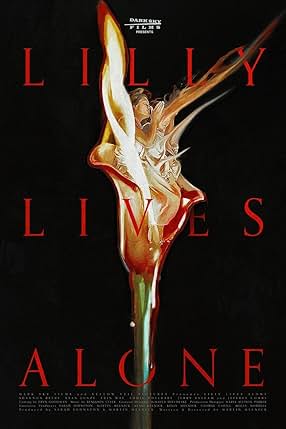

“Lilly Lives Alone” (2025) is set during a time of rotary phones, answering machines, tube televisions and cassette tapes. On the tenth anniversary of her daughter’s death, Lilly (Shannon Beeby) spends the night in a push and pull with the outside world wanting to be alone and needing someone to keep her in the present. The past haunts Lilly’s present. How will the night end?
Beeby takes the audience on an emotional journey. Lilly starts off as a matter of fact, working class woman who is not the kind of person who tries to smooth things over and uses bluntness like a weapon but will also turn on a dime and add a little truthful tenderness when deserved. Lilly devolves into a jumpy, paranoid mess. She is an unreliable narrator who drinks a lot of hard liquor to wash down pills, including clonazepam, and later suffers a nasty bump on her head, so it is hard to figure out if anyone or anything is real or a figment of her imagination. While Beeby’s performance is seamless, it is not enough to offset frustration over an ambiguous ending.
Lilly strays from routine when she has a one-night stand with Jed (Ryan Jonze), who is not repelled by Lilly’s rejection and keeps poking around her as if she is a mystery to be solved. If he is real, he is a somewhat validating presence. Jed also sees some shadow lurking in the rooms and hears the same strange noises that Lilly does. In a different movie, he would either be the hero who clears the cobwebs from her mind and gets her back on track in the land of the living or be a menacing figure, but he is just a guy with few dating options or unfortunate taste in women.
Lilly is not just an object of curiosity for Jed. There is someone (Eddie Wollrabe) outside monitoring and recording her. His little section of “Lilly Lives Alone” seems to explain the movie the best. People live uninteresting lives of quiet despair, so anyone or anywhere that has brushed against the sensational or oblivion because fascinating as if watching this person will award insight to the viewer because of proximity, but it does not. Everyone lives their little sad lives and despite all the efforts at connection, must live in their private hell alone except for the torment of their perseverating thoughts. Lilly just happens to be better at it than anyone, and by better, most incapable of not escaping the torment of tragedy.
The second-best development of this theme comes from Russel (Jeffrey Combs). Combs is probably the main draw for people who decide to watch “Lilly Lives Alone.” He plays her neighbor who is spending the night sitting on folding lawn chairs and drinking beers with Randy (John Henry Whitaker). Lilly is suspicious of them sitting outdoors in her line of sight all night, which is fair late in the film. In one light, he represents her terror of a community with images reminiscent of John Carpenter films with people standing still in a perfect line facing in the direction of Lilly’s house, but in another light, are far more quotidian. Combs is a horror and sci-fi icon so naturally it is easy to side with Lilly’s suspicions, but first-time feature writer and director Martin Melnick switches to their perspective of Lilly, who may be the worst neighbor ever and a spectre of fear. Kindness curdles into resentment when unsolicited offers of help are rejected.
“Lilly Lives Alone” is effective at showing the limits of trying to help a troubled person, which is what saves it from being as frustrating and unfulfilling as “We’re Not Safe Here” (2025), which very similarly focuses on the atmosphere of fear in people’s minds without payoff. Real or not, there is one character who actually resembles how people would act in the real world. Claire (Erin Way) is Lilly’s only friend in and out of work. She is responsive to Lilly’s cues of what Lilly wants and does not. She does her best to bring Lilly out of her bad drunk spiral, but when Lilly’s behavior gets too erratic for her, she nopes out of there. Claire accepts Lilly’s flaws and is understanding but also prioritizes herself and understands her boundaries before they get violated. Claire needs to give TED Talks.
Melnick is a better director than writer. The images are evocative and mysterious. Overhead shots of the tenebrous, overcast town makes it seem cursed. A shore with jagged rocks suggests something primal, maybe showing what Claire saw when the random filmmaker told her the story that started his journey. There are shots of burgeoning biological substances which gradually reveal the cycle of a pregnancy, which has more in common with “Alien” (1979) than the natural cycle of life. There are shots of Lilly in a peaceful forest wearing white appearing as her best, calmest self. There are flashbacks, but it is unclear if they happened or not, and they are shot in different ways. One is lit with a golden spotlight as if part of a stage production, but the tone of the past is the opposite, and brings to life a horrible memory. A flashback of a work break with Claire and Lilly sitting across from each other at a table has the lighting as if it is an interrogation scene, but that tone is more lifegiving. Melnick’s editing adds to the atmosphere.
The lighting holds part of the narrative key. “Lilly Lives Alone” is about how wounded people get obsessed with past, but not the good memories. In Lilly’s case, her will is so powerful that it makes her visions audible and visible to others assuming that they are real. It is a vicious cycle that keeps them stuck. Unfortunately, this review may be more interesting than the experience of watching it when you realize that you are stuck with the ravings of a troubled woman and seeing into her disturbed mind. My kingdom for less psychological horror and more actual horror, which may be the point of this film, to stop looking for spectacle in others’ pain and live fully in the present, but it makes for a far less interesting viewing experience. There is no real supernatural explanation despite appearances to the contrary. Just sad people. If there is a lesson, it is to stop bothering people to satisfy your own prurient interest in sensational headlines and adding to troubles. Steer clear of the weird lady in the house instead of daring others to knock on the door.
You may be tempted to rewatch “Lilly Lives Alone” to see if you can cobble together a cohesive story of Lilly’s childhood, but it will not be rewarding and is not the point. Melnick stubbornly refuses to make the past knowable so viewers will be forced to be in the shoes of the characters. An audience cannot live on atmosphere and vibes alone. A filmmaker’s objectives can be at war with the audience’s desires, but it does not mean that he will win. It is a spectacularly unsatisfying experience, but will be adored if a person comes with the right expectations.
S
P
O
I
L
E
R
S
Did Lilly’s mother (Karla Mason) die or leave? Did Lilly kill her father (Jerry Basham)? Was Lilly’s daughter (Ellianna Kelam) the result of incest? She died of an overdose after finding a packet of drugs. The Boy in the Grocery Store (Rylan Andrews) could be real or an image of what it was like when Lilly’s daughter died. I hate when movies start with the ending. No generational curses defeated here.