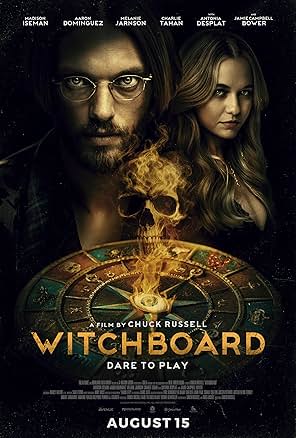

“Witchboard” (2024) is a remake or a reimagining of writer and director Kevin S. Tenney’s 1986 film. Starting in 1693, Lorraine, France then fast forwarding to contemporary New Orleans, the titular object’s origins influence the present when Emily (Madison Iseman) prepares to close one chapter of her life to start another with her fiancé, Christian (Aaron Dominguez), a chef preparing to open a restaurant, Creole King Café, until she finds a pendulum board which yanks her back into the past and threatens everyone she loves. Will the lessons of the past be learned in time for Emily to live her life? Be prepared to have a very different experience from the original.
Emily is a bland, underdeveloped character who exists to be the damsel in distress and support her fiancé’s dreams. Only her backstory makes her interesting, and she reflects a lot of emotional maturity when one of Christian’s friends, Richie (Charlie Tahan), invites Christian’s ex-girlfriend, Brooke (Mel Jarnson). Even though Emily presents as a good girl, she is a recovering addict. Even that aspect of her past makes her seem like a victim of manipulation at the hands of her former dealer Jessie (Francesco Filice), not an autonomous person making bad choices. Iseman does a good job in a demanding two hander playing Emily as herself and later as the possessed Emily.
Brooke is Emily’s complete foil: well-traveled, educated and oozing sensuality. Cowriters Greg McKay and Chuck Russell, who also directed, seemed to want Brooke to function as needed depending on what kind of person was required for that scene: a rival, a friend, a villain or a hero. If Jarnson did not have complete confidence in depicting the role, her character would be unlikeable, and the “Witchboard” could have lost focus.
Christian is an annoying person who likes bossing people around, ordering them to do things that he could easily do like turn off a machine next to him and hates cats. None of these characteristics are meant to make him unlikeable but could just be how the writers imagine a chef acts. Chefs are eagle-eyed with a severe attention to detail. It requires Herculean suspension of disbelief that he would not notice a change in ingredients leaving his kitchen and be oblivious to a huge cat plating a dish in his kitchen. He is also aggravating because when the supernatural shenanigans begin, instead of telling his girlfriend about his concerns, he leans more on Brooke, which exacerbates the situation. While he is not cheating physically or emotionally, his view of his fiancé is not as a capable equal, but someone who needs to be saved. Dominguez is handsome and serviceable, but the highest compliment that he deserves is that he is a better actor than any of the male actors in the original.
Christian’s friends and colleagues, i.e. Emily and Christian’s “family,” are severely underdeveloped and seem to exist just to have enough people to increase the body count. Other than Ritchie, moviegoers would find it impossible to recall the names of any of them even if their life depended on it. Also, it feels inadvertently offensive that a bunch of people opening a Creole restaurant in New Orleans seem like transplants, not residents pre-Katrina. McKay and Russell clearly put all their energy into the backstory of the spirit board, which is more developed and threads throughout the entire story compared to the original.
“Witchboard” borrows more from “Tarot” (2024) than the source material in creating Naga Soth (Antonia Desplat, who was magnificent), which means she who will never forgive and is the woman who created the board. Naga Soth’s story is a very contemporary reimagining of history of the misunderstood villain and winds up being more sympathetic than expected thanks to her nemesis, Bishop Grogan (David La Haye), a villain who would make the Archdeacon in “The Hunchback of Notre Dame” novel blush. The weakness in this story is Naga Soth using Emily for her own agenda like Bishop Grogan, and it did not give the impression of “hurt people hurt people,” but a sign of the lack of attention to detail in the mythology, which felt tagged on when it focused on the 1996 murder connection to the object, which is never resolved with a revelation of that murderer. Also, Naga Soth’s transition from a villainized woman into the villain is abrupt and offscreen as if it is the easiest thing to become a witch capable of time travel.
Dr. Alexander Babtiste (Jamie Campbell Bower)—why spell it Babtiste instead of Baptiste—is a mysterious man with an agenda. Brooke introduces Christian to Alexander as an expert who can help Emily. It is obvious that he means no good because he is into the occult, has a British accent and hosts summer solstice orgies. He also hangs out with some white witches who style themselves like “Game of Thrones” Khalessi (Emilia Clarke) and are triplets called Asha (Renee Herbert, Elisha Herbert and Chiara Fossati). Bower is solid and plays his over-the-top, sinister character in a straight manner with no sense of embarrassment. Once he appears on the scene, “Witchboard” channels the dangerous eroticism of Nineties horror.
Bad girls are sexual. In this version, if Emily does not become conscious of her past, it will obliterate her as much as being Christian’s devoted girlfriend will. The pendulum board exists to eliminate anyone who stands in the way of Emily becoming a three-dimensional person or stops her from getting what she wants, which means that the men in Emily’s life are in danger. The problem is that rooting for Emily’s survival and self-actualization is theoretical since she is a blank slate. If the audience is supposed to believe that Emily untethered is potentially powerful, it did not work.
Visually “Witchboard” feels like a high-definition television movie, horror anthology series or a Dimension Films production. The horror notes are bountiful compared to the 1987 movie, but unoriginal and are occasionally reminiscent of Sam Raimi’s work if diluted. After “Batman Returns” (1992), there has not been such a huge congregation of cats in an alley, and they are all the friendliest, fluffiest, happy cats, but they are supposed to be evil and sinister. The cat slander is not appreciated and congratulations to the cats for revolting and acting in the opposite manner. Some of the horror elements just seem tagged on instead of being integral to the story. Russell has been in the biz since the late seventies, and he seems to be a man of his times, but the presentation could be an effort to pay homage to the original. He also seems to think that horror needs more action, and the soundtrack can be very intrusive.
If you are interested in how the remake measures up to the original, it is almost impossible to compare the two, but some aspects of the narrative remain. McKay and Russell did not seem to understand why the original resonated with audiences but were intrigued at the idea of a love triangle and removing one of the points just like the first film to make a stronger union, except they did not lay enough of a foundation to make that pairing truly resonate. They also decided to keep the possession storyline without warning the audience though it is easy to see it coming. They also kept my least favorite trope, law enforcement mistaking an innocent for the culprit, which the original thankfully did not belabor in such a sensational manner. It was a good move to tie the addiction theme to the user of the board, but they did not take it beyond that. They expanded the psychic role and took it in a completely different direction which enhanced the horror theme instead of using it for subverting supernatural tropes and using the character for comedic relief. The location of the ring felt more organic in the remake than the original though it would have been great if Emily’s secret passion to become a plumber would have made Emily interesting. By showing and not telling, the shower scene spells out what is happening to Emily, which seems obvious so it may feel redundant and unnecessary to some and welcome to others.
By being uneven, “Witchboard” is faithful to the original and begging for a sequel, which seems unnecessary. It is an ambitious story that under develops its characters and is too comfortable with tropes. It is not an either/or proposition. Characters should be as complex as their narratives. While the girl power redemptive impulse is welcome, McKay and Russell need to make more than one woman character worth rooting for, but congratulations to the actors for filling the gaps that the writers left.