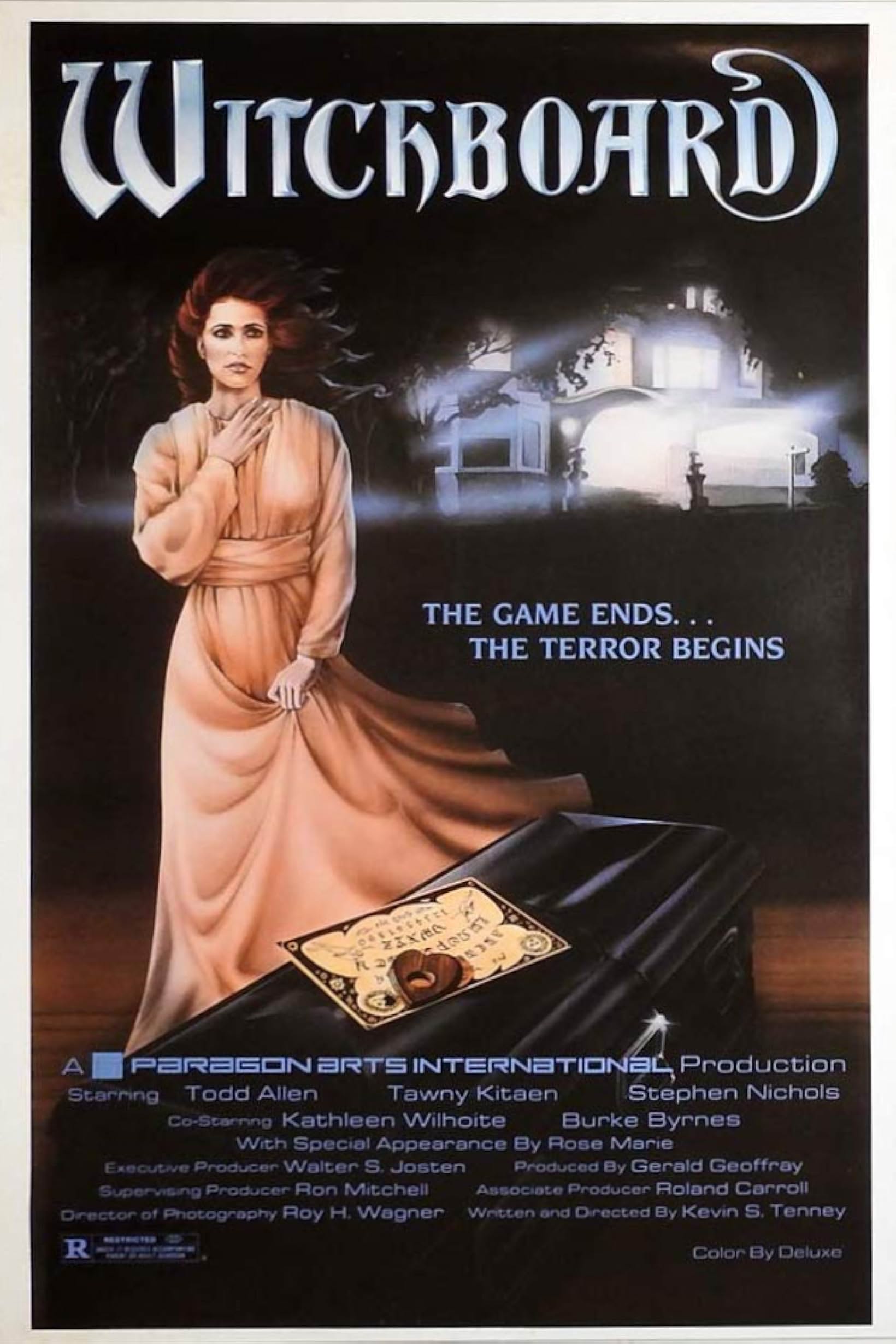

“Witchboard” (1986) is the first of three films. Two former best friends, Jim Morar (Todd Allen) and Brandon Sinclair (Stephen Nichols), are at each other’s throats seemingly over a woman, Linda Brewster (Tammy Kitaen), Jim’s current and Brandon’s former girlfriend. When she becomes fascinated with a Ouija board, and a spirit endangers her, they team up to save her but it may be too late. What is the spirit’s real agenda? This Eighties classic was widely panned at the time, and it is emblematic of the best and worst aspects of that era.
Jim is genuinely an annoying character, but Allen must have been considered a hottie in the day because he is often pictured shirtless. Brandon’s only redeemable qualities are that he genuinely cares for Linda, nopes out of any supernatural shenanigans that feels dangerous to him and seems like less of a snob when he is shown paling around with Zarabeth (Kathleen Wilhoite), Sarah Crawford, an untraditional psychic who is very much a product of her times and location, California. On the other hand, Brandon is the one who brought the Ouija board to the party and is pretentious so his bad qualities cancel out his good.
Kitaen was probably the best actor in the bunch and reflected some nuance in her performance when she was playing Linda or the evil spirit. She also is a good sport because she does the heavy lifting of selling the supernatural component of the story, which included walking through dry ice generated fog. If she looks familiar, she was a video vixen in a Whitesnake music video. She feels very Geena Davis coded. While Linda has many good qualities, her push-and-pull relationship with the board gets annoying. She has one of the most memorable shower scenes in a horror movie after “Psycho” (1960).
When “Witchboard” opens, writer and director Kevin S. Tenney shoots Jim and Brandon’s apartment building as if it is a haunted house or streaight from “The Exorcist” (1973) poster with hazy light streaming out of the windows. It portends the importance of the location to the supernatural events that affect the trio, which is revealed entirely too late. It is alluded to sparingly throughout the film but needed some more work since it is the foundation of the story. The story works better with repeat viewings because of the benefit of hindsight.
When “Witchboard” introduces the three characters, Brandon and Linda seem more like a couple than Linda and Jim. There is an obvious socioeconomic divide in the party. Jim’s construction worker pals are dressed casually and treating the gathering like a party. Linda’s law school friends are dressed more formally and engaging in apologetics, which, believe it or not, is realistic, but usually occurs more in college than law school. The seething hostility between Jim and Brandon feels like what a movie would look like if it continued after a typical Eighties movie of a different genre when the underdog actually gets the popular guy’s girl, but they all inexplicably decide to still hang out together, and the problems with that victory begin to reveal deeper issues between the men. The girl is not the point.
Jim has no emotional intelligence. He is always on the verge of going off the handle at the least provocation, never apologizes and takes nothing seriously. It turns out Brandon and Jim have a deep history. Brandon’s manners are left at the door when it comes to Jim, and he sees Jim as someone incapable of caring about anyone or anything, but himself. The titular object seems to share the same animus as Brandon. Because of the men’s conflict, Jim does not heed Brandon’s warnings about Linda being vulnerable to possession even though it parallels a sudden rash of unusual deaths in the surrounding neighborhood.
While the spirit allegedly wants to possess Linda, all its actions point to stripping away anything that exacerbates Jim’s attitude, functions as an obstacle to Jim being a good partner and facilitates strengthening the relationship between Linda and Jim. Jim’s blue-collar friend, Lloyd Salvador (James W. Quinn), prevents Jim from maturing. The conflict between Jim and Brandon also ruins Jim and Linda’s ability to be a public couple in the community. Eliminating Brandon as a rival also makes Jim into a more eligible option. The possession also primes Linda into being an ideal mate by forcing her to choose between masculine and feminine norms. Linda is going to law school, and she actually is a fun character because she routinely shouts and swears at Jim when he does something that no one likes, but it is sadly a sign of the spirit’s progress, not her customary mindset. The masculine side of her is dangerous and negative. The evil spirit also forces Linda to stop going to school and need Jim’s protection so it is not genuinely empowering. Linda’s feminine side is depicted as thrilled to talk to the spirit of a ten-year old boy named David and be pregnant with Jim’s child. To be fair, all three work on their talking with (dead) kid skills.
For viewers watching “Witchboard” in the twenty-first century, it will either satiate your hunger for nostalgia or become a hate watch because the acting is a bit stiff and declaratory, which was more customary in the Eighties though criticized when the film was originally released in theaters along with the special effects. While watching the movie, you can be forgiven if you confused it with “Village of the Damned” (1960) because there are so many blonde people at the beginning of the movie, but it was set in California, so it makes sense, especially considering that era thought Janice Dickerson was exotic for having dark hair. Jim and Linda have a waterbed! Everyone is styled in a way that is now considered dated.
Tenney’s camera work depicting the POV of the evil spirit is quite effective and gives the mysterious evil spirit a personality before its identity is unveiled. If the story feels muddled on first watch, it is because Jim seems to have an addiction problem thanks to his family history and his use of alcohol to cope with frustration over Brandon’s insulting behavior at the party, but Linda is the one addicted to using the board, stops being functional and behaves like a drug addict to keep the Ouija board from Brandon. Shout out to Gloria Hayes who plays the memorable Wanda, the proprietor of Wanda’s Warehouse, who gives the spirit’s backstory and looks amazing while doing it. She feels like the inspiration to the changes adopted in the reimaging reboot in “Witchboard” (2024). It may not be intentional, but characters with a vaguely Hispanic name were either evil or layabouts.
“Witchboard” is an uneven horror classic that has a strong narrative, but the execution needed improvement. It also does not help that it was not strong at the time of release, so time reveals its flaws more. It shamelessly left the door open for a sequel, and two did follow. As a completist, I’m tempted to watch them, but in those days, sequels were usually worse than the original, so it is not high on my list of things to do.
S
P
O
I
L
E
R
The spirit was actually Carlos Malfeitor (J.P. Luebsen), a serial killer who lived in the building, not David.