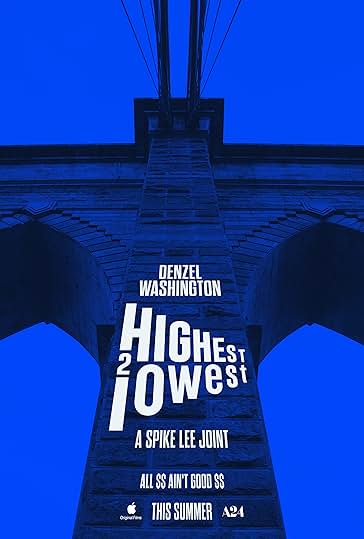

With Ed Bain’s 1959 novel, “King’s Ransom,” and Akira Kurosawa’s film, “High and Low” (1963) serving as inspirations, not source material for an adaptation or a remake, “Highest 2 Lowest” (2025) is Spike Lee’s latest movie and his fifth collaboration with Denzel Washington (“Mo’ Better Blues,” “Malcolm X,” “He Got Game” and “Inside Man”).* David King (Washington), also known as King David or “the man with the golden ears,” is on the precipice of making the most audacious business deal of his life to become a majority stockholder of Stackin’ Hits when a crime that hits close to home disrupts his plans, and he is forced to choose between profit and his soul. The biggest risk is losing yourself and what you love.
Kurosawa fans will consider “Highest 2 Lowest” an abomination. Boston sports lovers will probably skip the film entirely considering that he devotes an entire sequence to chants “Let’s go Yankees. Boston sucks.” As a sports atheist, I’m just surprised that he cares more about baseball than basketball. Haters are fans, and he did not mind Boston when he was working at Harvard in 1991 before NYU brought him back home. Even if composer Howard Drossin’s score is beautiful, you will grow to hate it after never having a moment of silence in most of the first half as it melodramatically and incessantly tells moviegoers what to think and feel when it is obvious. While Lee’s films often belong in the musical genre, even musicals have silence.
The first half of “Highest 2 Lowest” hews closest to the cinematic source material if it was filtered through a New York strainer. A kidnapper snatches the chauffeur’s child, Kyle (Elijah Wright), instead of King’s son, Trey (Aubrey Joseph), which leads King to the dilemma of whether to pay for someone else’s kid and bring his family to financial ruin. In the US, it feels more realistic that a Black, new rich family would be more vulnerable to reverse mobility. The hardest part of watching “High and Low” during the worst timeline is suspending disbelief that a wealthy man would do this, especially if he is not so wealthy that paying the ransom would send him tumbling back down the hill to poverty. People do not even want to pay taxes and begrudge supporting people in their family, even themselves, and would rather outsource any costs to anyone else while keeping their own pockets full. Lee deserves credit for establishing a relationship between King and Paul Christopher (Jeffrey Wright), his driver, who also lives with him. While their backstory is not discussed, King and Paul’s friendship is as sincere as the financial divide allows them to be and likely originates back to the days when King only had his name, not the cash, to back up his title of being on top. Pairing Wright with Washington is one of those magical moments that people put on their casting wish lists. They get along also because Paul knows the rule of “big bank beats little bank” and accepts when King does not let him say bye to his son before dropping them off at basketball camp.
Lee also devotes time to showing the difference between how law enforcement treats King and Paul though they are suffering the same predicament. Sometimes Lee makes the tension, and outbursts lean towards the histrionic instead of realistic when the latter would have been more emotional resonant than theatrical. Detective Higgins (Dean Winters, who also plays Mayhem in the Allstate commercials) initially is on a hair trigger when Paul breathes around him. Inexplicably once Paul is no longer a suspect, Detective Higgins must talk down Detective Earl Bridges (John Douglas Thompson) from a silent standoff. There is a scene where all the cops encircle Paul thus preventing him from returning upstairs to his home soon after finding out the news, and it just does not work. There are plenty of ways to show the class disparities and the mistreatment of those with criminal records without putting the thumb on the scale. It is characteristic of the masculine posturing that also happens between King and Trey, who clearly love each other, but there is not a single encounter between the two where King does not feel the need to assert his dominance. Lee makes the sons older in this version as foils for the antagonist as “Highest 2 Lowest.” There is a bit of subconscious moralizing about how young men should position themselves to their elders as if Lee is a bit anxious and territorial.
The first half adopts Kurosawa’s then innovative police procedural style as an excuse to memorialize Black culture that is teeming in King’s two-story apartment in the sky. It also offers a lot of handwringing about social media, the use of AI in art and the ethics of the dilemma, which is a fairly decent translation from the twentieth century story about the shoemaking business, quality versus profit, and concerns about newspaper coverage of the ransom in Kurosawa’s film. King’s wife, Pam (Ilfenesh Hadera), is the one who introduces the concept that “High and Low” ends on: what if starting over and leaving Stackin’ Records is the answer. If it was up to me, I’d cut the first half down severely to get to that theme sooner rather than later.
Riding the 4 train from Borough Hall to 161 St-Yankee Stadium is when “Highest 2 Lowest” becomes wholly Lee’s film. King drops his comfort and security like he drops that ransom bag and get back in touch with his hustler street side and who he was when he first started Stackin’ Records. Hot tip: if you are carrying all your money in a bag, use the straps to hang it to your body so you do not drop it. While it would be a fair, well-earned criticism to complain that this Americanized version centers King more and is way more of an old man’s fantasy that he still has it, Lee clearly most resonated with the story of the shoemaker who worked with his hands, became an executive then wanted to incorporate both skills into something that reflected his fullest self, and he wanted to explore it. The “Law & Order” franchise owes much to Kurosawa for the second half, and if Lee replicated it, his average viewer would confuse whether Lee was emulating the movie or the possible series. Instead “Highest 2 Lowest” is literal and metaphorical. It has more in common with films like “The Lincoln Lawyer” (2011) and “Arbitrage” (2012) where a white-collar man is such a mover and shaker that he can navigate all socioeconomic circles and go up and down that ladder without losing a step. King does not need cops to handle his business.
The kidnapper, Yung Felon (Rakim Mayers, A$AP Rocky, aka Mr. Rihanna), as King David’s biggest fan and self-appointed nemesis works better than expected, and it is a shame that the trailers give away so much about his story, so it won’t be discovered in context. Mayers holds his own in a face-off with Washington, which is as exciting as any chase scene on foot or in a car. Plus, after “Highest 2 Lowest” finished, I found myself singing his rap song and dancing around my home. Damn it! It is interesting that so many movies lately are about the generational gap, and this one may be the first where it is the older generation revealing fears and seething resentment of the younger generation. To be fair, King should be hostile to Yung Felon, and the implicit underlying themes of their conflict would not be considered if not for the tension in the father-son dynamic. There is an implicit idea that the wealthy only care about ethics based on how it affects them or how close it hits to home, but someone like Yung Felon is invisible though he is in many ways just as much the King’s family in a societal sense. There is not as much discomfort in the idea that he is expendable and irredeemable.
By recognizing that King joined the game for the love of the music, not the money, theoretically King makes amends at the end. If he stayed in touch with the music, he would have heard Yung Felon earlier, but the other lesson is that young men need to wait their turn and apprentice under older men, not carve their own path, to find success. At this point in his career, Lee seems insecure as if someone else’s success would endanger his future, especially if they did not learn at his feet and show indefinite deference. He does not have to. When he remains untethered from the past and tapped into the present, no one is more bold or innovative. The only one who can trip up Lee is Lee himself.
*For fun, I asked ChatGPT that question, and it answered, “Malcolm X” (1992), “He Got Game” (1998) and “Inside Man” (2006) and not “Da 5 Bloods” (2020). Google AI got it right. ChatGPT probably omitted “Mo’ Better Blues” (1990) because of the sexual content. Is this your king, tech bros? If the world relies on AI, people with good memories will eat anyone alive who relies on these large language models.