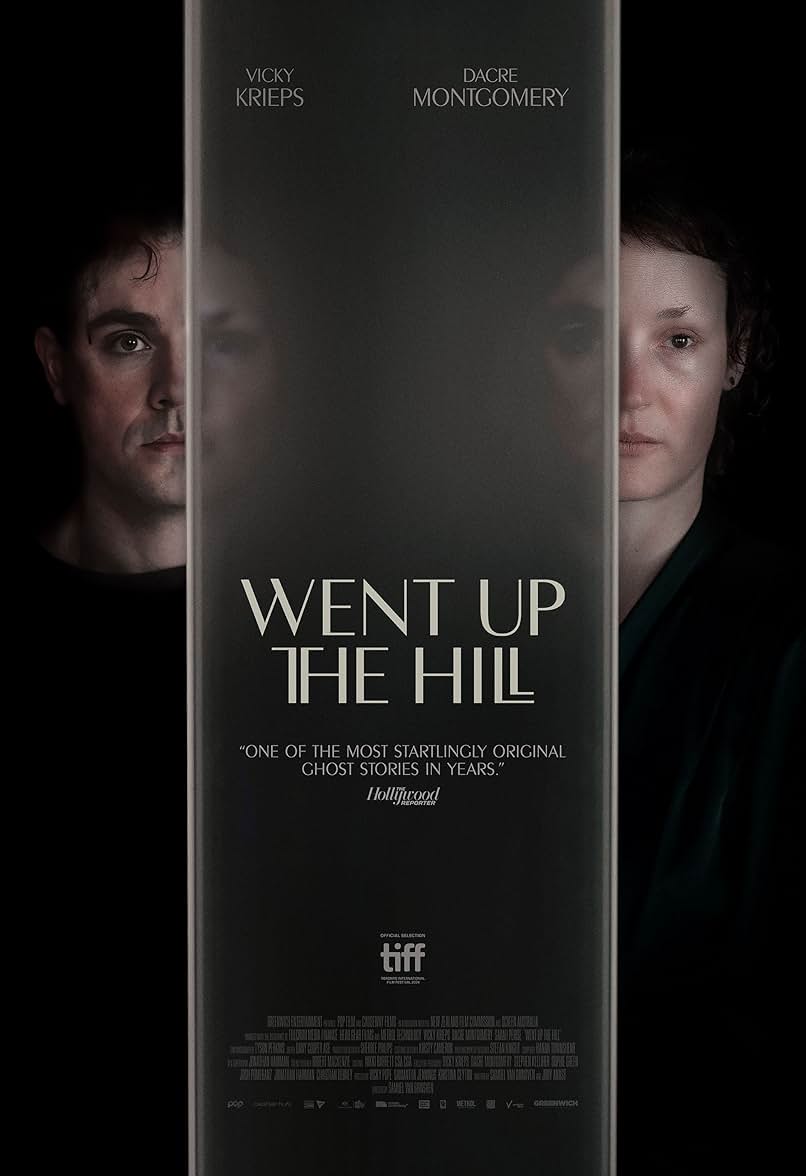

The trailer for “Went Up the Hill” (2024) starts with the line, “Three Souls, Two Bodies.” The two bodies belong to Jack (Dacre Montgomery) and Jill (Vicky Krieps), Jack’s mother, who lost custody of Jack when he was a child. Jill invites Jack to stay at the marital home, which has a view of a mountain and a frozen lake so not quite a hill, but good enough. He comes to the funeral and meets his mother, Elizabeth, when the deceased’s soul possesses Jill. Jill confesses that Elizabeth does the same with Jack’s body. Why is Elizabeth back and how will she move on?
Krieps is an amazing actor, so it is no surprise that she knocked “Went Up the Hill” out of the park. Earlier this year, she delivered her customary perfect performance as a supporting actor in “Hot Milk” (2025). Here she plays two roles: a weaving wife in mourning and Elizabeth, the deceased, who is never shown in her original body. Krieps does act like two different people in her physicality, her demeanor, her voice, etc. She loves her wife and is willing to accept this phenomenon since she is not ready to say farewell.
Montgomery is less of a known quantity, but he may be the hook to draw people into an artsy fartsy movie despite its supernatural premise. Jack may be one of Montgomery’s few feature roles as an adult and is a serious one to boot. He is best known for appearing in “Stranger Things,” which I still need to see. Here Montgomery fills Jack with yearning, constant woundedness and flickers of astonishment. He keeps up with Krieps, and his performance as a mother and son is as convincing as Krieps. Jack is an artist, and his romantic relationship is on the rocks more because of self-sabotage than lack of interest, but he is stuck trying to make sense of the past. With his mother’s death, that resolution will never happen. In many ways, he is claiming a filial stake that he never had in life, but in a quiet, understated manner. Initially he is unaware that possession is a two-way street.
New Zealander director and cowriter Samuel Van Grinsven and cowriter Jory Anast are clearly well-intentioned and deserve credit for taking some big swings in subverting possession and haunted house mythology and using them for maximum psychological impact to explore grief, loss and denial. Jack has never known his mother except briefly as a child with few, if any memories. It is a surprise and a relief that “Went Up the Hill” dispenses of Elizabeth trying to prove her identity to Jack while in her wife’s body. Jack just accepts it without questioning Jill’s sanity and does not appear initially alarmed at the situation. In many ways, his maturity level is arrested, and he is still a kid who wants his mother. When Montgomery acts as Elizabeth, seasoned moviegoers will begin to see the red flags. Even though this film is billed as a horror film, the horror is not the inexplicable possession theme, but the lack of enthusiastic consent in this arrangement. Elizabeth seems to act first and expect everyone to get onboard, but do not conflate Jack and Jill’s joy at the return of their deceased loved one with consent to everything that Elizabeth wants to do with their bodies and future.
It may not be a good idea to see “Went Up the Hill” if you are currently a friend of someone in a relationship that is bad for them, and they kind of know it, but chug along anyway. It walks a fine line with a situation that is rape, and the violated party reacts in that way, but it is not a deal breaker, and it is only the first of many moments that are difficult to watch. It is frustrating that television series and movies brush over the impact of such assaults on male characters. Helen (Sarah Peirse), Elizabeth’s sister, is written ambiguously. She could be aware that Elizabeth is back because she seems conflicted as if she is happy to see Jack, but also eager to get him the hell out of there as if she knows that he is in danger.
“Went Up the Hill” can also be frustrating because it spells out details that can be inferred and leaves other parts up to the imagination which needs more foundation. There is a scene when Helen references Curtis’ kids. Does Jack know Curtis? Would he even know or care about these kids’ location? It must be on the cutting room floor, but that residual line got left behind. On the other hand, what is going on with Jack’s family that is so bad? Many of the scenes show something, then Krieps whispers the dialogue that explains it. It slows down the pacing that is already deliberately glacial but probably is helpful for less seasoned moviegoers.
Also “Went Up the Hill” is like “Kissing Jessica Stein” (2002) and “The Cakemaker” (2017) where it uses same sex relationships as a backdrop to explicit depictions of heterosexual sexuality. Fortunately, in this movie, it uses that heterosexual dynamic to surreptitiously sneak in an issue as endemic to same sex relationships as heterosexual ones, but the heteronormative veneer is still a reflection of a pulled punch. It is also so rare to have a male character wake up in a woman’s bed without consent and know that he did not do anything wrong. To destroy that dynamic and revert to the more prevalent one in fiction and reality is still shocking, maybe more so, but a missed opportunity to create new images for people to be on guard against.
Van Grinsven is much better at executing his vision as a director than a writer. The landscape is shot at times crystal clear and other times in an oneiric style that makes it seem unreal. In some scenes, it is deliberately hard to tell when something is up or down, clouds or fog, and it adds to the unease and danger. I’m assuming it was unintentional, but the exterior architecture of the house in the opening scene, especially with the multiple chimneys, felt like a visual reference to a concentration camp. On one hand, the house had warm welcoming tones, but with its concrete or stone juxtaposition, it felt cold and dangerous. It is a tenebrous film with the light falling on the wood in such a way that matches the gothic constant deep moans. It may be a modern house, but it feels as if the shadows are hiding something. The decision to blur characters to signal possession is an excellent way to introduce the concept though it becomes clearer and shot head on after the supernatural element is hashed out.
“Went Up the Hill” uses horror tropes to examine real life horrors but pulls punches filtering it through a romantic lens as if only love can transcend death. An emotionally textured story could get lost in the deliberate pacing and narrative structure missteps, but Krieps and Montgomery keep the story on track for an ultimately original tale about choosing yourself above all else and breaking with the past if it is harmful.