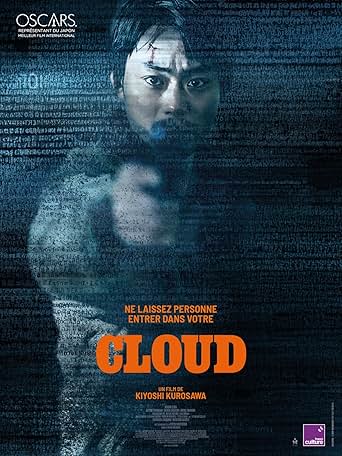

“Cloud” (2024) follows Ryôsuke Yoshii (Masaki Suda), a reseller who advertises using a different username, Ratel, which means honey badger. Yoshii is allergic to the demands of a conventional life and commits to selling items online without much consideration for the people that he buys the goods from or the people who buy them. His move to the country leads to his online persona catching up with him. Which side of him will survive? This is going to be a spoiler review.
I’m unfamiliar with Kiyoshi Kurosawa’s work, and “Cloud” is likely the first Kurosawa film that I have ever seen. It felt like “Jacob’s Ladder” (1990) meets “Identity” (2003) filtered through a late era David Cronenberg sensibility without the body horror, but that cool, grey monotone drab style characteristic of his latest films. Instead of sex, hustling consumes Yoshii. It feels like this movie is about Yoshii’s death, literal or spiritual, until he has no humanity left.
When “Cloud” begins, the movie feels as if it started in the middle of the story. Yoshii’s Tokyo’s routine is established: hustle, home, work, girlfriend, Akiko (Kotone Furukawa), and friend, Muraoka (Masataka Kubota). He also lives in the city and uses two different types of vehicles: a van and a motorbike. As the story progresses, he becomes stripped of these things, i.e. his humanity, either of his own volition or by force. Yoshii shuns every aspect of his life that distracts him from his hustle except Akiko: quitting his job, turning down his friend’s offer to collaborate, etc. He only behaves like a normal person around Akiko.
There are signs from the beginning that his luck is turning bad: a dead animal left on his front stairs, electricity issues at home, his supervisor, Takimoto (Yoshiyoshi Arakawa), appearing outside his apartment. Also, Muraoka seems to be unraveling though he does not share what happened. If the events in the movie are real, based on what happens to Yoshii later, it provides a clue regarding what stressors Muraoka is experiencing. The biggest near-death moment in Tokyo is a clotheslining incident. The only disturbance that feels quotidian, not sinister, is when his girlfriend distracts him from making an online purchase as they discuss the future stage in their relationship. The most sinister is when all the diegetic sound stops while Yoshii and his girlfriend are on a bus, and a man in black looks at Yoshii’s telephone screen with his new home’s address then leaves without his face being visible.
After Yoshii leaves Tokyo, “Cloud” is rife with surreal moments that do not feel rooted in reality. Usually, movies get more sinister when people arrive in the city, but Kurosawa makes the suburbs more dangerous and brings out everyone’s worse self. The events have an oneiric logic, fever dream aura with his conflicted or split inner self expanding. After moving to the suburbs. he hires Sano (Daiken Okudaira), an unemployed local who also seems to be well connected, amoral and devoted to Yoshii. Randomly a cop, Hojo (Toshihiro Yagi), turns hostile and knows about Yoshii’s shady business dealings. When Yoshii becomes more invested in his hustle instead of disinterested, he begins to show more emotion and get desperate whereas before, his hustle style was described as instinctual and effortless.
“Cloud” uses the Internet as a site for conspiracies, which is fair since doxxing exists then Kurosawa puts that mobbing action into the three-dimensional world to show how demented it is. It raises ethical issues. If you would not do it online, you should not do it in reality, and vice versa. The online conspiracy translates into disparate personalities coming together to get revenge on perceived slights against Yoshii. It is absurd. People are allowed to quit their jobs and reject promotions, yet it is an offense that Takimoto deems deserving of the death penalty. Tonoyama Souichi (Masaaki Yamada) seeks revenge for the opening scene when Yoshii did not pay him what he thought the items were worth. A man masked like a killer in a slasher, Miyake (Amane Okayama), joins the mob to make money because he is a reseller with a smaller bounty on his head. Muraoka is just as fervently out for revenge even though Yoshii has not done anything to deliberately hurt him other than have more perceived success and spend less time with him. In real life, people are keyboard warriors, but few would translate their online actions into physical violence or collective action. It is not real. They do not even care about collateral damage and kill others with impunity.
It is also interesting that the mob’s destruction of property never damages the merchandise. One running joke, which becomes the punchline in their rampage, is the inability to use an espresso machine, which is one of the items that Yoshii and Akiko buy and see as a symbol of their success, but actually using it reveals how incompetent they are as normal people when they try to use it. Akiko is a normal woman who is not practically very useful, and through the course of “Cloud,” she begins to act more like a femme fatale in a noir and cares more about money and things.
Similarly, exaggerated and unrealistic conditions force Yoshii to choose between being a normal person or an underground criminal. Yoshii initially does the prior, but with Sano’s help, he begins to defend himself and lose all normal human reservations about hurting people until he is gunslinging like a gangster. When the exaggerated Yoshii and Akiko reunite after the threat is extinguished, the outcome of their relationship destroys Yoshii’s last shred of humanity. The final scene feels very Biblical, which is unlikely since Japan does not have a Christian mythology background, but it reminded me of Satan tempting Jesus on a mountain since Sano and Yoshii are in a car with clouds surrounding them as if they are above the world or ascended to heaven in an iron chariot. It reminded me of a more depressing “Suspiria” (2018) with figures usually considered evil winning but associated with images that usually have positive connotations.
In the end, “Cloud” is ambiguous, which I don’t mind, and well executed, but not for me. It could be literal or a metaphor for soul and/or physical death, exaggerated or accurate. It could be the personification of the Internet’s atmosphere. I love a bonkers, strange plot, but as more characters were introduced, I became less invested in the plot and could see where it was going even if I could not predict every detail of the twist and turns. Because Sano was the personification of a get out of jail free card, and Yoshii became a Mary Sue to make a theoretical point, I did not care. It does not mean that the movie is bad, but it just was not for me. It could be satire like “Eddington” (2025), but it hit less hard because I am not a part of Japanese society. All genders get doxed, but if a woman was the protagonist, it would feel more plausible that all these random people, especially her boss and friend, felt as if she deserved to die if she did not exist for them.