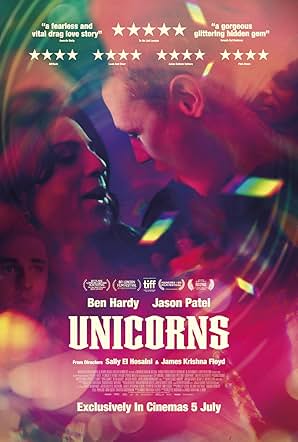

“Unicorns” (2023) is about an unlikely pair crossing paths and finding themselves drawn to each other. Luke Tilson (Ben Hardy) is a working-class mechanic who cares for his son, Jamie (Taylor Sullivan), and works with his dad. Like Alice in Wonderland, he discovers a vibrant, loud and vivacious world when he sees Aysha (Jason Patel in his feature debut) whom he is immediately attracted to until he finds out that Aysha was assigned male at birth. After Aysha finds a reason that Luke will find acceptable so they can continue to get to know each other, will they find a way to shake off the roles that they believe that they are supposed to play and just admit that they love being together?
Luke knows someone in his life is missing, and he would latch on to any person who showed a bit of interest. The scene leading up to him meeting Aysha is codirector and cowriter James Krishna Floyd and codirector Sally El Hosain’s finest work. One minute, he is living an ordinary, quiet life alone then he is emerging from Plato’s cave into a world that is completely foreign to him in his own backyard. Aysha’s first appearance on screen is not when Luke sees her but as she is getting ready at home in fabulous fragments with a pulsating soundtrack simultaneously in two places at once with clips as if she is already dancing in the club. When we finally see her in full on the street as a person, she still looks amazing but expresses frustration. There is the image and the real person, and the image is like a goddess, which is who Luke initially sees. The rest of the film is about making sure that Luke really sees the complete person, not a fantasy or an image that he has been taught to react to with revulsion. It is also about Luke discovering himself: what he likes, what he wants and how he feels. For all his bluster, Luke is fundamentally decent and shows respect to everyone. The hardness is a veneer.
If Patel is giving such a seamless performance his first time at bat, what will he do with more experience?!? The world when “Unicorns” was filmed versus when it is being released is dramatically different so let’s hope that he gets a chance to continue doing the Lord’s work and bring characters to life who are not easily defined or often given a three-dimensional depiction on screen. Patel is a magnetic performer, and all of Aysha’s dance numbers are riveting. Recast “Trap” (2024), and it would be credible that Aysha could fill stadiums with adoring, screaming fans.
It would be easy just to stick to the electric part of her life, but “Unicorns” gives a complete picture. After meeting Ben, El Hosaini and Floyd introduce the transition from Aysha, the drag queen, to Ashiq, his government name and the name that his Manchester family continues to call him. He is a practicing Muslim who is not out to his family as a gay man or a drag queen though they would have to be blind or stubborn not to intuit that he is queer. These scenes are painful and essential because the people who accept all the trappings of Ashiq’s femininity, the styling and dancing, are more vocal in rejecting that side of him when he tries to bring his full self to them than the members of his family who do not approve of these characteristics, but just coexist with all the trappings and are more offended at the Westernized language. Queerness is a commodity for heterosexual people to enjoy, not a person or a community to be embraced.
Aysha introduces Luke to the gaysian world, and Luke introduces her to his son. Just when they are opening up to each other, they each entertain the possibility of returning to their lives before they fundamentally changed on a soul deep level. At this point, Ashiq’s story takes center stage in a surprising, heartbreaking and necessary way to prove that Luke is not just into the flesh, but the soul of the person before him. Luke returns the favor that Aysha did for Ashiq: remind him of the joy of being alive. It is a nice change to have Luke do the heavy lifting instead of the person of color being magical and life changing.
“Unicorns” is full of surprises. I went into it thinking that it would be a trauma-free meet cute version of “Femme” (2023) with the white working-class guy resisting his feelings, but it is so much more. It actually reminded me more of “Weekend” (2011), especially in the scenes with Luke and his friends, Danny (Dan Linney) and Poppy (Madelyn Smedley), although it is not as tight a story. Luke has this wide-eyed epiphany when he is palling around with Danny that it is the physical sensation, not the gender, that gets his engine going. That quiet mixture of panic and wonder would definitely be worth journaling if he was into that kind of processing. Floyd and El Hosaini devote more time to each person as they live their separate lives and together, which is realistic, but makes the movie feel a bit unwieldy and lose momentum. It does create the unstoppable urge to see them back together again because they crackle. There is a cut of this movie that makes it perfect, but it is not necessarily this one.
For all their differences, “Unicorns” also highlights an important fact of British life: class. It is easy to speak of Aysha/Ashiq and Luke’s differences (race, ethnicity, gender, sexual orientation, religion), but they share the same financial stage. In the United Kingdom, their families may have different demeanors with the Tilson clan living in a way that accepts their status as a fact, not good or bad, just is. As immigrants, Ashiq’s family’s class status is not known, but they are respectable and present as bourgeois in their sensibilities and décor though with a specific cultural twist, but the story is silent regarding their profession. Aysha makes a joke about being good at math because she is Asian, but Luke is the skilled laborer while Ashiq works in retail as a day job. They belong to the same class, which is why they can meet, but Ashiq’s family could have looked down on Luke and worry that he was a threat if they encountered him on the street.
There is a scene where the cab driver drops Aysha at home, uses the honorific “Miss” with that working class lilt and makes sure that she gets inside safely. Underlying “Unicorns” is this utopian world of possibility, a world where regressive identity politics of how the world should be are erased and people just are. This world can be a place where working class men are actually protective of people without looking under their skirt or examining their birth certificate, and it is possible to find what your heart needs if you broaden your horizons a little bit. Isn’t that better than seeing a working-class man and worrying that he is going to beat someone up?