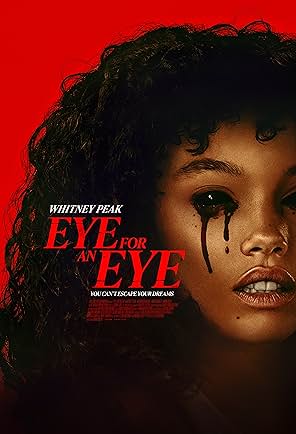

Don’t confuse “Eye for an Eye” (2025) with the Sally Field/Kiefer Sutherland 1996 rape revenge film. This one involves folklore about Mr. Sandman, a dream monster who punishes bullies with nightmares before taking their eyes. After her parents die, incoming senior in high school, Anna Reeves (Whitney Peak), moves to Georgia and falls in with the wrong crowd, Shawn Heard (Finn Bennett) and Julie Cross (Laken Giles). When someone seeks revenge against her new friends, Anna gets lumped together with them though she did not actively participate in the wrongdoing. Can she make amends and break the generational curse? The film adapts Elisa Victoria’s “Mr. Sandman” (2025), which is described as a horror adult picture book on the author’s website and is no relation to Neil Gaiman. Victoria works with cowriter Michael Tully to translate the action from the page to the screen, and director Colin Tilley brings Victoria’s images to life.
To gauge how good “Eye for an Eye” is, you need to understand that S. Epatha Merkerson, who is best known for her iconic, nineteen-year performance as Lieutenant Anita Van Buren on “Law & Order,” plays Anna’s blind grandmother, May Roberts, who lives in an isolated house in the woods. Even without a vengeful folklore tale, Merkerson’s performance is so unsettling that it can only be described as the equivalent of a velociraptor in “Jurassic Park” (1993) meets a woman more subtle than Doormat Mom at the glee that she shows when she meets her granddaughter, which implies that her daughter (Jessica A’Zora) went no contact with her. Even her sister, Patti (Golda Rosheuvel), suppresses revulsion when she visits. The narrative’s underlying tension is that these sisters are tied together for half a century in regular contact, and they cannot stand each other. It turns the backdrop of the mythology into a visceral, waking nightmare. Imagine “What Ever Happened to Baby Jane?” (1982) without the overt abuse, and then suddenly some kid drops in completely clueless about the mess that they walked into. Is this hagsploitation? If it is, then more of this please and thank you! Delicious, ruthless and unremitting.
It is not even the worst aspect of Anna’s life before she crosses paths with a dream monster. She was in a car accident with her parents and survived then she had to leave her hometown to live with these strangers. Anna basically got a main course of trauma, a side of trauma, an amuse bouche of trauma with the dessert of trauma rounding the corner. Peak is stunning even as Anna is put through the ringer and left looking wan and ashy. From the opening scene, Peak conveys Anna’s bone deep exhaustion. While engaging in her artsy fartsy hobbies, it becomes extremely apparent that more than the average bird, Anna is attached to her eyes, and they are intrinsic to her way of life. Peak may be an artist in real life and/or a great actor because she seems like a natural. Also “Eye for an Eye” is not a dialogue heavy film, so Anna’s instinctual wariness of her grandmother is the equivalent of a prey animal in the presence of a predator. Because Merkerson is such a beloved figure, it is hard to give credence to Anna’s reactions, but not for long.
The weakest element of “Eye for an Eye” is believing that Anna would hang out with Shawn and Julie. Shawn felt like the kind of guy that would hang out with other guys, not girls. The only way that it feels plausible is if there were no other people their age in the area. Shawn is a walking red flag, and the story would have worked better if his good side made a single appearance. By association, Julie feels questionable, and her first scene with Anna sounds like a veiled threat. Also, the dialogue was disproportionately weighted with Chekhov’s threatening water, so it feels like a letdown when those allusions have no significance except as a feint. Considering how they were acting in the opening scene, it is easy to believe that they are capable of far worse. Let’s chalk up the relationship to timing and circumstance. That relationship dynamic needed more work before everything went to hell.
Recently my critique of “Bride Hard” (2025) chided them for sneaking in a plantation wedding to avoid critique. In the case of “Eye for an Eye,” any story set in the South demands that a vengeful tree should have some antebellum deep history, maybe even an indigenous folktale. In the twentieth century, tales of Black children from the North visiting the South and winding up dead did not fit the horror section. It was history—think “Till” (2022). So initially Anna’s cluelessness in befriending two Southern teens who seemed suspicious and harmful from jump felt as if it was going to have a racial component, and it was a relief that they were just delinquents. Then Shawn has the aura of future rapist or abusive husband, especially in the way that he drives and interacts with Anna, but again, it is a relief to have a bad guy who is not sexist. It feels unrealistic, but also a nice break so if you feel conflicted about the story’s trajectory, you may be reading something that the story was not laying the foundation for, but exists in the shared collective, sociological conscious. Peak and Giles’ dynamic towards the end suggests that if their friendship had more screentime, it would have helped to keep the audience focused on Mr. Sandman. It is also a treat to have Black villains that do not further racist tropes and are characteristic of individual pathologies. If you get harmed or die in this world, at least it is not because of prejudice. The horror of this film is more optimistic than our own world.
The mythology is so fresh and unpredictable. Think a mute Freddy Kruger meets Guillermo del Toro imagery. It was very reminiscent of the Benjulle spirit in the South Korean television series, “Island” (2022) or “Aillaendeu,” which was a combination of a contract demon with tree spirits, mokryeongsin. Normally adding elements to a simple story leads to plot holes, but here, it just makes everything more bonkers. As more details are given about Mr. Sandman, it gets confusing, which does not disrupt the terror. It also becomes more unclear whether the imagery is oneiric or real, but if it is the latter, it elevates the risks because at least with Freddy Kruger, you just stay awake. Mr. Sandman is more accommodating. It constantly feels as if “Eye for an Eye” is in the “Drag Me To Hell” (2009) territory, and Mr. Sandman is merciless. Mr. Sandman is scarier from the side than in daylight with nothing obstructing the view. It is always a treat when a story does not revisit the same well with overexposed mythology.
Tilley is really good at unexpected dread, and the writers will keep viewers guessing on whether they have a line that they will not cross. When Anna first appears, before her past is revealed, the sound of careless cars peeling away pierces the audio and infects the audience with her fear of vehicles. There is a black, tarlike substance that could be mud, but also oil or why not just the inner contamination seeping out and showing the real spiritual health of the person oozing it. In one scene, when the tables get turned, it is not a moment of triumph but morbid escalation characteristic of the film’s tendency to raise the stakes in a Spartan way. Blood, broken bones, stabbing and lots of eye gouging are threats that feel more terrifying than death, which is also on the table. In the final act, one common household item makes the rounds, and you will find yourself begging that someone put them away. While the ending could be called a happy, it is closer to a Pyrrhic victory. “Eye for an Eye” has plenty of gore but does not feel cheap or exploitive. Again, this feels like a Gothic, fairytale land complete with an animated sequence that feels spiritually reminiscent of Edward Gorey’s work and perhaps is a direct homage to Victoria’s work. Is Anna an on-screen surrogate for Victoria in the scene when Anna sees the past through her creative lens?
This film does the impossible: makes revenge seem unappealing. “Eye for an Eye” is not only a reference to Leviticus 24:20, but a great moral fairy tale about how bystanders are just as culpable when they stand by and do nothing. The path to redemption and who deserves it is harsher than anyone is prepared to take and is unavailable to most. It is easier to be an upstander who stops evil from happening before the harm is done than to undo it. Also, even if you are a perfect person, there is nothing scarier than losing your parents and relying on strangers who have no biological imperative to prioritize you. Maybe a good double feature with “Bring Her Back” (2025), which is far more menacing, but also thinks orphans are fair game.