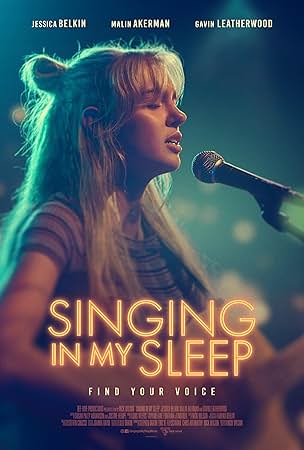

“Singing in My Sleep” (2024) is about Charlotte Lakes (Jessica Belkin), a California young woman who works at an ailing record store, Kevin’s Music, gives guitar lessons, live streams her music on Parse platform and still lives with her mom, Mary (Malin Akerman), to raise money to go to the Nelson Conservatory the following year. She also happens to be the daughter of a music legend, Jack Lakes (Gavin Leatherwood), whom she only met once, but his legacy overshadows her ambitions. Is Charlotte ready to face the truth about Jack’s role in her life so she can move forward?
It is a nice palette cleanser to have a movie about relatively regular people without an apocalypse, dystopian setting or high stakes. It is simply about someone trying to figure out how to step into her future. The backdrop does share one theme with other movies like “Juliet, Naked” (2018) or “The Ballad of Wallis Island” (2025). It uses the aura of fame and glory in the music industry but focuses on the behind-the-scenes life of a cult musician as familiar and relatable. In this case, Jack is part legend, part disappointment and oneiric Rorschach symbol to reflect Charlotte’s subconscious fears. Belkin is a smart choice to ground “Singing in My Sleep” whether as the regular, humble girl next door who has no idea how a mindset adjustment one way or the other could change her world or the confident person who knows exactly who she is and is not. She is worried that she will fail to launch or wind up in the vortex that made her father an inadequate presence in her quotidian life. She is authentic and rejects anything that does not fit her.
Belkin and Akerman have great chemistry, and they actually look like they are related to each other. Akerman does not get enough quality work. As the cool mom, Belkin plays a wide emotional range from treating her daughter more like a buddy than her child to being concerned about her daughter throwing away her future when ignoring a once in a lifetime opportunity. Mary is flawed and even damaging, but not so severely to tip into villain territory thanks to Akerman’s performance. In anyone else’s hands, Mary would be Charlotte’s biggest op and the most hated onscreen character of the year. There is also a theme of self-medication from pot to hard alcohol to handle the fallout from past trauma shared between mother and daughter. Different viewers may have mixed feelings about how it is addressed, but it was nice to not have the expected beats of a substance use recovery story suddenly inserted into the narrative.
As Kevin, the father figure, record store owner and Jack’s friend, Michael Graziadei makes a meal out of a morsel. As the bridge between Jack’s wild world and Mary and Charlotte’s lives, Graziadel conveys nuance and multiple messages in brief exchanges that reflects that Kevin may be the only adult in Charlotte’s life who is looking out for her. It certainly was not Jack, which means that Leatherwood has the heaviest lift. He is not exactly playing a real person, but an icon as seen on a concert DVD, a memory as a person incapable of relating to his daughter as a person outside of his safe space, music, and the social lubrication of fan adoration, and as a dream figure who is Charlotte’s inner voice parenting her more than Jack would have if he had survived. Writer and director Nick Wilson and Leatherwood’s collaboration works because it is impossible to confuse which Jack is on screen.
Wilson’s visual style is very smooth, colorful and polished. It is very West Coast easy and bright even when Charlotte is going through emotional turmoil. He uses black and white to symbolize Jack as the perfect rock star. Scenes are shown through a gauzier and softer lens with a grainy grit filtering out some golden hue of the sun to depict the imperfect past even during heartbreaking scenes. It is almost indistinguishable from the dream sequences, which is where the audio plays more of an important role and other context clues like Charotte as an adult in scenes with Jack when he died when she was a child reflect the shift. When toggling between timelines and the real world, and Charlotte’s memories and dreams, it would be easy to confuse the audience, but Wilson is clear. If there is one flaw, it is when Wilson shows Mary’s memories and includes a perspective that only Kevin had though Mary would have heard it. The screen casting worked, and the role of social media in Charlotte’s life was an unobtrusive way to offer more context.
Wilson falters a bit as a writer with two intriguing threads that needed work and put a drag on the narrative’s momentum. Charlotte has no social life with her peers because they are in college like Barry (Jacob Bond), a friend who had a crush on her, and he introduces her to his college friends, Scooter (Christian Vuipola) and Michelle (Miya Horcher). While Charlotte seamlessly fits into the group, she still feels insecure because they outnumber her and share experiences with Barry that she does not. There is some eleventh-hour drama with Barry, which kind of works, but “Singing in My Sleep” would have been tighter without that complication. Also, it strains credibility that Charlotte has no friends her age because in this economy, most people cannot afford higher education. After years of the MCU, it is annoying to have an inevitable storyline where friends hit the rocks to increase the tension, especially when there is enough tension. The real story is between Charlotte and Jack. Her friends should have been a backdrop to help her process.
It also turns out that Jack left behind a widow, Rissa (Annie Ngosi Ilonzeh), and young son, Skylar (Grae Carter Mathews). It is totally plausible that Charotte would not know them well even though they lived in the same vicinity. There would be resentment and envy, but Rissa is an underexplored, furtive character. Did she bump into Rissa to ensure that Charlotte would play at a tribute concert to celebrate the twentieth anniversary of his debut album? Rissa seems like a caring figure, but she also is deft at hiding the ball, and Charlotte seemed too cool with her given Rissa’s penchant for secret agendas. This character needed more thought though Ilonzeh does her best to imbue her character with a warmth that if lacking, would signal Rissa as an enemy. Also, Skylar and his little friend, Will (Christopher Farrar), felt like a perfect tie to Charlotte’s life as a music teacher plus because they are kids, they can point out the elephant in the room without feeling like a contrived way to address her anxieties.
“Singing in My Sleep” sounds good. Lately the music pivotal to the plot that the characters listen to and play within the movie’s world does not sound good, but everyone is acting as if it is the second coming of pop Christ when it would barely last a second after shuffling to it on Pandora before hitting breakneck speeds to hit fast forward. Melanie Fontana and Lindgren wrote songs that did not sound like ear worms, but I found myself singing along to as they kept reappearing in different incarnations. No one is more surprised than me because I am not into this style. While Leatherwood and Belkin should not give up their day job, they could definitely explore the life of a multihyphenate.
“Singing in My Sleep” is a terrific coming of age story that should appeal to a younger audience, especially music lovers with dreams of artistic achievement more than fame. The daddy-daughter issues, money troubles and fear of failing to launch grounds a story that would otherwise be too predictable as it approaches the denouement. While the pacing loses steam under the weight of uneven storylines, it is still a solid, enjoyable movie that avoids the trite Cinderella theme that it could have fallen into. “My Old Ass” was a success that showed how audiences are starving for more content about normal people, and Wilson’s directorial debut is far better and consistent despite its flaws.