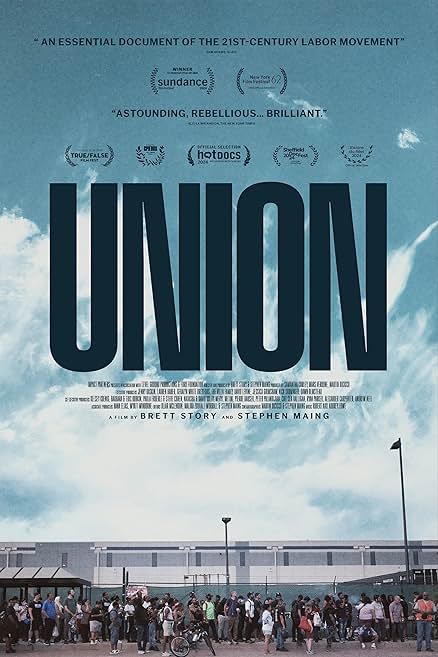

Filming the year leading up to Amazon workers voting in favor of unionizing thus creating the Amazon Labor Union (“ALU”), “Union” (2024) is a classic David and Goliath story with Amazon cast as the giant. The filmmakers captures the grassroots campaign in and around Staten Island’s Amazon JFK8 Fulfillment Center and how the underdog labor organizers were able to sway their fellow and/or former Amazon workers to approve it despite Amazon’s constant attacks to counter their messaging during the work day with implicit on-the-job reprisals. The small but mighty documentary charts the victory but also notes the Herculean challenges ahead to see if they can be an effective union.
While “Union” does not have a protagonist per se, the film predominantly focuses on Christian “Chris” Smalls, the optimistic, focused labor organizer and father of three, and it is easy to get attached to him because he is recognizable, but there are numerous people who are shown on screen even if not named until the closing credits or noted here. Connor Spence, a long-haired redhead in the early part of the film, is a prominent onscreen presence in leadership. After the film, Spence became the union president after Smalls. Jason Anthony, who works at Amazon, has a detailed understanding of the commuting challenges that extend the average Amazon worker’s workday. Anthony’s resolve gets shaken after the police arrest him even though he was not trespassing. Is it a coincidence that he was filming the confrontation on his cell? Natalie Monarrez has the most dramatic personal narrative arc. College grad Madeline Wesley arrives from Florida to work and organize, and her relationship with Monarrez reflects the intersectional challenges within the movement with Monarrez focusing on practical realities and obstacles, and Wesley’s earnest, devout, idealistic approach does not stop her from recognizing the validity of Natalie’s arguments without minimizing them or retreating from her position.
Because this movement occurred during the pandemic, many of the filmed subjects are masked and harder to identify though they are distinct individuals. Brima Sylla is a phone bank volunteer and one of the older workers who lends a quiet reserve to the proceedings. Gerald Bryson is a constant supporting presence who is one of the vocal cheerleaders. Angelika Maldonado points out the conflict among workers stemming from envy. Justine Medina’s most memorable appearance is during a screen casting recording of a Zoom meeting suggesting that a marathon approach may be an acceptable approach. Medina also plays a pivotal role among a handful of masked workers, which included Bret Daniels, who persuade an Amazon worker self-professed to only care about money and almost seemed like an Amazon paid actor to fight against dues but proves not to be when he eventually gets converted. Derrick Palmer is quiet but a constant presence, but he begins to speak more after the election. Palmer could have been one of the masked individuals who closed the deal with the initially resistant union supporter. Julian Mitchell-Israel is instantly recognizable but is off-screen when he chides an Amazon union buster for stealing union pamphlets. Like Smalls, Mat Cusick was a fired organizer, but he is only visible on the edges of the action—blink and miss him. He is fairly vocal in criticizing Smalls’ presiding style.
Edited with the benefit of hindsight, Smalls becomes the de facto protagonist because his strategy and suggestions are vindicated over time, but “Union” does not conflate that positioning with trying to project a unified, harmonious, kumbaya narrative. As the weather gets worse, so do their spirits, and people begin to bristle as they disagree over strategy, which includes Smalls’ tendency to interrupt and speak over people in an organization where everyone is equal. It shows democracy as a fragile group project that can fracture with something as seemingly insignificant as meeting times. To reference a famous AITA post, it is not about the yogurt! The action unfolds in several spaces: outside the warehouse staircase and parking lot, which has the effect of attending a family barbeque, inside the Orwellian warehouse, and virtually on Zoom until the pandemic protocols begin to wane and everyone can meet in person inside office spaces, which also seems to exacerbate relations. Each space has an individual, distinct tone.
Canadian director Brett Story, a great surname for a director, had experience filming Amazon workers, which is how producers recruited her to work on “Union.” Story made a short film called “Camperforce” (2017) about Amazon recruiting seasonal workers among RV traveling retirees. This short adapted Jessica Bruder’s 2017 nonfiction book, “Nomadland: Surviving America in the Twenty-First Century,” which was later adapted into Chloé Zhao’s Academy Award winning film, “Nomadland” (2020) starring Frances McDormand. In this film, cars are liminal spaces that function as homes, conference rooms, offices and finally vehicles to get to work if they are fortunate enough not to need the time-consuming bus. Once Story realized the scope of this film, she requested help from Emmy Award winning, Brooklyn filmmaker Stephen Maing, who did not have to be asked twice. Story and Maing uses Jeff Bezos’ trip to outer space as a visual theme throughout the film by filming the sky through windshields or using a static camera shooting the sky as a cargo ship stacked with shipping containers slowly inches in or out of the frame. If you can see it, you can achieve it, so the sky might be the limit, but it is still hard to escape gravity.
The labor organizers and Amazon workers are also fellow filmmakers surreptitiously recording footage in the warehouse to reveal the counter-campaign, which may not solve the “anti-film” visual problem of usually vertical cell phone footage disrupting the horizontal cinematic screen, but does create a subconscious found footage feel that innately increases the tension. Fighting for workers’ rights feels like an innately dangerous business if you recall nineteenth century American history, but despite the feeling that the overseers can notice and single out any employee, no violence erupts on screen outside of the arrest. This observational documentary mostly shows but also offers explicit context through exposition written over certain scenes to explain to viewers the milestones that the ALU is trying to achieve or any other germane information.
“Union” proves that context does not have to be obtrusive to be informative, and a documentary does not have to be a glorified clip show filled with archival news footage to exist. The first act also does not have to be boring and safe and wait to take chances after finding its footing. It can race out of the gate and maintain the pace. It feels like a movie, not a documentary, which is probably why additional context is not provided such as the names of each person printed on screen or even more personal footage to explain how Smalls could organize full time while financially supporting his family. It vaguely feels like there is another story just out of sight and out of reach for the sake of the union’s conception story. The conclusion teases a possible sequel with other locations inspired to unionize but wisely elects to tell a complete story rather than a comprehensive one.