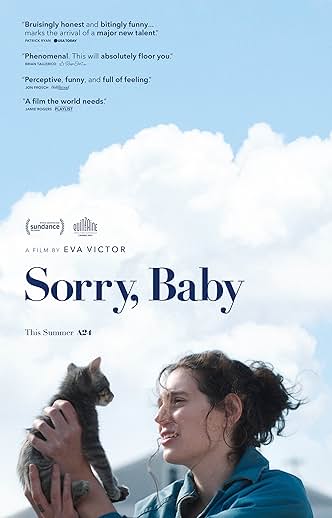

Filmed in Ipswich, but set in Maine, Agnes (Victor) works and lives in the same place that they went to grad school. After a coworker and former classmate, Natasha (Kelly McCormack), asks for the story behind their extraordinary thesis at an informal reunion dinner, the film rewinds to the events surrounding that time about three years ago. Can you watch and not be scared, but just be there for Agnes? “Sorry, Baby” (2025) is triple threat Eva Victor’s feature debut as writer, director and star of a poignant, hilarious, perfect film. Most filmmakers can spend their entire life not making a film even a fraction as riveting and original as Victor. It may be a long shot because of timing, but this film should get nominated for and win an Oscar.
“Sorry, Baby” is kind of impossible to write about because it is better seen than discussed so you can experience it and be surprised. Trust me and just watch it then feel free to come back, but if you insist on staying, here goes. Agnes is a literature professor, and while guiding a student, they uses the following classic critique to guide their description of the class assignment, reviewing Vladimir Nabokov’s novel “Lolita,” “form, presentation and content.” In this context, form is the way that the film is structured, so narrative technique and editing and the genre; presentation is how it looks and sounds, so direction, cinematography and acting style; and content is the movie’s message. In film criticism, we describe the characters, the plot, analysis of the movie’s execution of its raison d’être (reason for being), and is it worth your time. In the analysis section, I always ask who benefits from the story and what is missing from the story when describing the raison d’être of a film. The raison d’être of “Sorry, Baby” is to depict a life experience in a realistic and artistic fashion without trivializing and minimizing it so it feels like you can understand it. It is not all one thing or another.
“Sorry, Baby” is framed in the present with the bookends focusing on how thrilled Agnes is to hang out with their best friend and former grad school roommate, Lydie (Naomi Ackie). Traditional external life markers characterize Lydie’s character such as discovering her sexual orientation, marriage and having a baby, but at her core, Lydie models how the ideal viewer will relate to Agnes: complete love, acceptance and joy. She can watch Agnes go through something difficult, not be scared and accept then without trying to fix the situation or impose her agenda on it. In most films, Lydie would be a two-dimensional supporting character who is impossible to imagine existing outside of the protagonist, but Lydie and all the supporting characters have lives outside of Agnes, but the way that they interact with Agnes denotes how the audience will feel about these supporting characters.
“Sorry, Baby” and Agnes’ story between those bookmarks is chronological but starts further back in time before the traumatic incident happened during grad school. Because Agnes occupies the same environment, it is easier to focus on Agnes as a person and see the surrounding space as an external reflection of their interior experience because it is mostly static: their home, their neighbor’s home and the campus, specifically their office. Agnes is a bit awkward and contentedly lives in an isolated, cozy wooden house where the nearest neighbor is not visible without walking a considerable distance through fields with a spattering of trees. The campus, a car ride away in a walkable town, is a traditional red bricked, warm and inviting place. These locations are almost like individual characters. Before the sequence when the event happened, there is a blink and miss it sliver of a shot showing Agnes at home as innocent as a baby enjoying their self at home before leaving and having their life changed forever.
Victor’s visual approach is very Chantal Akerman-esque and often has a horror tone reminiscent of Ari Aster meets John Carpenter, especially with the exterior shots of houses. Side note: Victor shadowed Jane Schoenbrun during the filming of “I Saw the TV Glow” (2024). Agnes as a protagonist is not just based on Victor’s acting performance, but also their work behind the camera. Any one of Victor’s jobs is challenging, but to juggle acting, writing and directing then pull it off is astonishing, especially since this film is so unexpected and mind-blowing. Victor mostly uses static shots allowing the camera to start and remain in a space long after the characters have left the frame. These spaces are like a stage with people entering and leaving the stage as needed. The diegetic sounds of one scene can bleed into the other scene before Victor shows the audience where the sounds are coming from. The composition of each frame, editing and directing are highly stylized though “Sorry, Baby” feels realistic and organic like a slice of life. Ask yourself about the function of these spaces: public or private, are we supposed to go inside or not, why not, once a character is inside, do we see what happens inside and if we do not, why not. Who is supposed to be in that space? How is that space supposed to be used? How long should a person be in that space? How long does it take to get from A to B? How do you get there: by foot or vehicle? Is it worth the trip? It is also about time and tone with the other person in that interior space. Natasha is almost like the antonym to Agnes, completely insensitive and yet her space is inviting, warm and welcoming though tenebrous.
Doorways and windows are natural framing devices that make pictures within the picture that the frame already makes. In one scene, where Lydie and Agnes are in an exam room, there is a door and a window into the exam room that reveals who is on the exam table. The open-door frames Lydie, and Agnes fills the window. They are together, but also apart in terms of experiences, which their placement in the room symbolizes. After the doctor (Marc Carver) enters the room, the door closes, and the blinds are drawn. We are not supposed to be in there, but Victor invites us when they change the camera location. Within the room, by the end of this sequence, Lydie and Agnes are side by side while the doctor is isolated on the other side of the room. They are a united front opposing him. “Sorry, Baby” infuses significance into the most quotidian circumstances and shows how the past affected the present even when that traumatic event is still a mystery: Olga the Cat (Noochie the Cat), the papers in the window, the choice in footwear and its location, the way and location of where characters eat sandwiches.
When I went to the Coolidge Corner Theater screening of “Sorry, Baby” on April 30, 2025, Victor was present and said that their film contained many moments depicting the absurdity of how institutions fail people even when trying. Victor’s film is also brimming over with love about how people carry each other to the other side of that moment whether it is Lydie, Pete (John Carroll Lynch), a random sandwich shop owner, or Gavin (Lucas Hedges), the neighbor. Also, in a shocking turn of events, while the judicial system does not play a direct role in their life, the courtroom becomes a place that listens to Agnes, does not rebuke Agnes for not fitting into their well-worn script and accepts their words without challenge or mockery. In a more understated way than “Orlando: My Political Biography” (2023), the courtroom also becomes a place of trans rebirth that orients the viewer to who Agnes is, what they want and do not want, which the court honors and respects without trying to change them. There is a quiet identity epiphany born in the bureaucracy. I
Because Agnes survives and finds a countercultural way to stand their ground, they can be that person and represent an institution to the future and return the favor, the love, the acceptance, the warmth and lifeline to others whether it is Jane (Lensley Miles Adams and Langston Shelby Moore), the first baby of Lydie and Fran (E.R. Fightmaster), the envious Natasha, or a random student struggling with thoughts for the first time. “Sorry, Baby” is the funniest, friendship/acquaintance love story about handling PTSD.