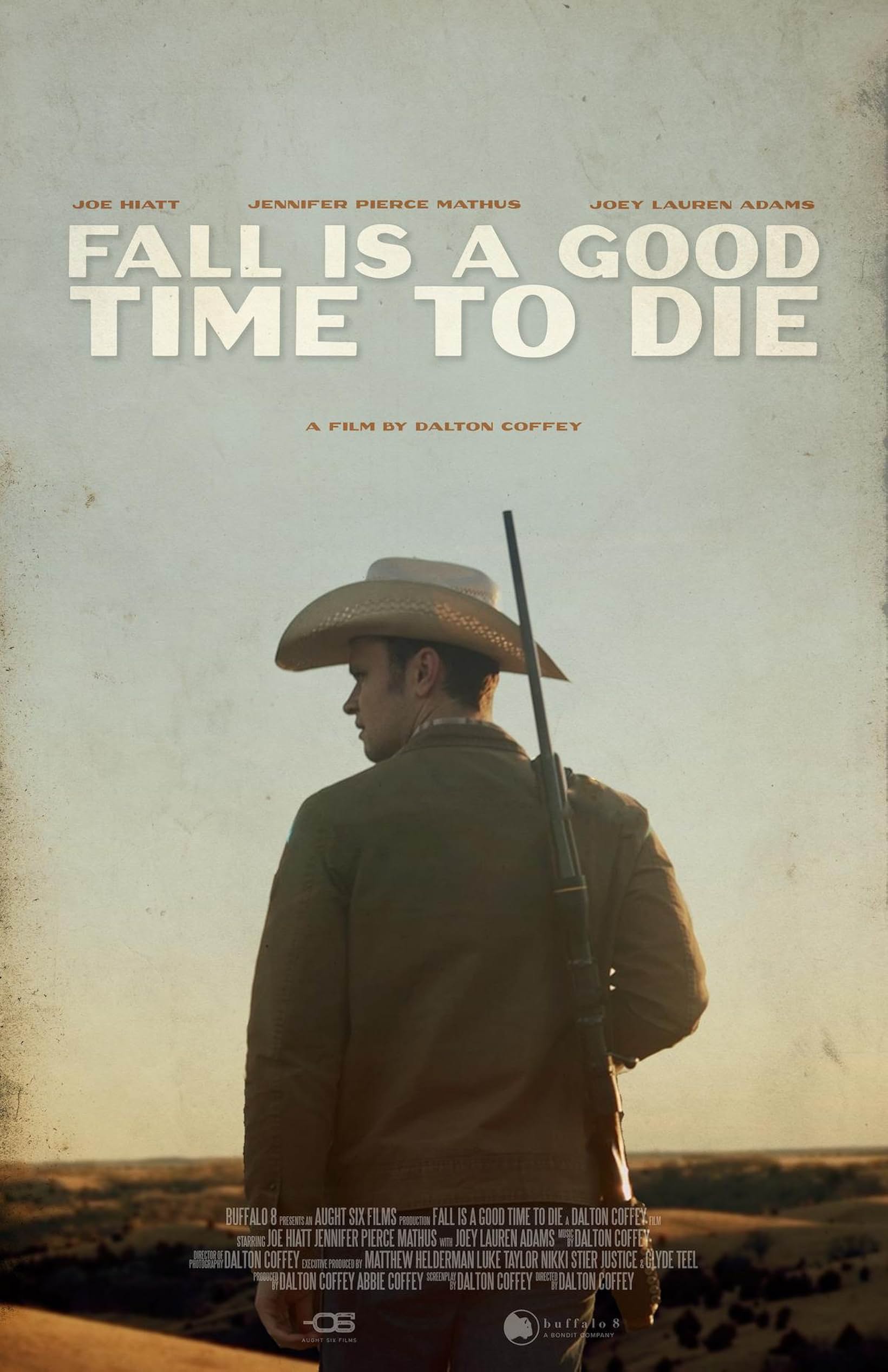

“Fall is a Good Time to Die” (2025) is the kind of movie that is best seen on the big screen, but if it is seen at all, it will only be seen on screens too small to appreciate it. Cody (Joe Hiatt) lives a quiet, simple life until his aunt, Trista (Joey Lauren Adams), unexpectedly visits and delivers the news that Jason White (Christopher Dobesh) is no longer in prison; thus, putting him on a vengeful path. With the depressed sheriff Jane noticing Cody’s interest in Jason, will Cody succeed in finding peace?
Do you know how you can tell that someone is a goddamn star? When they appear, everything snaps into focus. Adams only appears a few times in “Fall is a Good Time to Die,” but each time, before she even says anything, she is like getting doused with freezing cold water in the best way possible. Trista is the most talkative character in the movie and a complete pot stirrer, the kind of person that you turn around and walk the other way when you see her, even if she notices. It is a great performance because instead of hating her, Adams’ demeanor humanizes her character.
With two out of three of his film performances appearing in producer, writer, director, cinematographer and editor Dalton Coffey’s movies, Hiatt is a solid muse. Coffey shows and does not tell in this neo-Western in Hiatt’s role as the vengeful, hesitant vigilante. Coffey did a good job of establishing Cody’s character in the first act, and Hiatt conveys a lot without saying anything. If he was cast in “The Unholy Trinity” (2024), he would have been more convincing when called a boy. When Cody feels compelled to act and is no longer just a young man rich in his surroundings looking at the majestic, flat landscape, “Fall is a Good Time to Die” starts to lose momentum.
On one hand, it is good to mess with the formula of the revenge movie and make it more realistic, but on the other, if you are sitting on a couch, you will be fighting sleep because of the deliberate pacing of this character study. The juxtaposition of characters with their post-fall environment starts to relax you. Cody is not good at this for multiple reasons, including, he is not a cold-blooded killer, and the land is flat so he can be seen from a mile away. Cody’s movement from maintaining fences on unblemished land for his laconic boss, Jim (Bill Sutton), stands in harsh contrast to the seedier, more congested environment of the South Dakota town and the junkyard like surroundings on the White brothers’ property rings the alarm that he should not be there. Civilization contains the seeds of corruption. The White brothers even have loud, obnoxious pick-up trucks. We get it. Chop chop. In a movie theater, Coffey’s cinematography could be appreciated, but at home, it feels redundant and leans towards the excessive side. Again., if Coffey was the DP on “The Unholy Trinity” and was the script doctor, he would have made it a better movie though he needs to work on momentum.
Cody’s story is intercut with Jane’s. A recent divorcee of eighteen years, Jane is an underwritten character descended from Frances McDormand’s sheriff in “Fargo” (1996) without the humor or excessive violence. She is a woman going through the motions, but even on automatic, still on her game. Mathus does a deft job of making a meal out of a morsel in her no frills, elemental performance. When she started eating out of the pan, it was the most realistic, revolutionary moment of a woman on screen since Viola Davis took off her wig in “How To Get Away with Murder.” Yes, that is what women are like! Once Jane and Cody meet, frequent movie goers will probably predict a lot of the denouement.
The good news is that what you cannot predict is a Nolane-sque narrative structure that is not obvious until the end, which retroactively makes “Fall is a Good Time to Die” into a fantastic movie that you will want to see repeatedly to see if you will be able to pick up on the twist. The first time around, I anticipated how the scene should play out, but when it did not, it did not feel important. If you do decide to watch it again, it will be obvious that Coffey deliberately left something out so it would not give away that an experimental narrative structure was even used. Is it cheating? Sure, but did it work? Yes. Well, it did on me, and as the only person bored to tears with a lot of Nolan’s hits because I saw the twist coming in the first five minutes, I appreciate getting got.
“Fall is a Good Time to Die” deserves kudos for not pulling a Marvel and making Cody mistaken for a bad guy. He is the most suspicious person onscreen, and lesser writers would have used that misunderstanding to develop tension. The visual imagery for Cody is a bit heavy-handed. He wears a white hat and white gloves. Eyeroll, he is a good guy. We get it. The opening scene is only powerful if you remember it when you get to the end of the movie, and the weakest film device is starting in media res if it is not obvious. Normalize just beginning at the outset of the story.
“Fall is a Good Time to Die” has supporting characters that seem like ordinary people just going about their lives as if Coffey decided to go to a diner and asked for permission to film then started doing it immediately without letting the ink dry on the release form’s signature line. Such realism does not necessarily apply to the villain, Jason, who is so obviously bad news once he is the only focus that it is unbelievable that anyone would even go near him without the hairs standing up on the back of their heads. Not since Kiefer Sutherland’s performance in “Eye for an Eye” (1996) has someone so quickly stolen the limelight in such a short amount of time. No wonder Coffey only had Cody steal glances of the dude because once Cody faces him, the tone totally shifts.
If “Fall is a Good Time to Die” has a problem, it is that despite Hiatt’s pitch perfect performance, Cody is the least interesting character. Sensationalized stories about the emotional impact of sexual assault on anyone besides the target, usually women and girls, who directly experienced the trauma, is reaching the end of its rope. Even in a movie like “Materialists” where the protagonist could be the one in danger, Celine Song could not quite stick the landing. While Coffey’s movie is not flashy, the way that it handles pain is. It would be a more powerful movie if it depicted a simple man living an ordinary life without getting revenge.
“Fall is a Good Time to Die” deserves better than streaming and has stronger narrative execution than many Nolan films, but its excellence does not fully translate to smaller screens where other distractions compete for its audience’s attention. Let’s hope that it becomes a cult favorite and people demand to add it to a repertoire theater’s schedule so it could be fully appreciated.