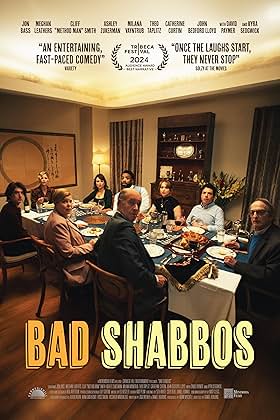

Set in present-day Manhattan on what should be another ordinary Friday night Sabbath dinner for a close Jewish family, elder son David (Jon Bass) is anxious about meeting the Catholic parents of his converted fiancée, Meg (Meghan Leathers). David just wants everything to be perfect, but when someone accidentally dies, it becomes impossible. Will this problem unite or divide the family? If you are a fan of movies where someone dies at a bachelor party but wishes that it was more wholesome and family friendly, then “Bad Shabbos” (2024) is for you.
It is nice to have an onscreen couple that has good chemistry and seem realistic as opposed to “Materialists” (2025). Bass and Leathers are adorable from the minute they appear onscreen holding hands in the back of a car. The first act is the strongest because the ensemble cast and director and cowriter Daniel Robbins and cowriter Zack Weiner do a great job of establishing the characters and their dynamic from the outset. Everyone is trying to make Mom, Ellen (Kyra Sedgwick), happy, but it is not quite working whereas Dad, Richard (David Paymer), is so universally beloved that even doorman Jordan (Method Man) adores him. It is also implied that Mom’s high level of control is to pick up the slack that the absentminded, but affable, vibing Dad leaves for everyone else to manage.
The conflict is the introduction of Gentiles into the family. Meg is trying to fit in and enthusiastically is willing to prove how much she has learned, but Ellen is clearly disapproving of the match. Ellen’s sensitivity is credible when Meg refers to the Old Testament as if it is a prequel instead of the New Testament as a sequel. later gets some good lines to explain away her prejudice-likening her faith to a precious, living heirloom If more people articulated their fears in a similar fashion, they would be more sympathetic too instead of seeming like an unbridgeable chasm. In contrast, David’s sister, Abby (Milana Vayntrub), is dating the horrible Benjamin (Ashley Zukerman). Abby is less observant than the rest of her family, and the family is rooting for their breakup, so the irreverent Benjamin is under less pressure. He is so mean and effortlessly corrupting that you need an acerbic character like that for such nice people to deal with because they are not equipped to handle him although little, aimless, medicated brother, Adam (Theo Taplitz), is willing to rise to the challenge. Zukerman’s dry delivery and the character’s effortless willingness to corrupt fuels the momentum of the first act.
The second act is like a snowball, and the accidental death becomes a Rorschach test to see if Meg is really a part of the family. Basically, everyone panics and must deal with the fallout, but it is such an absurd, heightened send up that “Bad Shabbos” starts to fall apart. Just call an ambulance. You may find yourself wondering if this person is really dead, or if it is a misunderstanding. This section is supposed to provide the opportunity for everyone to hash out their problems, resolve them and come together. Method Man’s zaniness holds everything together, and it becomes his movie, which is delightful, but results in the rest of the endearing characters taking a back seat. The challenge is to clean everything up so they can still impress the future in-laws.
In the second and third act, “Bad Shabbos” starts to play with stereotypes about Black and Jewish people as part of the punch line. The doorman enjoys the family, but when he protects them, he uses some problematic language. Is he messing with the in-laws or inadvertently and innocently mixing up his appreciation of Jewish culture with Antisemitic media stereotypes? Similarly, the family reveals everything to him thinking that he can handle covering up a crime, and he is taken aback regarding why they would expect that. It is more of a misunderstanding microaggression as opposed to an explicit racist statement. While these scenarios do not derail the movie’s levity, it is a bit too serious to enhance the madcap nature of the scenario, but when it shifted gears and started referencing the fact that Black people can be Jewish too, it was the kind of dialogue that my Mom would have loved. It is basically a fun fact info dump disguised as dialogue and possibly a well-intentioned expression of the closeness and common ground that two historically persecuted groups share.
The in-laws are fine, but “Bad Shabbos” loses even more momentum with additional characters sharing the limelight. Catherine Curtin is a terrific comedic actor who is a deft scene stealer as the censor in “Saturday Night” (2024) and the single mom in “Hangdog” (2023). Here she is the internalized misogynistic mom, but she does not get a lot of time to put her stank on it. Also, it feels like a missed opportunity that the one universal issue that transcends faith is being harder on women than men. It is illustrated but never teased out. John (John Bedford Lloyd) is the straight man and plays a J.K. Simmons type, which is exactly what the family does not want. It is a great tie in with the premise of hiding a body, but again, the humor is not in the ridiculous cover up, but the characters.
The ticking clock of the doorman shift change, which means the less lovable and rule following Cano (Alok Tewari) will relieve Jordan and put the family under more scrutiny, returns “Bad Shabbos” to the light directing and editing that makes the audience feel like part of the family. It is like a visual inside joke tha plunges moviegoers into the fun and shows the audience more than the family similar to the stylings of Savage Steve Holland. This gambit worked, especially in the way that it linked to the introduction with an on-street joke between two people who appear at the bookends of the film. The icy Mrs. Grundwerg (Catherine Wolf) is set up as if she is going to be an obstacle, but like a real New Yorker, she minds her business and just wants her mail. A queen! These supporting characters make the proceeding seem real and neat touches to a script that often loses the thread. Also, the apartment is very Manhattan coded affluent. It has two floors! Even Pedro Pascal’s character could never.
The denouement is a little too tidy and pat to enjoy, but it solidifies the theme of uniting a family in covering up an inadvertent crime. “Bad Shabbos” was a funnier movie without the farcical tones, which distracts from the meat of the movie. The tension was sufficient without throwing a dead body into the mix. Everything escalates then deescalates too quickly. It is a funnier movie if no one dies, not because of some pearl clutching bourgeois mentality, but the only genuine conflict is not resolved at the root, which is preserving tradition while entering sincere fellowship with people truly willing to respect and enter the community.
“Bad Shabbos” goes too big, too soon after going home. With great ingredients, this family dinner should have been delicious, but instead of trusting the freshness of its characters, it starts dousing the narrative with too much extraneous, unnecessary fussiness and muddies the flavors until it stops short from becoming inedible.