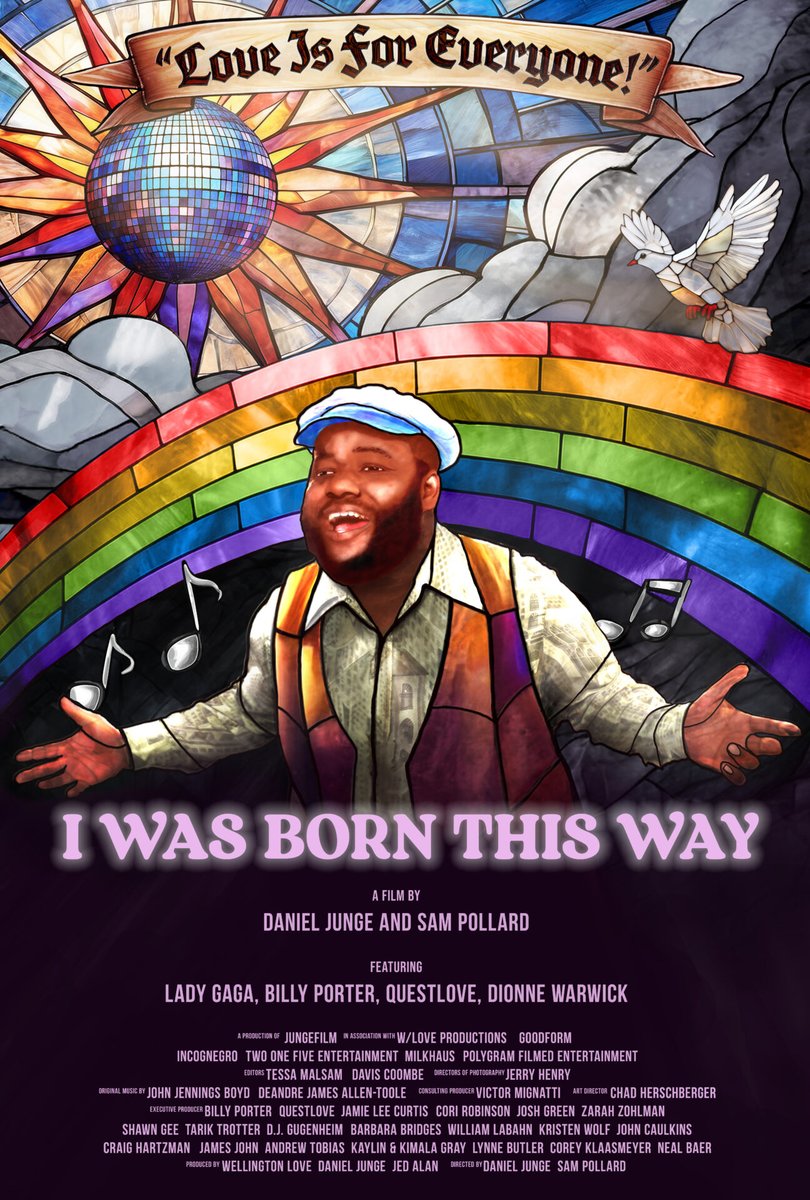

Find out more about the 1977 song that inspired Lady Gaga’s 2011 hit. “I Was Born This Way” (2025) is a biographical documentary about Carl Bean, who was born in Baltimore, went to New York where he developed his professional and personal identity before heading to Los Angeles where he found a way to change lives outside of the music studio, which ended with founding a nonprofit, the Minority AIDS Project, and a new Protestant Christian denomination, the Unity Fellowship Church Movement, which is the first denomination welcoming to LGBTQ+ Black people. Directors Daniel Junge and Sam Pollard make a riveting, rousing documentary that will bring tears to your eyes.
Junge and Pollard mostly structure the story in chronological order featuring interviews with Bean, who died on September 7, 2021, as the primary storyteller of his life so this documentary can be considered the defining biographical documentary about Bean without suffering the usual drawbacks of films with exclusive access to the subject such as pulling its punches and sticking to pure adulation. Bean’s two-day involvement is frank, raw and moving. The filmmakers illustrate his narration using rotoscope animation to recreate the past, which is rare for documentaries, has only been done once before with “Tower” (2016) and is the first time to represent a Black or LGBTQ+ person. They also used archival footage, home videos, montages of photographs and other interviewees’ confessionals to flesh out Bean’s story.
The other interviewees include Martha Payne, the daughter of the people who raised Bean and was effectively his big sister; Estelle Brown, his sister in spirit and fellow singer who collaborated with him; music legend Dionne Warwick, who met Bean in his salad days in Harlem and later helped Bean with his AIDS work; Royal Anderson, the drummer for Universal Love, the first music group that Bean formed; Reverend Elder Leslie Baker and Reverend Dr. Russell E. Thornhill, his successors at the Unity Fellowship Church; Rt. Beatitude Zachary Jones, who founded the 1992 Brooklyn branch of the denomination after offering transportation for Bean’s AIDS ministry; Mike Jones, a fellow activist who worked at Bean’s nonprofit; US Representative Maxine Waters, who got funding for AIDS after Bean inspired and educated her about the pandemic and introduced her to more gay men and their plight on other issues; and Paul Kawata, the Executive Director of National Minority AIDS Council. Baker’s story about a pigeon entering the sanctuary of their first church will immediately cause shivers since it is reminiscent of the Holy Spirit entering and filling the temple. Bean had the gift of prophetic dreams, a gift that has unfortunate roots in childhood sexual abuse trauma and processing it in his subconscious.
Only one interview, with Michael Feinstein, the President of AIDS Health Care Foundation, seems less personally connected to Bean or his hit song. Feinstein is the closest that “I Was Born This Way” comes to having a talking head discussing the sociological aspect of the story, but it is so brief that it is not disruptive. Feinstein offers perspective on the gay community and how oppressed communities are not being immune to racism. The filmmakers’ storytelling creative choices had the effect of feeling as if the viewer is immersed in Bean’s world, which includes a killer soundtrack featuring gospel and disco music.
Even though “I Was Born This Way” is primarily about Bean’s life story, it also chronicles the story of the song from its origin to today. Executive producer Iris Gordy, a former executive from Motown Records, which released the titular song, discusses its evolution, which another singer, Charles Valentino, covered before Bean recorded it. Valentino is still alive and discussed its initial impact on the gay community. Billy Porter has an onscreen role searching for the masters and discovering the B-side song, “Liberation,” which has never been heard before this documentary. Porter first visits Chris Jones, the son of one of the song’s writers, Bunny Jones, a beautician who also is notable for being the first Black woman who established a music studio. Jones reveals why his mother was so interested in music and intentionally supporting the gay community. The other song writer, Chris Spierer, also offers his two cents. Brian Kehew, an audio engineer at the Round and Wound Studio in North Hollywood, works with Porter on recovering the song then having Porter cover it for the close of the documentary. This journey frames the borders of Bean’s life story and has the effect of bringing it forward to the present day. Watching a reaction shot of Porter listening to “Liberation” without hearing the song is probably the only major misstep that the filmmakers take.
“I Was Born This Way” also reflects the impact that this song still has on music to this day even if the artists are not gay. Questlove and Quentin Harris, who also helps Porter onscreen with his work on covering “Liberation,” also discuss how they used this song in their work and how it is still bringing down the house. Lady Gaga offers an exclusive interview crediting Bean and this song for “Born This Way.” Lady Gaga explains, “When that song stopped charting, they did not stop playing that song in clubs and the movement did not stop.” The song is an anthem that unites and hypes up a crowd behind not just behind the beat, but the message.
Normally including famous people to discuss the subject of a documentary feels like a shameless cynical way to get people to see a documentary, but in “I Was Born This Way,” it is so central and necessary. There is an unspoken tension that gets relieved in the documentary when Lady Gaga appears. Regardless of whether it is true, she feels like one of the few white musical artists who actually credits specific Black artists for their role in her work and redirects her fame and talent to the person who came before her, which has the effect of an unofficial music and LGBTQ+ history lesson. As Presidon’t’s policies have an intended censoring effect in the private and public sectors, sometimes the only countermeasure that can keep this history alive is a documentary, which few may watch, but if a figure with global reach has scores of zealous followers who are willing to disseminate her words, then it ensures that Bean’s work and legacy will live on. It feels as if regressive forces periodically repress LGBTQ+ voices so they cannot gain momentum and continue to believe that they are an aberration, not part of a long-storied past.
“I Was Born This Way” is essential viewing for music lovers, members of the LGBTQ+ community and all Jesus followers who may have thought that being a Christian only looked a certain way. It is also a conventional documentary that does not feel stale or predictable. I wish that the filmmakers had delved deeper into what destroyed Bean’s mobility other than years of pent-up trauma from the rigors of helping the dying and facing the brunt of racism and homophobia. Even though the film does not explicitly say it, it is a feature, not a flaw, that the risk of becoming disabled rises if you belong to a persecuted community. It is not always a seismic pandemic like AIDS or Covid. It can be smaller, daily accumulated omissions of providing care combined with causing harm that suddenly leads to an overnight inability to walk.