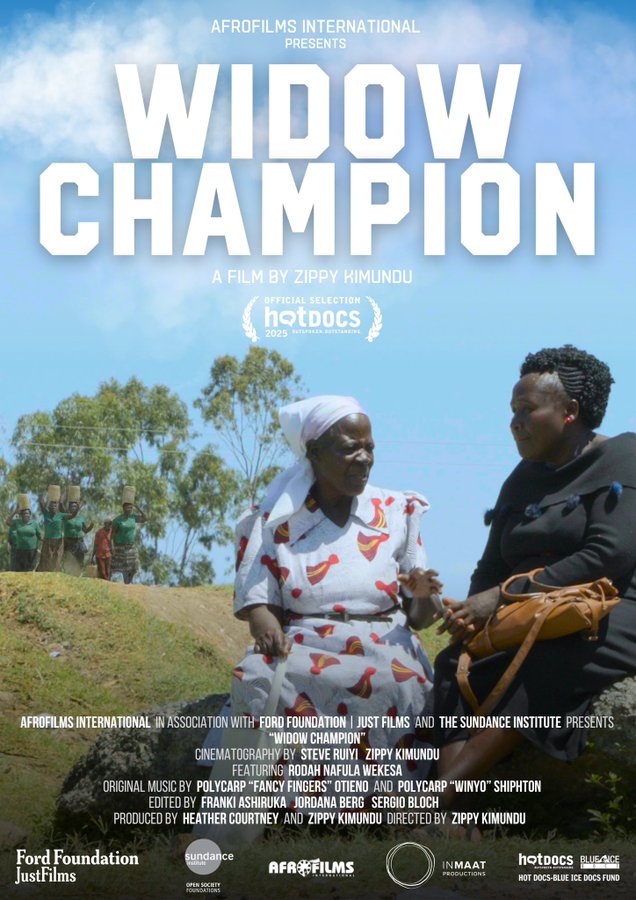

If the Assistant Editor of “Queen of Katwe” (2016) makes a film, you watch it. Starting in 2019, Kenyan documentarian Zippy Kimundu’s “Widow Champion” (2025) follows Rodah Nafula Wekesa, who has the titular mantle, as she walks around Ahero Kisumu County working on two widows’ cases to ensure that they can stay on their husband’s land and work towards getting the title deed because the husband’s family actually owns the property and wants them out. The main problem is convincing the family to do the right thing and cooperate. Will Wekesa succeed or will she end up in the same predicament considering that she still does not have her title deed?
“Widow Champion” is a no-frills, basic slice of life documentary so do not expect any fireworks or dramatic moments. Kimundu just captures everything with tons of closeups of Wekesa’s practical footwear as she trudges through mud, dirt and gravel to accomplish her goal. The only thing that Wekesa has in common with Annaliese Keating is the walk and constantly toting a heavy bag, which is the opposite of a purse. Kimundu films Wekesa at home with her family and protégé, Nancy, at the market, at government buildings for her own project, educating people, holding Widows Self Help Group meetings and conducting mediations. She is no firebrand lawyer, but a woman who has practical experience dating as far back as 2010 when her husband died of AIDS leaving her to fend for herself and three children with no help from her in-laws. Wekesa is presented as the best-case scenario, and she still has a rough life.
Do not pat yourself on the back about your property rights. This problem is Biblical and universal, but it just looks different depending on what part of the world that you are in. Think about all the American women who move to their husband’s preferred location away from their family and think about their economic prospects, especially if they have children and cannot work fulltime. Classic Hollywood women movies’ action usually kicked off with the death, illness or faithlessness of a husband. Just visit Reddit to see how things have not changed much even if the systematic way of ensuring that women remain financially dependent on the men in their life changes.
“Widow Champion” ends with the specifics after telling the human story, but it is important to realize that this story is a microcosm of a cataclysmic problem. 8 million of 53 million Kenyans are widows with 90% of widows not possessing title deeds and 50% under forty years old. HIV prevalence in Kenya is 3.2%, but in Kisumu County it is 2.5 times higher, i.e. 11.7%, which means there are more widows. Other than Wekesa, the documentary does not divulge how the cause of other husbands’ death. Even over six years of filming, more people than expected die on both sides of the conflict. It is wild. The Covid pandemic is not a factor discussed or visually reflected in the film even though that period overlaps with the production. Could it be a factor in the death? Who knows.
The tradition of “widow inheritance” is supposed to protect widows, but in-laws abuse it, which results in defamation, sexual, physical and/or financial abuse and leaves children vulnerable and impoverished. Their homes get razed, and if a widow gets permission to stay, if she does not build another home (with what money), she could lose that chance. Defamation takes the form of blaming the widow for her husband’s death; thus, rationalizing why she should not get the property. Tribalism is blamed for this phenomenon, i.e. women from a different tribe should not inherit property in a region that they are not originally from, but this phenomenon has ancient roots and is universal, even in blue states. Misogyny is not explicitly referenced or explored but is the root cause. So, ladies, remember, when that man promises to provide but wants you to move, forget love or promises to provide, stay put and close to your birth families. The Bible, Deuteronomy 24: 5 and Genesis 2: 24, says so.
Widow Mary Atieno Ragen fights multiple men for the right to have a place to live: first, brother-in-law Dickson then her nephew, Michael. Their respective wives, Jane and Susan, have varying levels of empathy ratioed to their age and how close they are to being in Mary’s shoes. On screen, some of the women are less repentant than the men in their greed, but it is less representative of that demographic. Widow Theresa Atieno Chacha has a more elevated conflict with alleged death threats and a brother-in-law who does not appreciate the attention that Wekesa brings with her notetaking.
Along with Wakesa, the Luo Council of Elders basically persuade and implicitly shame the men of the family into being decent but have no actual legal authority to force these men into doing the right thing. Elder Kasuku, the seemingly only man in the council, carries the most authoritative weight and is the only one who explicitly brings up HIV in the mediation to deter accusations of misconduct levied against the widows. The other elders are less individuated, but one includes Elder Joyce, who uses a more objective, but less effective approach because of her lack of a penis. Again, if you have ever been in court and heard how some male litigants address women judges, this development is less about the merit of her argument, but her gender. It could also be cultural since community moral pressure seems to carry weight.
For Western audiences, the hardest part of watching “Widow Champion” is how the Council and Wakesa superficially act as if both sides must meet halfway, and the in-laws are not entirely at fault. When the widow finally has an opportunity to get some verbal licks in, no catharsis is permitted. Wakesa and the Council admonish both sides to treat each other like family. At the end of meetings, everyone sings and prays together, which seems to have the effect of solidifying that bond but also talking in Swahili may lose some of the saltiness and passive aggressiveness in translation that would be revealed if this imposed harmony is as forced and hard to take for the participants as it is for the viewer. It makes sense because the Council and Wakesa have no actual authority to chide people so persuasion is the only weapon in their arsenal, but damn, it still feels like partially validating misogyny. It also gets frustrating because the abuse permeates broader society, not just families, including the ability of widows to earn a living.
“Widow Champion” may feel like deliberate pacing because of the simple, sedate story, but it rewards movie goers who pay close attention and has insane plot twists. It is a high stakes movie that may be downplaying the challenges so the tone of the movie could be hopeful and inspirational. Apparently a NGO, the Kenya Legal & Ethical Issues Network (KELIN), developed this program, and if the documentary dropped the ball, it is because the film showed did not fully denote KELIN’s involvement in this work.