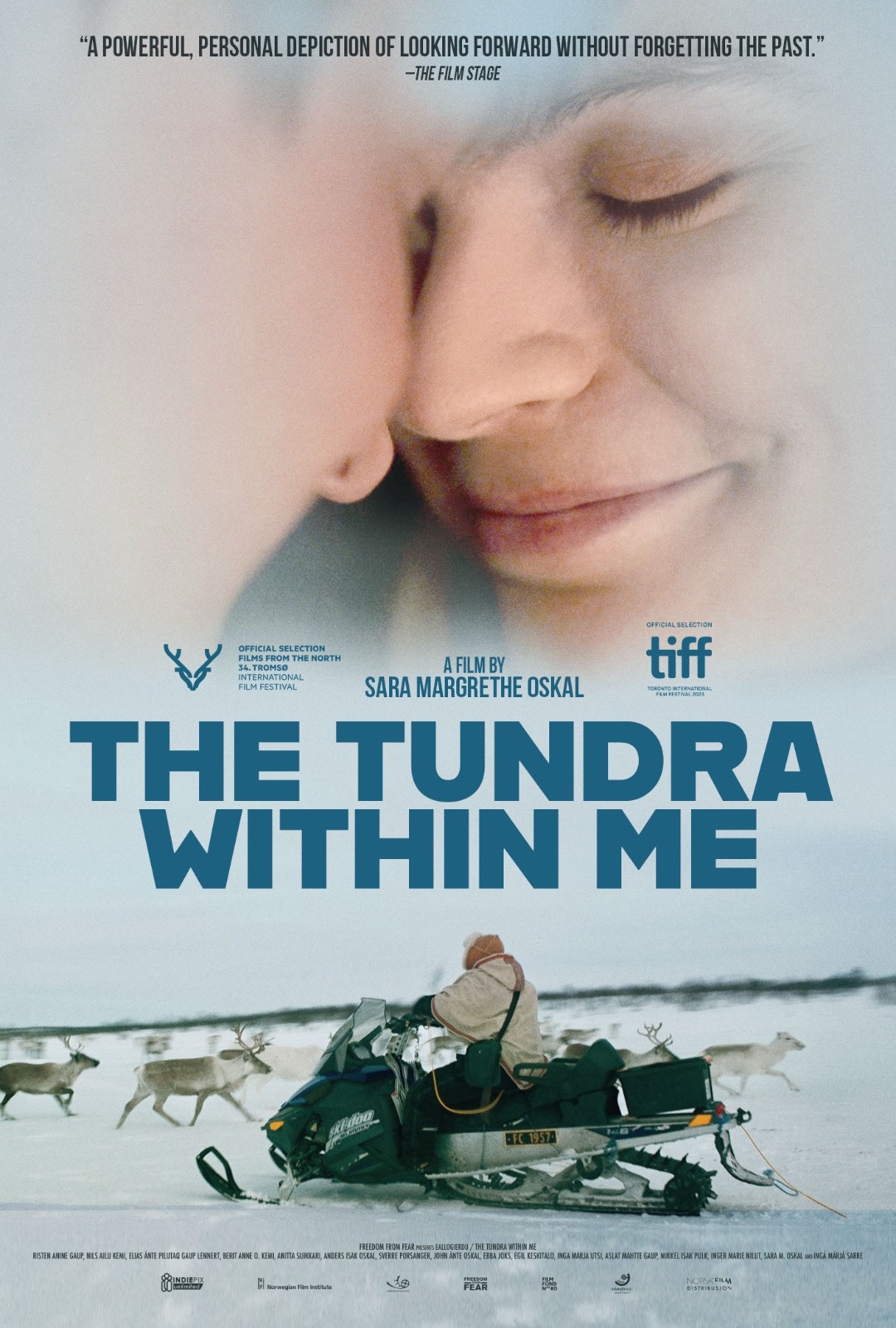

“The Tundra Within Me” (2023), original title “Eallogierdu,” is former actor Sara Margrethe Oskal’s feature debut film, which is notable for being one of under thirty films that center the Sámi people, an indigenous group who lives in Sápmi, which includes the northern part of Norway, Sweden, Finland and Russia’s Kola Peninsula, not to be confused with Scandinavians who migrated north from Germanic areas. Lena Thomasdetter Spein (Risten Anine Kverrnmo Gaup) returns home from Oslo with her son, Jonas Ántá (Elias Ánte Pilutaq Gaup Lennert), to work on a visual art project depicting the harsh reality of being a woman reindeer herder. Máhtte (Nils Ailu Kemi), a male reindeer herder, is the only person in the community who welcomes her home without having a prior relationship with her. They fall in love, but can they be together when their work is leading them to different places?
I’m an ignorant American who did not even know that the Sámi people existed before watching “The Tundra Within Me” so the following should be taken with a grain of salt since I am reading the film from a completely foreign context. Lena is a tortured individual struggling with fitting in, but she also doles out an incredible dose of self-condemnation, which is quite understandable given the sociocultural context. Lena is a strong woman unafraid to note all the qualities that make her less than desirable within the community, but the problem is that she kind of agrees with them. She receives a frosty reception from the locals, including her mother, who know of her and are more content talking about her behind her back than welcoming her. Lena’s reasons for leaving Oslo, where her work is better received, are not stated, but it could be because she misses home, wants her son to be exposed to a culture that she values and broke up with her son’s father, who is a nonissue in the movie. Lena is a more avant garde artist than her hometown is used to. They would prefer almost photographic, less abstract,conceptual depictions of their life and think that by critiquing, not glorifying, her experience as a herder, she is disrespecting them.
Oskal, who was also once a herder and became an artist, explicitly stated in an interview that she put elements of her life in Lena’s story, so Lena is her onscreen surrogate. While making movies is inherently subjective, Oskal’s images are explicitly at war with itself. On one hand, the scenes predominantly show almost everyone treating Lena like an outcast, but there are also scenes that suggest she has a larger number of supporters than outside of Máhtte and her childhood friend, the local bartender. She becomes the local joik (traditional, pre-Christian, deeply poignant singing that could rise to the level of religious significance) champion. For the first, she needs votes, and in a second jolking scene, people, men and women, are cheering her. Lena has valid feelings of being an unaccepted outcast for being a conceptual visual artist instead of staying in the traditional profession, but Oskal also chooses not to not individuate the jolk audience who supports and cheers her on. They are shown for a second.
All the traditional indigenous women are depicted as hostile, which could be true, but none of the indigenous women who support her get more than a few seconds of screen time. The one woman who greets her with a smile does not get named though an audio recording of her interview later gets played and seems to articulate Lena’s reason for abandoning tradition. Lena is not alone. Her creative decision could be an unconscious instinct to project or externalize her shame for giving up her traditional vocation but Lena’s status as the local pariah should not be classified as a fact. Oskal may have to further unpack and decouple the way that she prioritizes negative people and their feedback over her supporters., but that internalized shame, which may stem from self-hatred for being a woman or an indigenous person, impacts her creative choice to primarily focus on the haters with the slightest nod to her supporters outside of her love interest.
In the US, women are gradually learning that it is a red flag when a woman claims to only have men friends and only complain about women not liking them. It is usually a sign of internalized misogyny and/or her prioritization of men, i.e. she is a “pick me.” Lena has no women friends. Lena is also depicted as the ultimate specimen of Sámi women, the fairest of them all. She lassos better than the guys without practice and can navigate a herd with ease on her scooter, but does not show any women engaging in similar activities so it makes her seem more authentic than the sour women who surround her as if they are all talk. Decolonization is a lifetime process. Though unrelated, as someone who spent most of his life living in a fascist regime, Pedro Almodóvar took a lifetime to directly confront the historical traumas that he lived through in his films. I’m not criticizing Oskal, but just observing and calling her in to face herself even more than she has already done in “The Tundra Within Me.”
This need for decolonization also explains why Lena, the protagonist, becomes a supporting character in the second half of “The Tundra Within Me.” All the momentum is in the struggle for Máhtte’s soul. Will he remain a herder or go to Oslo? When Máhtte is initially introduced, he seems like a profligate windvane whose head can be turned if a pretty woman walks through the door or a shiny scooter is available. He is ready to chow down on some reindeer steaks while his mom Gáren (Berit Ánne Oskal Kemi) actually knows how to heal and save the reindeer’s life, which gives a broader margin of error when she starts acting like a jerk. As the movie unfolds, the scooter validates his professional judgment, which reflects an appreciation of how contemporary solutions can preserve traditional values and explains why he is so attracted to Lena. He needs it to protect the herd and have a life whereas his mother wants his entire life to be about herding. Tightening control over him has the opposite intended effect.
Gaup and Kemi, who are both in their first feature film, have terrific chemistry because the story does not devote a lot of time to why they are attracted to each other yet seem plausible as an instant match when they end up hitting it off. Oskal establishes their individual lives so the audience can see how they complement each other. There is a red flag moment during the aforementioned second joiking scene, which felt too seismic of a disturbance in character to brush over in an otherwise solidly paced film. Lena loves Máhtte for being everything she wanted to be and could not.
Visually the editing between the outdoor scenes and Lena illustrating her mother’s story about the creation of the Earth is sublime work, which makes the subsequent entry of mom Márjá (Anitta Suikkari) and her assessment of the painting such a gut punch. If “The Tundra Within Me” could improve, it would be to make interior spaces as riveting to watch as the outdoors. Oneiric scenes that occur in the real world also depict the creation myth using a lone albino reindeer or reindeer running around Máhtte as they are herded into an enclosed space but not stampeding him. It reveals the connection between primordial elements, animals and human beings like a covenant.
“The Tundra Within Me” is an innovative autofiction film that has value on multiple levels: to document Sámi people and culture, to tell a story about three-dimensional characters, to show a familiar environment in an elevated cinematic way. Will it be one of my favorites of the year? No. The story feels as if it pulled punches by delivering a happy ending without tackling the practical obstacles in the relationship. It feels as if they are kicking the can down the road to get a happy ending.