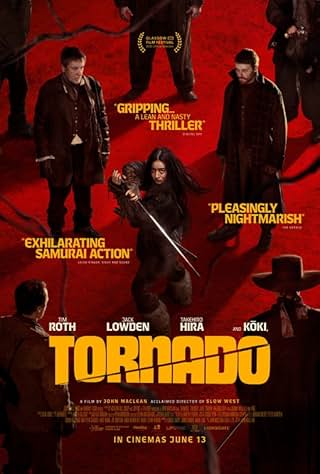

Set in 1790, “Tornado” (2025) is about a girl (Kôki, a musician whose given name is Mitsuki Kimura) who reaches a crossroads and takes a path that leads to a ripple effect of destruction for all who reside around a lake on the British Isles. Writer and director John Maclean learned from the mistakes of his first film, “Slow West” (2015), by recognizing that Tornado was the most interesting character, improving his story with Western meets Samurai elements and retaining his eye for breathtaking visuals. See “Rust” (2024), it is possible to simultaneously do something fresh and by the book.
Kôki gets a seat in the pantheon of girls and women kicking butt, especially since she often plays an unlikeable, vulnerable character who does dumb things. Kate Leys contribution to the story grounds the film in emotional and psychological realism, especially the lack of idealizing the daddy daughter relationship. Even though Tornado is the main character, and most of the movie rests on Kôki’s shoulders, the entire ensemble cast is phenomenal thus doing the heavy lifting for thin characters who would otherwise be two dimensional. There is little dialogue for them to lean on, but it feels credible that everyone is familiar with each other and have well established dynamics. At times, the characters are eyeroll worthy in how closely that they adhere to their archetype. The overarching theme is children rebelling against their parents to live differently but upending their lives in the process. Tornado is a growing teen who is tired of hearing her dad’s instructions, reenacting the same puppet show and leaning towards assimilation over embracing her Japanese heritage. It would be low stakes in a different environment, but they live on an isolated countryside.
The reigning authority is a gang, which Sugarman (Tim Roth) leads. Roth could play a villain in his sleep, and with just his physicality—slight gestures or more frustrated ones—and minimal dialogue, he conveys what an iron hold he has on his big group of men except for his son, Little Sugar (Jack Lowden). Little is rebelling in small overt ways and more substantial ways behind the scenes. Like Tornado, he would like to live a different life, and they both believe that the key to that new life resides in the same object, a possible cursed one if it was stolen from a church. They are decent, complementary, unlikely foils. Other possible obstacles to Sugar’s authority fold with the least resistance. Normally starting a film in media res or using the how we got here trope would drain any suspense from the narrative, but in “Tornado,” it establishes how unstoppable they are and roll over even the most established part of society though they are restrained in this scene compared to their subsequent rampages. Maclean knows how to pace conflict so even though the story is not told in a chronological fashion, it is told in a way that escalates the threat gradually throughout the film, which is something that a lot of filmmakers need to learn how to do. It is a guiding principle for all films involving physical conflicts.
His band of eight men are individuated though two dimensional. Kitten (Rory McCann) is Sugar’s right hand man and probably longest associate/friend. Lazy Legs (Douglas Russell) is the least obedient but because of personal failings, not rebellion like Little or Tornado. Archer (Jamie Michie) is the MVP, and honestly, Sugar does not really need anyone else. Squid Lips (Jack Morris) is a trigger-happy killer with comically slow reloading of gunpowder and ammo in his gun. Ian Hanmore plays a character only referred to as Thief but is almost as recognizable as McCann for appearing in “Game of Thrones” as Pyat Pree who wanted to capture the three baby dragons and Khaleesi in his magic tower to increase his power, but did not succeed for long. Here he has similar arrogance and staying power. Archer Assistant (Sammy Hayman) is the most forgettable. The most memorable visually is Dennis Okwera’s character, who is dressed in all black, but instead of a gun, sports a sword. Then there is a bandit (Bryan Michael Mills) who clearly majored in the arts in college, but there was no money in it, so he became a goon. A lot of movies do not make their henchmen more than red shirts for the hero to take down, and here, they really do seem as if they have the upper hand and are more memorable.
“Tornado” is a simple movie though the story structure is more complex. The first two-thirds involves running and hiding from Sugar and his men. The last third turns the tables as Tornado decides to confront them and avenge herself. Cinematographer Robbie Ryan somehow makes the landscape feel as if it could be a Western with the open spaces and hills or a samurai epic with all the thin, well-spaced trees. This look portends the final showdown. Costume designer Kirsty Halliday makes Tornado’s clothes match the landscape of the opening scene as if she is in camouflage. Maclean is deft at composition, especially people and their relationship to space, how he wants them entering the frame, and maintaining visual variety. Even though the scenario is familiar, it feels fresh because he is not monotonous.
“Tornado” is a story about ego and greed, and how both only lead to waste of life without victory. There are few good guys, and they end up dead. It is also about the basic, universal love of vengeance stories and the enduring power of art to deeply affect people, especially with an underdog protagonist like David and Goliath. There is a play within the movie that is so magnetic that it proves to be a greater attention grabber than gold. The actual story may be flawed, but the flaws, if there are any, are forgivable. The multiracial cast and multicultural characters expand the story with richer personal context than if it was more homogenous. Would Japanese people be living in Britain in the eighteenth century? It is possible though a longshot because after arriving in the early 1600s, the Japanese adopted an isolationist policy against the West in 1630 starting in the Edo period. Would a samurai teach his daughter how to use a sword? Yes, it is rare, but historically documented. Another flaw is that all the older characters are aware of Sugarman’s fearsome reputation, yet they are also acting brand new. People are murderers and thieves, but no racism, which includes exoticism. It is a nice break, but historical revision. The one that could destroy suspension of disbelief is how the gold winds up in one location. Who put it there when everyone was running or dead? Also, girl, why did you put the bandana over your face before your first attack? Everyone knows who you are, and you do not ever put it on again, so it is not the weather. It is just to be cool. Fine, give me the waiver. I’ll sign it.
“Tornado” is a film rife with tropes and anachronistic moments but is such a gorgeous and well-executed movie that you will not mind. Maclean’s sophomore feature is no slump. With a decade in between movies, Maclean proved that he used his time wisely, and it was well worth the wait.