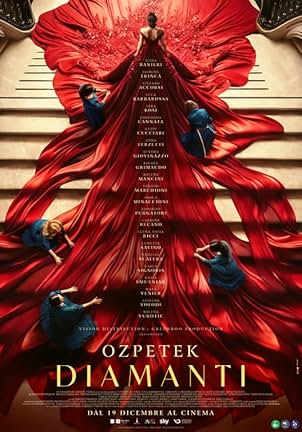

With a sprawling ensemble cast of roughly twenty-two characters, some playing themselves, Ferzan Özpetek’s latest film, “Diamanti” (2024), offers a glimpse into the lives of artists in Rome. Most of the movie revolves around those who work and live at the Canova cinema costume company during the Seventies, but the backdrop is set during contemporary times when Özpetek invites his favorite women actors to an al fresco luncheon and pitches his idea for this movie. The link between these eras and people is “we are nothing, but we are everything.” The work centers women’s ability to make the mundane seem sublime and transform miracles into achievable goals whether it is an elusive concept for a dress or this movie.
It would be over simplistic to dismiss “Diamanti” as a melodramatic, soap opera with elevated production values. After watching “Worth the Wait” (2025), an ambitious straight to streaming movie that tries to tie together ten characters, is filled with talent and glossy production values, it is easier to appreciate how hard it is to pull it off even with the best ingredients. “Diamanti” is approachable, relatable high art devoted to the magic of a creative workplace and how disparate people can unite over a common goal to make something beautiful while using that energy and inspiration individually to make a personal life that is worthy of these ordinary, talented artists.
When “Diamanti” begins, there is no real introduction. The moviegoer is tossed into the middle of the action and becomes instantly invested because they must draw conclusions from the overall context. Later, the dialogue confirms whether the guesses are correct. The spine of the business is Alberta (Luisa Ranieri), a demanding, strict woman whose tongue is sharp. Her eyes catch everything, and at first, she seems to solely take her cues from her customer, but Ranieri’s eyes tell the whole story of the guarded emotion that she stifles to keep everything going. As the seamstresses, the cook and the dyer are introduced, it is easy to visually distinguish them, and each actor portrays their character with a distinct personality. They are further individuated at the end of the day when there are glimpses of their home lives. “Worth the Wait” felt as if the same dynamic was replicated for every character whereas the private lives of these women are varied. There are devoted mothers with or without husbands, single women who wish they were not, single women who enjoy their freedom, single women devoted to their careers, happily married women who seem mysteriously upset, battered wives, and those who are a mystery who are never shown in their off hours. The men are supporting marginalized characters but no less rich as three-dimensional characters though they are mostly objectified as sexual objects. They range from passive to sensitive equal partners to utter brutish louts.
“Diamanti” will touch audiences for a multitude of reasons, but the overarching story of an Oscar award winning costume designer, Bianca Vega (Vanessa Scalera), a woman with a vision who seems to be the perfect foil for Alberta. When the director, Lorenzo (Stefano Accorsi), arrives and undermines her in front of everyone, unlike Alberta, her commanding voice transforms from a commanding presence to reveal a subtle note of pleading. Deflated, she goes outside with the women surrounding her. At some point, Alberta and Bianca have upbraided these women who are supporting their vision, but they do not take this opportunity to kick her when she is down. Instead they relate to her and bring her up. The image of women bosses is a complex one—they hold things together and keep people at arm’s length, and they are also sensitive and vulnerable. No mean girl dynamic here so not set in the United States! (Oh no, is that a regional thing unique to the US?) There is a genuine emotional payoff when these determined women finally let go, but it also gives them the opportunity to be supported so everyone can achieve their goals.
Özpetek and editor Pietro Morana create a dynamic film in confined locations which makes it feel sweeping and epic. There is a scene where the camera lens is pushing into one character while intercutting to other characters with similar camera lens movement that conveys the emotional attention being given to one of the characters. It is a silent intervention and alarm. It looks easy but the movement remains the same in each shot. If one shot was just a skosh further forward than the subsequent shot, it would have felt discordant and ruined the flow. When “Saturday Night Live” does it in the skit with the Californians, it is dramatic, and each sketch artist looks at the camera in the same way. “Diamanti” is a long movie that does not feel like it because these filmmakers make it seem light and easy as they juggle so many different elements of the narrative.
“Diamanti” is also a breaking the fourth wall kind of film with the director and actors appearing in the film as themselves and treating the Seventies’ storyline as if it is a memory that they shared instead of fiction. It is both. If movies play such an important role to the ones who consume it, imagine what it feels like for those who created and lived it. Though imagined, movies get jumbled in the mind of everyone involved and becomes a fixture of life. Movies are not pure imagination but become a collective pursuit to take form and become realized. The parallel storylines amplify the importance of creative endeavors and professional relationships as potentially deeper or at least just as rich as personal lives if focused on creating something bigger than themselves and giving flesh to a shared vision. It is funny that in the Seventies’ storyline, the director is irrelevant to how the women feel, but in the contemporary storyline, it is the opposite. Özpetek is not the little boy, Simone (Edoardo Stefanelli), the son of one of the seamstresses, but he shares that position almost as a bystander witnessing and appreciating everything, feeling cared for.
“Diamanti” would not be possible without costume designer Stefano Ciammitti, who is also known for working on Oscar nominated “Io Capitano” (2023). Ciammitti was working overtime because he had to work on ordinary clothes for both periods and design multiple costumes for the fictional theatrical production and the fictional movie within the Seventies story. Controversial hot take: the denouement dress was the only costume that did not live up to the hype, and no it is not featured in the poster or promotional stills. It is a surprise.
While “Diamanti” is an undeniable feast of a masterpiece that is also entertaining and relatable, it is hard to ignore that it is a film that has men in the helm. The cowriters, Elisa Casseri, Carlotta Corradi and Özpetek, feature more women than men, but it is men who are mostly visually translating their words. Without Özpetek, there probably would be no movie, but it is a missed opportunity not to give more behind the camera roles to women as another demonstrable way to praise women’s work.