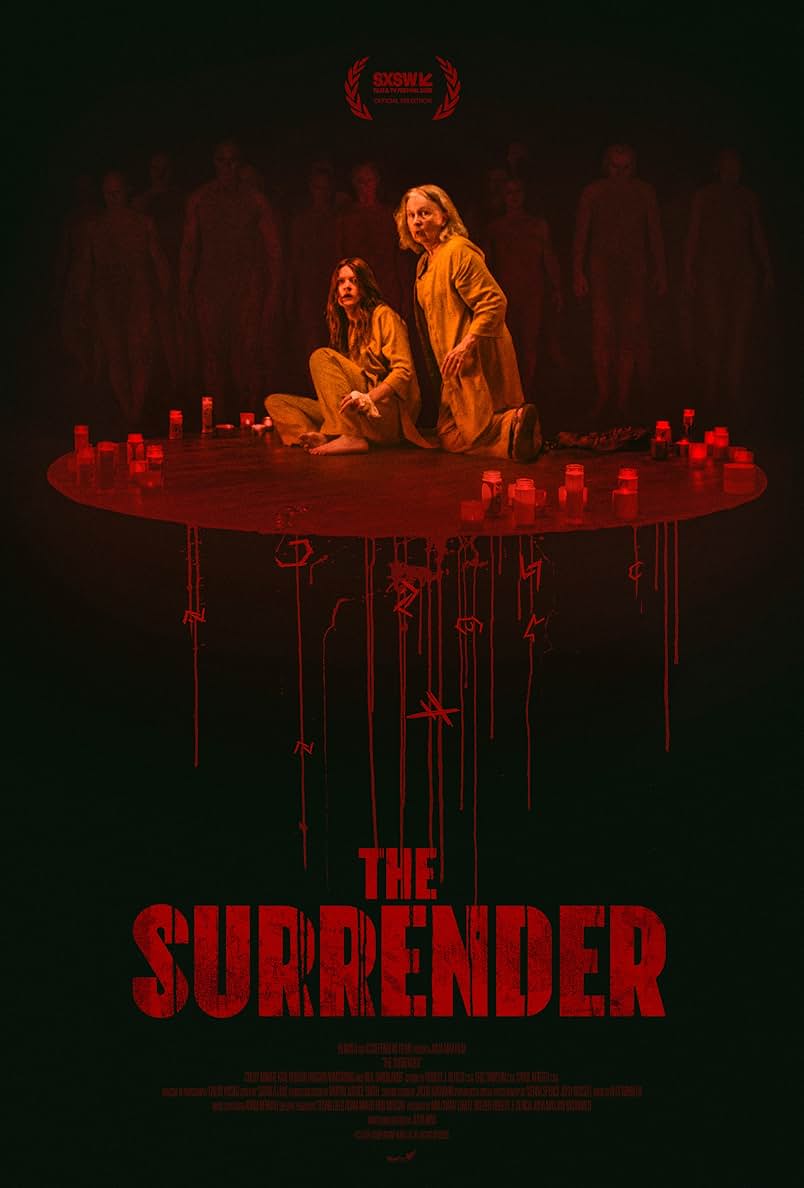

“The Surrender” (2025) is a horror movie that teaches the lesson that if your friends say batshit stuff about vaccines and autism, don’t take advice from them, and sometimes it is ok to be the bad guy. When Megan (Colby Minifie) comes home to help her mom, Barbara (Kate Burton), care for her dad, Robert (Vaughn Armstrong), she ignores all her natural instincts and defers to Barbara. The problem: Barbara wants to perform a ritual to resurrect Robert. Thanks to a mixture of guilt and a lifetime of grooming from her father of humoring her mother, Megan goes with it. What’s the worst that could happen?
Minifie as Megan is compelling, relatable and sympathetic, but Megan annoyed the fuck out of me. When things start to go south, she regresses instead of acting her age. If I was in a theater with people who talk to the screen, someone would say, “Stop yelling ‘Mom’ or ‘Dad.’ You are an adult, and none of these people care otherwise you wouldn’t be in this predicament.” She is guilt and money motivated, but not for personal gain. It was kind of like “A Normal Family” (2023) where charitable acts matter more than a core, bone deep morality, except Megan is not a bad person. She is a weak one who was never taught how to be an adult and expected her mother to change at the eleventh hour instead of acting independent of her mother’s commands. When Barbara took her cell phone, and Megan let her, I knew that Megan did not know how to stand up.
Burton is a fave. If “The Surrender” was not a Shudder film, Burton would have been enough of a draw to tune in. She became a fave from “Scandal” as the Vice President, and it did not occur to me to look up her autobiography until recently. She is Richard Burton’s daughter! No one remembers that you are a nepo baby if you are talented. Burton has a gift for playing unlikeable woman who are still fascinating and magnetic. As Barbara, she is so determined that the appeal of following her is plausible though clearly madness. Barbara is male centered, but a flashback reveals how a constant drop of water wore her down over the years until the stubbornness and resentment were redirected to her daughter. She got trained not to protect or nurture her daughter. It would otherwise be impossible to imagine this woman being anything but the closed-off, certain person that Megan sees who is willing to sacrifice anything to keep her husband.
Writer and director Julia Max’s debut feature sets the stage perfectly, and her visual depiction of the ritual and opening are incredibly strong that the rest of the movie suffers from being unable to keep up with the opening volley. Robert is mostly depicted through Megan’s memories or as her imaginary father. The real Robert is either a man screaming in pain or a dead body. Her imaginary dad gives bad advice from a pleasing, affable persona that could be demonic if Megan had not created him. The memory of Robert is not evil, but the way that his words and actions tear down the people that he allegedly loves reveals an insidious side which is not obviously abusive but is clearly soul killing. Why would either of them want him back? The movie is mostly told from Megan’s point of view but occasionally shows Barbara’s perspective, so it was a missed opportunity not to see if Barbara’s memories aligned with her image of her husband. During the ritual, are we finally seeing who Robert really is?
When things start to go south, it is long before The Man (Neil Sandilands) arrives to perform the ritual. When he does arrive, his silence and Barbara’s almost instinctual, unquestioning obedience is disturbing enough to turn around. Girl, you just let the strangest of men in your house. Instead of Megan acting, she tries to convince her mom to change course or begs her to stop. The Man is just an exaggerated example of the mother and daughter dynamic when the father was still alive. If “The Surrender” is disturbing, it is because these parents are not good and never once cared about Megan’s well-being, only how her existence affected them. The most telling scene is when Barbara resents Megan for not intuiting that Robert got worse even though Barbara lied to her about his condition. Megan is in a double bind. If she obeys Barbara, she is wrong, and if she disobeys Barbara but reads her mind incorrectly, she is aggravating her mother. Whenever The Man interacts with Megan, and Barbara watches without a protective bone in her body, the situarion felt more monstrous.
“The Surrender” loses steam once the ritual starts. It is so clearly a bad idea, and almost every step is a deal breaker that when things go south, it feels as if it is a collection of familiar images of the damned that the afterworld is less scary than the ritual that gets them there. Overall, the images seemed too general and did not tie back to the narrative’s themes. “Rosario” (2025) was more viscerally disturbing with the scares aligning with the protagonist’s fears. The emotion underlying the third act works: a mixture of regret and Megan wishing that she could go back and change how things unfolded to heed the lessons that she learned. While the inability to let go of an ideal is an effective way to hammer home Megan’s mistake, it also perpetuates how Barbara sees Megan. Barbara incorrectly belies that Megan is responsible for Megan’s mistakes and Barbara’s, which is why the ending does not quite work.
There are some clever notes that sardonically poke holes in the family’s bourgeois sensibilities and Barbara’s attempt to be spiritual. She accuses Megan of being a “cultural chauvinist.” They are so worried about being appropriate that they are not concerned about what they are appropriating from and the consequences. The big joke is that the right terminology is prioritized but not the concern over lack of preparation of going to places that they do not belong.
While watching movies, sometimes I ask myself which character I would play. No one, including hospice worker Nikki (Mia Ellis), who waves the definitive red flag that Barbara is not giving enough morphine to Robert to ease his pain. “The Surrender” is the kind of movie that would end if one character just had a dab of common sense, but it is Presidon’t’s America, and this may be the definitive movie that explains the psychology of how things can go so wrong so fast even when people who should know better do not act that way. No one who belongs to these systems knows how to break free of them even when their safety is on the line.
“The Surrender” is no Philippou Brothers’ horror movie, and you should probably just wait until “Bring Her Back” (2025) is released to get a good movie that handles similar themes. It has good bones but loses momentum in the second act. It is a uniquely American movie about how people destroy themselves for an empty promise that only hastens death and despair instead of living authentically and being an adult without having it all.