
After watching “Mission: Impossible II” (2000) in theaters soon after its release date of May 24, 2000, I decided not to see anymore then promised to return once the franchise was on its last film. Time to pay the piper and (re)watch the existing entire franchise, seven movies, before “Mission: Impossible – The Final Reckoning” (2025) is released on May 23, 2025 (or more specifically before my screening on Wednesday, May 21, 2025. First, “A Minecraft Movie” (2025) and now this! What I do for the love of the game! I’m probably the only person not into this franchise.
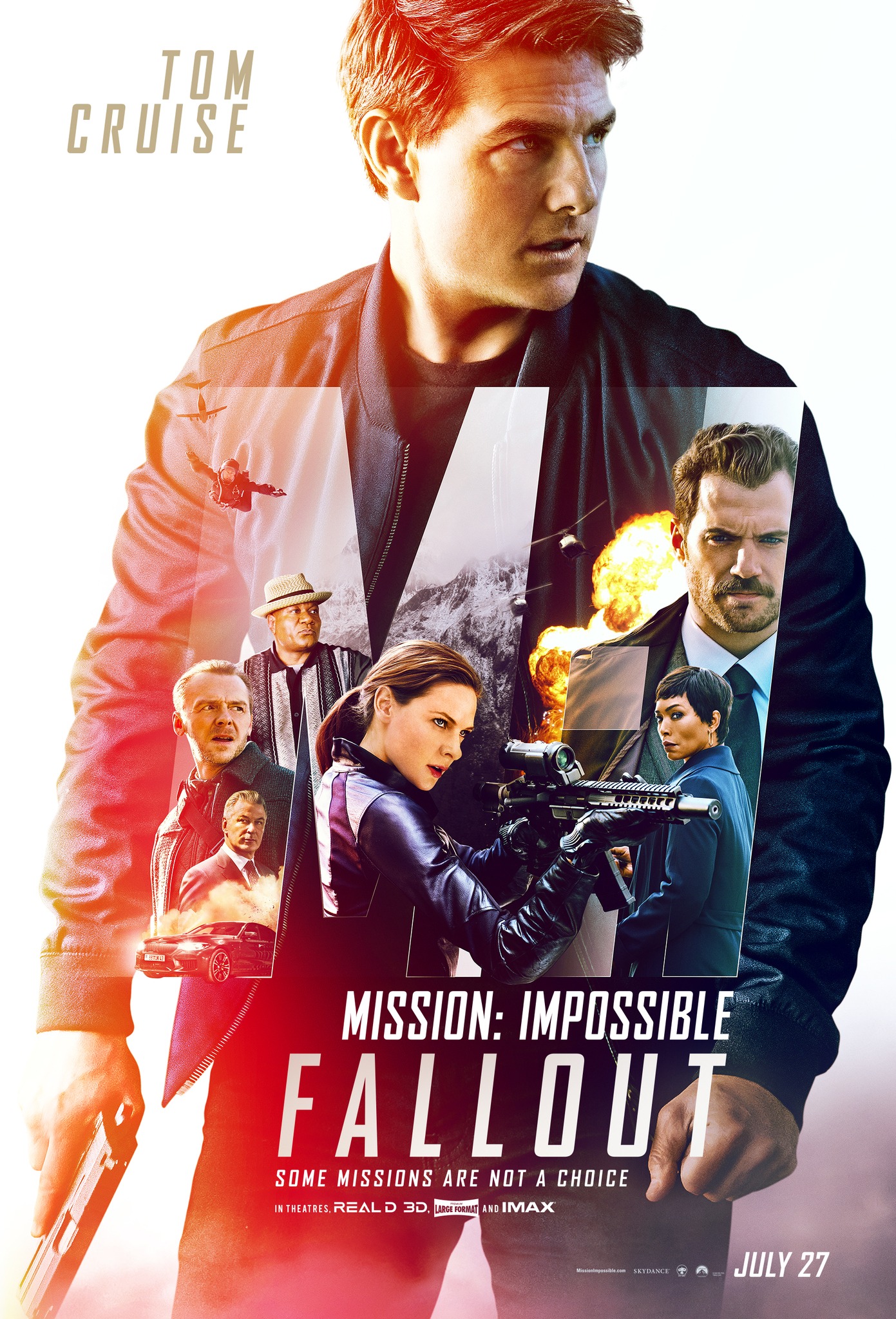
“Mission: Impossible – Fallout” (2018) is the sixth of eight movies that reboot the television series. It continues two years after “Mission: Impossible – Rogue Nation” (2015). The Apostles, a more radical branch of the Syndicate, are determined to bring about world peace through destruction. Ethan Hunt (Tom Cruise) is unable to sacrifice one life and prioritize the world thus not completing missions and escalating global threats. With anarchist Solomon Lane (Sean Harris) determined to get revenge against Ethan, and M16 agent, Ilsa Faust (Rebecca Ferguson), determined to kill Lane, Ethan needs Lane alive to stop the Apostles from pulling off their elaborate plan. Ethan may have to sacrifice someone to save the world. Will he find a way not to let anyone down?
Cruise will never surpass his “Mission: Impossible II” hotness and is in his reigning King of Hollywood phase so business as usual, impossible white man cruise control mode (yes, the pun is intentional). I should have accepted it in “Mission: Impossible – Rogue Nation,” but two is a pattern. This Ethan is still in a straight line from that movie: feeling his mortality and everyone else’s, still able to do everything but beginning to feel the psychological strain and missing a step but with a solid reaction time to recover from it. Remember when there used to be tons of Impossible Missions Force (“IMF”) agents besides Ethan and his team. These story lines are beginning to suggest that if Ethan would retire or fake his death, move to Paris with Catwoman and raise a distant glass to Alfred, the bad guys would lose interest, but nope. For some reason, it must be him. My favorite stunt is when Ethan is running through office spaces and on rooftops, which is when Cruise broke his ankle. Cruise pays the bills, but the elephant in the room is his adrenaline addiction. When is someone going to intervene? He is a consummate professional, but no one wants him to die to entertain us. It is not worth it.
Besides Lane, Ethan’s main antagonist is the bitch at work who is all in his business but is ineffective: CIA Agent August Walker (Henry Cavill). He is the younger, bigger, badder buck trying to steal Ethan’s glory. Reloading his arms aside, ol’ Walker is not actually good at keeping himself alive, forget outshining Ethan. He does not let that stop him from talking mad shit. It is a great character, but nothing comes for free in “Mission: Impossible – Fallout.” He comes with the compulsory overrated, overused trope of the protagonist as top suspect, but because they remain allegations and suspicions and never rise to Ethan ending up on a wanted poster, I am relieved to report that the count remains at three to four of the “Mission: Impossible” movies featuring Ethan as a rogue agent. Still, I’m sick of it even being a factor. This time, the identity of an extremist John Lark is unknown, and Walker suspects that it is Ethan with Ilsa in cahoots. If you guessed the real identity without watching the movie, congratulations.
I fear that “Mission: Impossible – Fallout” is the sign that I’m never going to be into the stories again. Everyone else may be in it for the spectacle (the stunts, the foreign locations, the outfits), but for me, even in an action movie, the story is everything, and I needed a break to get through this one. I love mainstream movies, especially blockbusters, but I actually feel my capacity to absorb more complex content diminishing with each “Mission: Impossible” movie. Director and writer Christopher McQuarrie took the wrong lessons from prior installments. Here are the ingredients: have a love interest in jeopardy like “Mission: Impossible II” and “Mission: Impossible III” (2006), have an effective team without grabbing too much of the spotlight like in “III,” use the villain and external power threat to IMF from “Mission: Impossible – Rogue Nation,” and nukes as the global threat in “Mission: Impossible – Ghost Protocol” (2011). That last ingredient is the best. What does that mean in practical terms?
Ilsa gets to do the same thing, but less effectively with less screentime. Ferguson is such a captivating presence that if the world was based in merit, Ilsa would be the protagonist because she saves Ethan and his team repeatedly and is better at getting intel and knowing the movers and shakers of their world. To be fair, Ferguson was pregnant during the shoot, which probably explains her reduced role in this round. Luther Stickell (Ving Rhames) gets to be a two-time hostage, which means it is time to retire from being a field agent. He serves as a walking, talking recapper about prior “Mission: Impossible” movies. It means the return of Julia (Michelle Monaghan). On one hand, I love that Julia can rise to the task and act like an IMF agent when necessary, but on the other hand, that says more about the declining competence of IMF agents, which brings me to Benji (Simon Pegg). The good news is that there is less Benji, and Benji is often in danger, but alas, still alive to appear in another sequel. Bad news: no Brandt (Jeremy Renner). I had high hopes because I thought that Renner had one more movie in his contract, but guess that he was too much of a distraction from Cruise, so Renner was released from his contract early? No, Renner was filming “Avengers: Endgame” (2019). Renner is more essential to this franchise than the MCU.
“Mission: Impossible – Fallout” overall features a better narrative than its immediate predecessor, which only got thrilling after one hour forty minutes at the point when two minor supporting characters clear up everything and basically steal the entire movie in minutes. Here, McQuarrie tries to have lightning strike in the same way twice after one hour nineteen minutes but keeps it in the family with the IMF team and Secretary Alan Hunley (Alec Baldwin). Instead of focusing the film and clearing the air, it makes the movie more convoluted turning the remaining one hour seven minutes into a helpless shrug of “sure, I guess” and just surrender to the absurdity instead of trying to make it make sense. Hunley clearly never got the memo that the Secretary should not be in the field from “Mission: Impossible – Ghost Protocol” and got too cocky from surviving his first appearance, but he was in the CIA then. With CIA Director Erika Sloane (Angela Bassett) around to deliver a verdict with a commanding, authoritative tone, Hunley became redundant. Will there even be a Secretary in the future? Sloane could not get out of the field fast enough and wisely stays her ass home.
I stand by my prior verdict that “Mission: Impossible III” (2006) still had the worst mission, and “Mission: Impossible – Rogue Nation” has the second. “Mission: Impossible – Fallout” tries to put more meat on the Syndicate’s bones—destroy the current order and somehow magically things will automatically improve because the neoliberal status quo will go the way of the dodo. What happened to people just going postal on their immediate employers instead of everyone? Fine, no offense intended, but they are the Bernie Bros circa 2016 of the villain world. At least they are no longer being called the anti-IMF although the Apostles still implies that they are the anti-Christ with Ethan as the Jesus figure. Again. Cruise pays the bills, and big bank beats little bank, but can he just restrict being a messiah to his off hours, not while he is on the clock? Apparently not. On a related side note: without religious connotations, Arnold Schwarzenegger went through a similar phase before he became the California governor then he seemed to no longer want to be action Jesus, but it was an insufferable plot point in his movies so for the record, I’m an equal opportunity eye roller whenever it happens even when I like the movie. Ethan has a prophetic foreboding dream sequence which feels like a reference to “Terminator 2: Judgment Day” (1991), which was a great way to begin the film, but before Ethan becomes a prophet, can he work on improving his helicopter piloting skills? I cannot believe that of all the things that Ethan knows how to do, he never got around to flying.
Lane is a better villain in “Mission: Impossible – Fallout” than he was in “Mission: Impossible – Rogue Nation” because styling a villain matters. Before Lane looked like the average Eurotrash villain who could be defeated if he just stood in the sun without sunscreen and no shade within arm’s reach. He wore leather, dyed his hair blonde and was coldly quiet. In jail, you don’t get hair dye, so Harris looks more recognizable with brown hair and wild but still sculpted facial hair so yes, thank you. We need more men with accurate facial hair in these movies. Sorry Cavill, that mustache was not worth ruining “Justice League” (2017), and it is not your fault, but before signing the contract, ask more questions. It did feel as if Lane and Ilsa were in a better movie that we did not get to see, but ultimately the film pulled punches. If Lane does not kill Benji, he is not hard enough, and the same rule applies to Ilsa killing Lane, which is literally her job. Booo, hiss to the story pulling punches. Harris gets some cool moments proving how Lane got to be the head of an evil organization starting with how he reacted to his enclosed space filling with water or seeing someone shoot at him. Even the hardest man may fall to pieces, but he is just like, “OK. Next.” Unflappable and petty are villain qualities that I can appreciate. Yes, let’s destroy the world, but multitask and make it especially harrowing for certain individuals because I wanna. Treat yourself. He also was one hundred percent fine with dying if he got front row seats to his symphony of vengeance (like seriously, it feels misdirected because Ethan did not recruit him). I don’t want to see more of Lane, and Harris is no Philip Seymour Hoffman (who is), but if he keeps improving with each appearance, I’ll mind less.
The White Widow, aka Alana (Vanessa Kirby), is my favorite character in “Mission: Impossible – Fallout,” and not only because she is the daughter of Max Mitsopolis (Vanessa Redgrave), who was my favorite character in “Mission: Impossible” (1996). She is styled like a classic Hollywood chanteuse, but instead of singing, she delivers speeches. Her mom was a gender bended character who was undeniably a woman, but did not lead with her attractiveness as her main asset whereas the White Widow does, but to be fair, her mom never got her hands dirty, and Alana seems like she enjoys the occasional rumble. She has henchmen, but she does not need them. The camera ogles her, and she and Ethan had chemistry, but her storyline abruptly drops. While no one wants a cat fight, i.e. there can only be one woman character, it is puzzling why McQuarrie introduced a rivalry between the White Widow and Ilsa for it to go nowhere. The character gets abandoned early in the story, and the film suffers for it. Hopefully she will appear in the rest of the franchise. I’ve seen Kirby in films before, but she finally made an indelible impression just in time for her appearance as Invisible Woman later this year in “The Fantastic Four: First Steps” (2025). Elizabeth Debicki would have also made a very interesting White Widow. If I had to choose between Black Widow and White Widow, the latter wins.
I probably liked “Mission: Impossible – Fallout” less than most critics because I saw it on television, not the big screen as intended. I’m actually a fan of McQuarrie’s work. Though his “Mission: Impossible” films are commercially successfully, they are his weakest artistic work. McQuarrie wrote “Edge of Tomorrow” (2014), one of my all-time favorite Cruise movies, “The Usual Suspects” (1995), “Valkyrie” (2008), “Jack Reacher” (2012), the critically acclaimed “Top Gun: Maverick” (2022), which I still have not seen, and the panned, unsuccessful “The Mummy” (2017), which I did not hate and paid to see. As a director, he has not missed a beat, but it also hurt that I saw it after “John Wick: Chapter 4” (2023), which uses some of the same locations such as the Arc de Triomphe. “John Wick: Chapter 4” cinematographer Dan Lautsen elevates that movie to sublime imagery without sacrificing any action and basically molly wops cinematographer Rob Hardy, who did an amazing job with “Fallout,” but was nowhere near the title of artist. Comparison is the thief of joy and accolades. While I acknowledge that it is not fair to compare the two movies, which had different objectives, it is what it is. “Mission: Impossible – Fallout” is not the kind of movie that shots could be taken out of context, framed then hung on a gallery or a museum wall. Even in a short amount of time, the action genre bar has raised. It is not just about the stunts or difficulty of the shoot, but great, original, iconic, transcendent filmmaking.
“Mission: Impossible – Ghost Protocol” remains the gold standard after watching six of the eight movies. The rest of the ranking is “Mission: Impossible II,” “Mission: Impossible III,” “Mission: Impossible – Fallout,” “Mission: Impossible – Rogue Nation,” and “Mission: Impossible.” The sixth film started strong, but this story is archetypical and lacks staying power. Favorite Cruise films for context (not in a particular order or an exhaustive list): “Interview with the Vampire” (1994), “Magnolia” (1999), “Collateral” (2004) and the aforementioned “Edge of Tomorrow.” To be fair, I tend to stay away from spending money on anyone who owns an island (among other reasons), but he is entertaining.