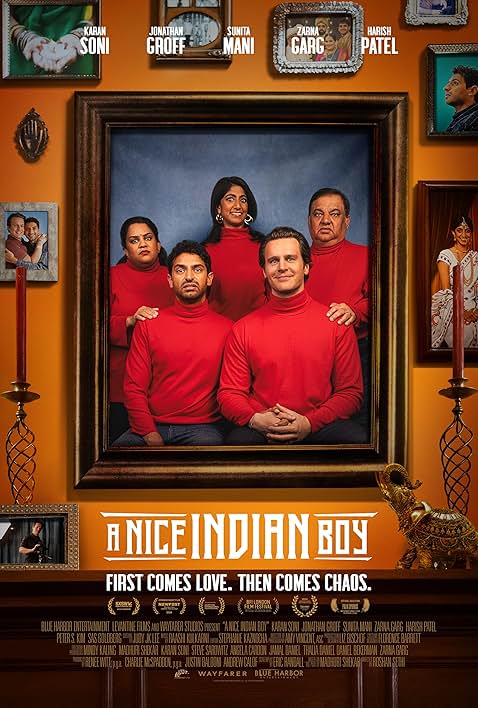

“A Nice Indian Boy” (2024), which adapts Madhuri Shekar’s 2014 play with the same title, is a rom com about younger son, Dr. Naveen Gavasjkar (Karan Soni), meeting the love of his life, Jay Kurundkar (Jonathan Groff), a freelance photographer and transracial adoptee who is white with Indian parents. Only the Gavaskar family’s unresolved issues threaten to divide them, and only Ganesha, one in a pantheon of Hindu deities, who removes obstacles, brings good luck and patron of the arts and sciences, knows and can help.
Soni, who is best known for playing Dopinder, the cab driver in the “Deadpool” franchise, takes the lead as the severely awkward and muted doctor who wants love, but has fully withdrawn into himself. He is out but does not feel as if he has the permission to fully express himself, which seeps into every aspect of his life. It feels like a curse when well-meaning people at weddings say, “You’re next.” It is not a feasible option given how he moves in the world, so it feels mean. “A Nice Indian Boy” initially shows people through his assumptions then gradually adjusts its focus to reflect more than their surface.
Tony and Emmy award winning Groff is the equivalent of Beyoncé for many communities, especially theater kids. He plays King George in “Hamilton” (2020), is Kristoff in “Frozen” (2013), which I still have not seen, and is becoming a staple in movies with gay themes. I want to see “Mindhunter.” When Naveen first sees Jay, Jay does literally seem like an answered prayer to all Naveen’s longing. Jay is the opposite of Naveen: open, expressive and intuitive, but as “A Nice Indian Boy” unfolds, he reveals that he is not as self-assured as he may seem and wounds at the slightest rejection. Dating Naveen is like walking in a land mine because Naveen downplays their relationship in public and makes Jay change to fit in. It was refreshing to see a character react immediately to and protect themselves from red flags instead of being empathetic and self-abandoning. Side note: Groff has similar features to Bill Skarsgård, especially his smile, while also looking nothing alike.
If Sunita Mani looks familiar, you may remember her as one of the two scientists in “Death of a Unicorn” (2025). As Naveen’s sister, Arundhathi, she is the object of Naveen’s envy for being perfect and the focal point for the family’s attention on relationship and ordinary life. Naveen feels there is no air left in the room for him to share about his life because she meets the ideal of expectations. He misses the fact that she does not want this attention and in the meanest performance yet that risked making her character irredeemable, she gives Naveen a taste of what she was feeling. People have gone no contact for less, but “A Nice Indian Boy” proves that it is possible to make an unlikeable woman character and still become invested in her.
Mom, Megha (Zarna Garg), and Dad, Archit (Harish Patel), may seem predictable, but then they get some of the best, textured moments that lead to genuine surprises. Garg, an author and stand-up comedian, may get the most poignant lines. Few would guess that it is her first movie role. Megha overshoots being accepting out of fear that her kids will completely shut themselves off from her. Archit becomes the unexpected heart of “A Nice Indian Boy” since he seems grumpy and as if he is suppressing homophobic comments. When he reveals his heart, it appears that Arundhathi may take after him in terms of struggle though they have different poor coping strategies. Patel has a long-storied career, but his most famous American movie appearance was in “Eternals” (2021) as the Bollywood manager. It was his performance that made me cry.
“A Nice Indian Boy” is a great movie, but the bonus is to finally see actors, who usually only get one dimensional supporting roles in the mainstream, take the spotlight and run with it. Even though Naveen is the protagonist, every character gets a portion of the movie devoted to their hopes and struggles, which makes the inevitable happy ending feel like a group project and a bittersweet way to heal cultural divides within the family of immigrants and Desi descendants so they could also become united and welcome Jay into the family. Consider it a more realistic “Everything Everywhere All at Once” (2022).
Anyone can watch “A Nice Indian Boy,” but it does not bend to meet people unfamiliar with Hindu culture so there are no explanations of the references. For example, fans of “Dilwale Dulhania Le Jayenge” (1995), aka DDLJ, which translates to the Brave-Hearted Will Take the Bride, a Bollywood musical romance, will have an advantage over other viewers. Even if you do not get it, there are enough context clues to figure it out.
“A Nice Indian Boy” has musical features but never tries to be a Bollywood film and critiques people trying to live up to an unrealistic ideal without tailoring it to suit them. It takes place six years after Arundhathi’s perfect wedding, the most realistic version of a Bollywood marriage, which is the implicit example that Naveen and Jay must live up to. Naveen and Jay’s relationship becomes the new standard of family health if they can abandon ideals that serve no one. In a broader sense, is not that true for society as a whole? If true love exists but it does not meet an imagined standard, is it the standard or the love that is wrong? Is it better to be unhappy and perfect than happy and not camera ready?
Through Jay’s art, the family portrait supplants the ideal media image in movies and life. Jay’s portrait with his family oozes warmth and red as if it is a fire that someone can warm their hands against. Jay’s family wears traditional clothing with his father holding an oxygen tank showing the threat embedded within the family. Jay’s naked and somewhat goofy joy and pride of belonging to his parents is infectious. Naveen’s family photo is awkward and commercial: a drab background with everyone wearing a red turtleneck, but it does not evoke the same emotions. The movie poster for “A Nice Indian Boy,” which is the end of the movie, shows Jay inserted into the family, a little more reserved, but physically everyone is connected through touch.
“A Nice Indian Boy” is the real spiritual heir to Ang Lee’s “The Wedding Banquet” (1993). Director Roshan Sethi is like an economical Baz Luhrmann with his talent at capturing the moment when love strikes the two and when the rest of the family also welcomes that love and embrace the freedom of expressing their emotions, love and acceptance for each other. Sethi and writer Eric Randall also deserve credit for being comfortable with showing the sorrow and regret for not doing so sooner and the loss in time, opportunity and wholeness with waiting so long to do so. The lesson: instead of resenting others for being free and having an easier life than you, celebrate it and join in.